

By using this site, you agree to the Privacy Policy.
Accept
The International Space Federation (ISF)The International Space Federation (ISF)The International Space Federation (ISF)
  • Science News
    • All Articles
    • Physics
    • Astronomy
    • Biology
    • Technology
    • Other
  • Research
    • Research Papers
    • Physicists Testimonials
  • Technology
  • About
    • About us
  • ISF News
  • Events
    • Events
  • Get Involved
    • Invest
    • Donate – Zero Point Foundation
  • Careers
  • Contact Us
Reading: Planet Type’s Missing Link
Share
The International Space Federation (ISF)The International Space Federation (ISF)
Search
  • Science News
    • Physics
    • Astronomy
    • Biology
    • Technology
  • Research Papers
    • Physicists Testimonials
  • About
    • ISF News
  • Events
  • Get involved
    • Invest
  • Translations
    online pharmacy https://worldneurologyonline.com/ no prescription pharmacy
Follow US
© 2022 International Space Federation. All Rights Reserved.
The International Space Federation (ISF) / Explore / Astronomy / Planet Type’s Missing Link
Astronomy

Planet Type’s Missing Link

Why are some planets rocky and some gaseous? We may just be nearer to finding an answer through a new planet discovered by master’s student Merrin Peterson.

RSF Research
Last updated: 2024/08/27 at 3:16 PM
RSF Research
Share
4 Min Read
SHARE

Why are some planets rocky and some gaseous? We may just be nearer to finding an answer through a new planet discovered by master’s student Merrin Peterson.

Have you ever wondered why the Earth is rocky and solid and planets like Jupiter and Neptune are gaseous? To add to the intrigue there are brown dwarfs which are neither planet or star, read more on brown dwarfs here.

So, what is it that classifies something as a planet and differentiates between rocky planets and gaseous planets?

Planets and stars are theorized to have formed in the collapsing dust of a nebulae, with the star forming in the centre of rotation and the planets forming in the corresponding disk. Obviously at the centre of rotation the angular momentum will be the greatest and the star will be experiencing significant energy production and emitting vast quantities of visible light. This is not the case for planets which by comparison will only be emitting small amounts of light and at a lower energy range – infrared.

Gaseous planets – such as Jupiter, Saturn, Uranus and Neptune – are believed to have first formed as rocky planets. However, their greater size allowed them to accrete and maintain a gaseous envelope – albeit not big enough to generate and sustain the energy production of a star. The size of the planet therefore seems to be the defining factor.

What is the Fulton Gap?

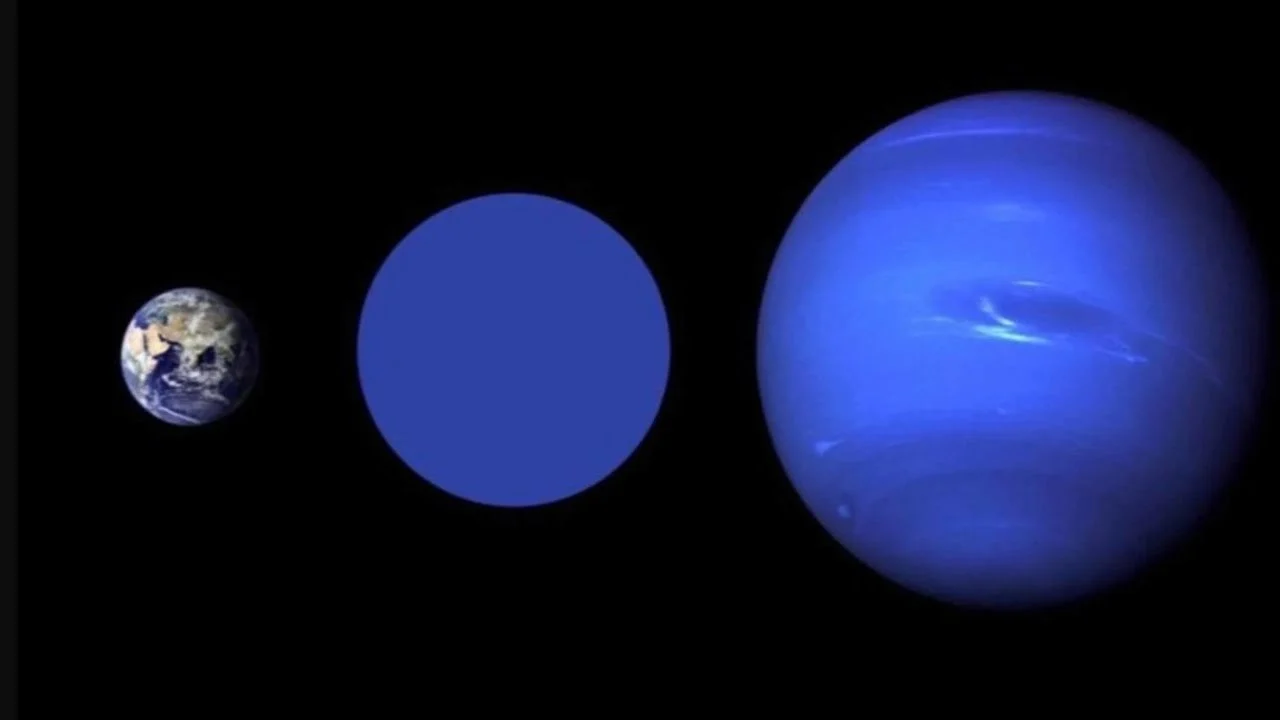
Last year, while studying the size of planets for his doctoral thesis, Benjamin Fulton noticed that planets of a specific size were less likely to exist – that is the population significantly decreases. This range is now known as the Fulton gap and is approximately 1- 4 times the Earths radius.

The Discovery of Wolf 503b: A New Exoplanet

Utilizing data from the NASA’s Kepler telescope, Merrin Peterson, a master’s student at the Institute for Research on Exoplanets (iREx), has just discovered an exoplanet in this Fulton gap. The planet known as Wolf 503b has a radius twice that of Earths and is located 145 light-years away in the constellation of Virgo, making it the perfect laboratory for studying this ‘missing link’ between rocky and gaseous planets.

The exact mechanism for star formation and planet formation is yet to be fully understood and is open for discussion. In the same way that supermassive black holes are now known to be at the centre of every galaxy – this could also be true for celestial bodies such as stars and planets. The characteristics of the celestial body defining it as a rocky planet, gaseous planet, star or a failed star could then be described in terms of the black hole dynamics, the size and the respective interactions with other celestial bodies.

Paper: https://arxiv.org/abs/1806.03494

Article: https://www.space.com/41787-alien-planet-discovery-exoplanet-sweet-spot.html

 

Learn more in our free Unified Science Course

Sign Up For Daily Newsletter

Be keep up! Get the latest breaking news delivered straight to your inbox.
loader

loader

loader

By signing up, you acknowledge the data practices in our Privacy Policy. You may unsubscribe at any time.
En vous inscrivant, vous reconnaissez les pratiques en matière de données dans notre politique de confidentialité. Vous pouvez vous désinscrire à n'importe quel moment.
Al registrarse, reconoce las prácticas de datos en nuestra política de privacidad. Puedes darte de baja en cualquier momento.
Share This Article
Facebook Twitter Copy Link Print
Previous Article Quantum Mechanics Defies Causal Order, Experiment Confirms
Next Article How Many Dimensions? A Deeper Look Into Outer Space

Stay Connected

981k Like
18.7k Follow
7.7k Follow
7.3k Subscribe

Categories

  • Astronomy106
  • Biology69
  • ISF News25
  • ISF Research14
  • Other22
  • Physics168
  • Technology36

You Might also Like

Astronomy

The Rotating Universe: Radio Galaxies and the Cosmic Dipole Anomaly

22. December 2025.
Astronomy

“Black Hole Stars” Detected at Cosmic Dawn

23. October 2025.
Astronomy

New Evidence Points to a Compact Object at the Sun’s Core

5. August 2025.
Astronomy

Image Reveals Coherently Ordered Spiral Vortex Around Milky Way’s Supermassive Black Hole

24. June 2024.
The International Space Federation (ISF)The International Space Federation (ISF)

Harnessing quantum vacuum energy for sustainable solutions – a unified approach to science, technology and education.

Quick links

  • About
  • Research Papers
  • Events
  • Invest

Explore

  • ISF Research
  • Physics
  • Technology
  • Astronomy
  • Biology
  • ISF News

Sign Up for Our Newsletter

Subscribe to our newsletter to get our newest articles instantly!

loader

Follow US
© 2023 International Space Federation. All Rights Reserved. INTERNATIONAL SPACE FEDERATION is a trademark of ISFS SA. The mark is registered in the United States under Registration No. 7772313. The ®️ symbol is used exclusively in the U.S.
  • Press
  • Careers
  • Privacy policy
  • Carrieres
  • Presse
  • Prensa
Join Us!

Subscribe to our newsletter and never miss our latest news.

loader

Welcome Back!

Sign in to your account

Lost your password?