
By using this site, you agree to the Privacy Policy.
Accept
The International Space Federation (ISF)The International Space Federation (ISF)The International Space Federation (ISF)
  • Science News
    • All Articles
    • Physics
    • Astronomy
    • Biology
    • Technology
    • Other
  • Research
    • Research Papers
    • Physicists Testimonials
  • Technology
  • About
    • About us
  • ISF News
  • Events
    • Events
  • Get Involved
    • Invest
    • Donate – Zero Point Foundation
  • Careers
  • Contact Us
Reading: Third Planet Detected in Alpha Centauri System, Earth’s Closest Stellar Neighbor
Share
The International Space Federation (ISF)The International Space Federation (ISF)
Search
  • Science News
    • Physics
    • Astronomy
    • Biology
    • Technology
  • Research Papers
    • Physicists Testimonials
  • About
    • ISF News
  • Events
  • Get involved
    • Invest
  • Translations
    online pharmacy https://worldneurologyonline.com/ no prescription pharmacy
Follow US
© 2022 International Space Federation. All Rights Reserved.
The International Space Federation (ISF) / Explore / Astronomy / Third Planet Detected in Alpha Centauri System, Earth’s Closest Stellar Neighbor
Astronomy

Third Planet Detected in Alpha Centauri System, Earth’s Closest Stellar Neighbor

A third planet has been detected orbiting our closest stellar neighbor Proxima Centauri in the Alpha Centauri solar system [1]. The Alpha Centauri system, at only 4.3 light years from Earth, is turning out to be a rich and diverse solar system: with an Earth-like planet named Proxima b that orbits in the habitable zone around the low-mass M dwarf star Proxima B— which we discussed in the RSF article ‘Potential Habitability of Exoplanets’ [2]— candidate planet Proxima c which has a much larger orbit outside of the habitable zone, and now Proxima d, with a mass about a quarter of that of Earth (twice that of Mars).

Dr. William Brown
Last updated: 2024/04/08 at 12:34 PM
Dr. William Brown
Share
4 Min Read
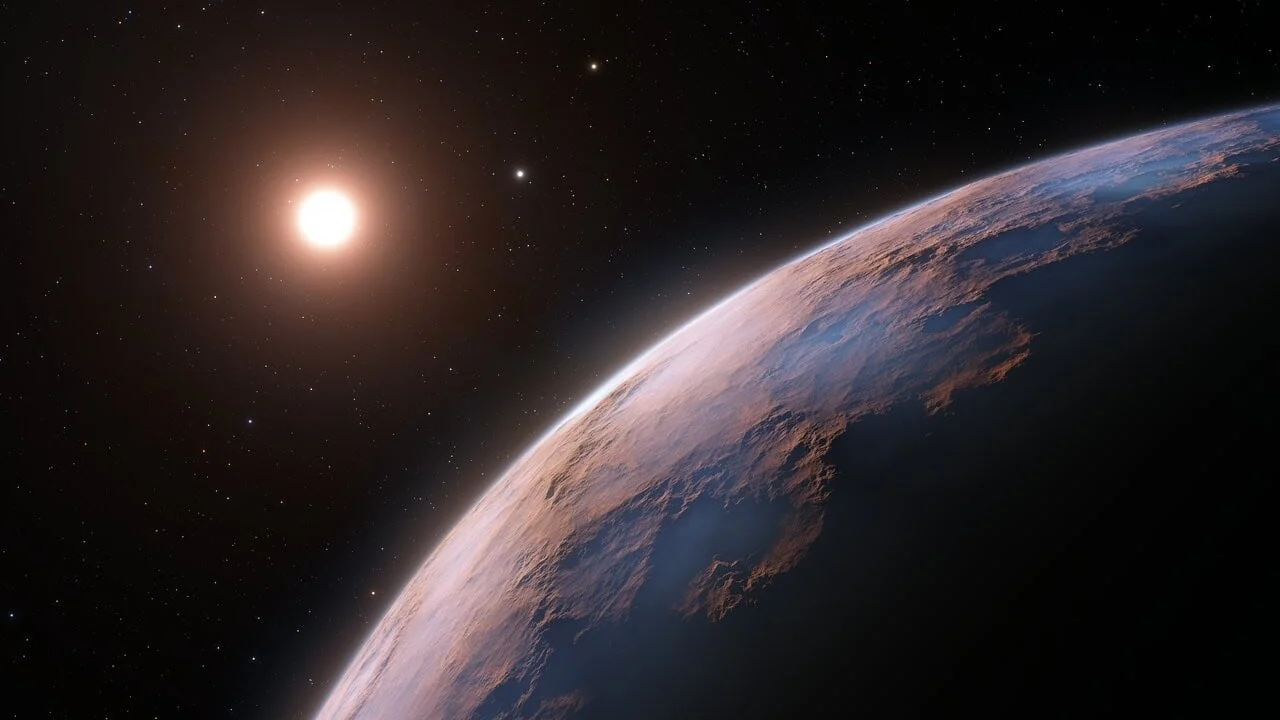
This artist’s impression shows a close-up view of Proxima d, a planet candidate recently found orbiting the red dwarf star Proxima Centauri, the closest star to the Solar System. The planet is believed to be rocky and to have a mass about a quarter that of Earth. Two other planets known to orbit Proxima Centauri are visible in the image too: Proxima b, a planet with about the same mass as Earth that orbits the star every 11 days and is within the habitable zone, and candidate Proxima c, which is on a longer five-year orbit around the star.
SHARE

“The discovery shows that our closest stellar neighbor seems to be packed with interesting new worlds, within reach of further study and future exploration,” João Faria, lead researcher and astronomer at the Instituto de Astrofísica e Ciências do Espaço, Portugal.

A third planet has been detected orbiting our closest stellar neighbor Proxima Centauri in the Alpha Centauri solar system [1]. The Alpha Centauri system, at only 4.3 light years from Earth, is turning out to be a rich and diverse solar system: with an Earth-like planet named Proxima b that orbits in the habitable zone around the low-mass M dwarf star Proxima B— which we discussed in the RSF article ‘Potential Habitability of Exoplanets’ [2]— candidate planet Proxima c which has a much larger orbit outside of the habitable zone, and now Proxima d, with a mass about a quarter of that of Earth (twice that of Mars).

Proxima d is the lightest exoplanet ever detected using a radial velocity technique, whereby tiny perturbations, or wobbles, in the motion of a host star is measured—revealing the tiny gravitational pull of a planetary companion. The mass and orbit of the planetary companion can be deduced from the magnitude and frequency of perturbation of the parent star, and Proxima d has such a minute effect that it only causes Proxima Centauri to oscillate at around 40 centimeters per second—which is quite the feat of detection by the team of astronomers at the European Southern Observatory’s Very Large Telescope Interferometer in Chile. The team used  one of the most eagerly anticipated instruments in the astronomical world: ESPRESSO, or the Echelle SPectrograph for Rocky Exoplanet and Stable Spectroscopic Observations.

This artist’s impression shows Proxima d, a planet candidate recently found orbiting the red dwarf star Proxima Centauri, the closest star to the Solar System. The planet is believed to be rocky and to have a mass about a quarter that of Earth. Two other planets known to orbit Proxima Centauri are visible in the image too: Proxima b, a planet with about the same mass as Earth that orbits the star every 11 days and is within the habitable zone, and candidate Proxima c, which is on a longer five-year orbit around the star. Image Credit: ESO/L. Calçada

The measurements show that Proxima d is very close to the host star Proxima Centauri, and is most likely very inhospitable to life, comparable to Mercury in our own solar system. Yet still, the fact that right next door (so to speak) there is a multi-planetary stellar system with an Earth-like planet in the habitable zone and planetary neighbors not unlike Earth’s own is intriguing and indicates there may be a rich abundance and diversity of planetary systems everywhere in the galaxy and beyond—the exoplanet catalog list 4,914 confirmed exoplanets and 3,686 planetary systems at the date of writing this report [3]. 

The researchers for the study report that “further observations of Proxima will help to complete our understanding of this multi-planetary system and may even unveil the presence of additional planets” P. Faria et al [1].  

References

[1] J. P. Faria et al., “A candidate short-period sub-Earth orbiting Proxima Centauri,” A&A, vol. 658, p.A115, Feb. 2022, doi: 10.1051/0004-6361/202142337.

[2] William Brown, “Potential Habitability of Exoplanets”, Resonance Science Foundation, 2019; https://www.resonancescience.org/blog/Potential-Habitability-of-Exoplanets

[3] NASA Exoplanet Exploration, Planets Beyond our Solar System. Accessed February 2022. https://exoplanets.nasa.gov/discovery/exoplanet-catalog/

Sign Up For Daily Newsletter

Be keep up! Get the latest breaking news delivered straight to your inbox.
loader

loader

loader

By signing up, you acknowledge the data practices in our Privacy Policy. You may unsubscribe at any time.
En vous inscrivant, vous reconnaissez les pratiques en matière de données dans notre politique de confidentialité. Vous pouvez vous désinscrire à n'importe quel moment.
Al registrarse, reconoce las prácticas de datos en nuestra política de privacidad. Puedes darte de baja en cualquier momento.
Share This Article
Facebook Twitter Copy Link Print
By Dr. William Brown
William Brown is a biophysicist, investigating the physics operational at the cellular and molecular level of the biological system. He presents lectures (Unified Science Review), talks, and Q&A forums to teach the syncretic theories of unified science. He is a part of the research team at The International Space Federation where he applies his extensive knowledge of cellular and molecular biology to an exploration of the biological system from a unified physics perspective; developing an understanding of life from the most fundamental level.
Previous Article Eridanus Supervoid May Explain Cosmic Microwave Background Anomalous Cold Spot
Next Article Evidence of Resonant Waves Found in Rat Brain Activity

Stay Connected

981k Like
18.7k Follow
7.7k Follow
7.3k Subscribe

Categories

  • Astronomy106
  • Biology69
  • ISF News25
  • ISF Research14
  • Other22
  • Physics168
  • Technology36

You Might also Like

Astronomy

The Rotating Universe: Radio Galaxies and the Cosmic Dipole Anomaly

22. December 2025.
Astronomy

“Black Hole Stars” Detected at Cosmic Dawn

23. October 2025.
Astronomy

New Evidence Points to a Compact Object at the Sun’s Core

5. August 2025.
Astronomy

Image Reveals Coherently Ordered Spiral Vortex Around Milky Way’s Supermassive Black Hole

24. June 2024.
The International Space Federation (ISF)The International Space Federation (ISF)

Harnessing quantum vacuum energy for sustainable solutions – a unified approach to science, technology and education.

Quick links

  • About
  • Research Papers
  • Events
  • Invest

Explore

  • ISF Research
  • Physics
  • Technology
  • Astronomy
  • Biology
  • ISF News

Sign Up for Our Newsletter

Subscribe to our newsletter to get our newest articles instantly!

loader

Follow US
© 2023 International Space Federation. All Rights Reserved. INTERNATIONAL SPACE FEDERATION is a trademark of ISFS SA. The mark is registered in the United States under Registration No. 7772313. The ®️ symbol is used exclusively in the U.S.
  • Press
  • Careers
  • Privacy policy
  • Carrieres
  • Presse
  • Prensa
Join Us!

Subscribe to our newsletter and never miss our latest news.

loader

Welcome Back!

Sign in to your account

Lost your password?