
By using this site, you agree to the Privacy Policy.
Accept
The International Space Federation (ISF)The International Space Federation (ISF)The International Space Federation (ISF)
  • Science News
    • All Articles
    • Physics
    • Astronomy
    • Biology
    • Technology
    • Other
  • Research
    • Research Papers
    • Physicists Testimonials
  • Technology
  • About
    • About us
  • ISF News
  • Events
    • Events
  • Get Involved
    • Invest
    • Donate – Zero Point Foundation
  • Careers
  • Contact Us
Reading: Was a Star Ejected from Our Central Black Hole?
Share
The International Space Federation (ISF)The International Space Federation (ISF)
Search
  • Science News
    • Physics
    • Astronomy
    • Biology
    • Technology
  • Research Papers
    • Physicists Testimonials
  • About
    • ISF News
  • Events
  • Get involved
    • Invest
  • Translations
    online pharmacy https://worldneurologyonline.com/ no prescription pharmacy
Follow US
© 2022 International Space Federation. All Rights Reserved.
The International Space Federation (ISF) / Explore / Astronomy / Was a Star Ejected from Our Central Black Hole?
Astronomy

Was a Star Ejected from Our Central Black Hole?

Generally thought to be the point of no return, our very own black hole seems to have ejected a star at hyper velocity.

RSF Research
Last updated: 2024/08/28 at 5:06 AM
RSF Research
Share
4 Min Read
SHARE

Generally thought to be the point of no return, our very own black hole seems to have ejected a star at hyper velocity.

The Hills Mechanism: A Theoretical Framework

In something known as the Hills mechanism – which occurs in binary star systems when they are disrupted by a super massive black hole – the stars are pulled apart and left to continue on their separate journeys. The closest star is pulled into an orbit around the black hole while the other is ejected at extremely high velocity. However, although this was proposed in 1988 by astronomer Jack Hills, it has never been confirmed.

First Observation of the Hills Mechanism: A Landmark Discovery

Now, a worldwide team of scientists led by Ting Li have observed what they believe to be the first example of such a mechanism.

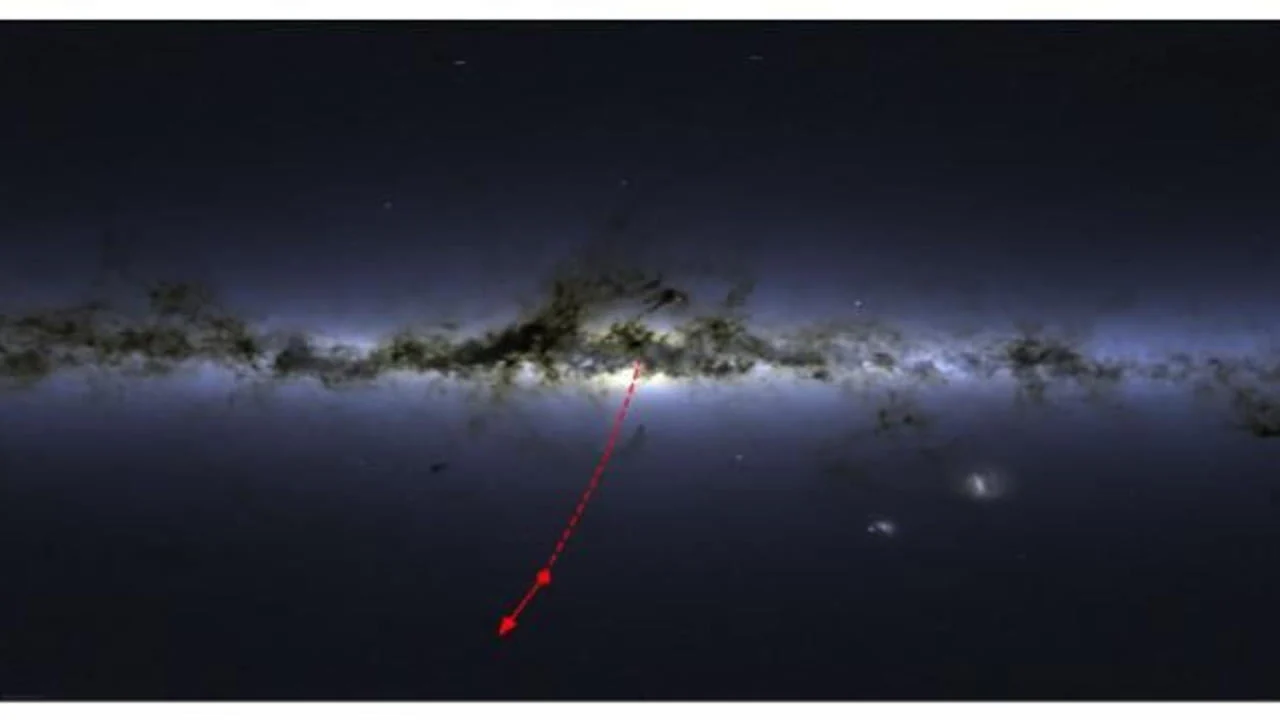
The team utilised data from the 3.9 metre Anglo-Australian Telescope as part of the Southern Stellar Stream Spectroscopic Survey – a survey that aims to map the kinematics and chemistry of long, dense regions of stars, known as stellar streams. Looking through the data for any stars with velocities greater than 800km/s, the team came across a star with a radial velocity of ~1020 km/s – that’s more than 2 million miles per hour. Further analysis revealed the star, known as S5-HVS, is a hot dwarf star more than twice the mass of our Sun and located 9 kpc (kila parsecs) – approximately 30 thousand light years – from the galactic centre in the Jhelum stellar stream system. Given the measured distance, the proper motion and the radial velocity, the total velocity of the star in the Galactic rest frame is a whopping 1755 km/s – almost 4 million miles per hour – making it one of the fastest known stars in the Galaxy.

To infer the origin of the star, the team studied the kinematics and traced the orbit backwards in time in the gravitational potential of the Milky Way. Remarkably, they found that the star can unambiguously be traced back to the Galactic Centre where it was ejected at a speed of 1800km/s 4.8 million years ago, making S5-HVS the first clear demonstration of the Hill Mechanism.

“This is the first clear demonstration of the Hills Mechanism in action.”
– Dr Ting Li, Carnegie Observatories and Princeton University

Highlights:

The generalised holographic approach offered by Nassim Haramein – in which all matter emerges from a black hole dynamic – the surrounding environment is much more conducive to life and not as final as one may typically think. With this in mind, it is completely reasonable to assume that a star could be brought into a stable orbit around the black hole while the other is ejected away, much like Hawking radiation where one particle is pulled inwards and the other is repelled outwards. It’s all spin dynamics!

Article: https://www.livescience.com/star-ejected-milky-way.html

Explore more about the universe in our free Unified Science Course

Sign Up For Daily Newsletter

Be keep up! Get the latest breaking news delivered straight to your inbox.
loader

loader

loader

By signing up, you acknowledge the data practices in our Privacy Policy. You may unsubscribe at any time.
En vous inscrivant, vous reconnaissez les pratiques en matière de données dans notre politique de confidentialité. Vous pouvez vous désinscrire à n'importe quel moment.
Al registrarse, reconoce las prácticas de datos en nuestra política de privacidad. Puedes darte de baja en cualquier momento.
Share This Article
Facebook Twitter Copy Link Print
Previous Article The Force of the Vacuum
Next Article Is the Universe Expanding at an Accelerated Rate?

Stay Connected

981k Like
18.7k Follow
7.7k Follow
7.3k Subscribe

Categories

  • Astronomy106
  • Biology69
  • ISF News25
  • ISF Research14
  • Other22
  • Physics168
  • Technology36

You Might also Like

Astronomy

The Rotating Universe: Radio Galaxies and the Cosmic Dipole Anomaly

22. December 2025.
Astronomy

“Black Hole Stars” Detected at Cosmic Dawn

23. October 2025.
Astronomy

New Evidence Points to a Compact Object at the Sun’s Core

5. August 2025.
Astronomy

Image Reveals Coherently Ordered Spiral Vortex Around Milky Way’s Supermassive Black Hole

24. June 2024.
The International Space Federation (ISF)The International Space Federation (ISF)

Harnessing quantum vacuum energy for sustainable solutions – a unified approach to science, technology and education.

Quick links

  • About
  • Research Papers
  • Events
  • Invest

Explore

  • ISF Research
  • Physics
  • Technology
  • Astronomy
  • Biology
  • ISF News

Sign Up for Our Newsletter

Subscribe to our newsletter to get our newest articles instantly!

loader

Follow US
© 2023 International Space Federation. All Rights Reserved. INTERNATIONAL SPACE FEDERATION is a trademark of ISFS SA. The mark is registered in the United States under Registration No. 7772313. The ®️ symbol is used exclusively in the U.S.
  • Press
  • Careers
  • Privacy policy
  • Carrieres
  • Presse
  • Prensa
Join Us!

Subscribe to our newsletter and never miss our latest news.

loader

Welcome Back!

Sign in to your account

Lost your password?