

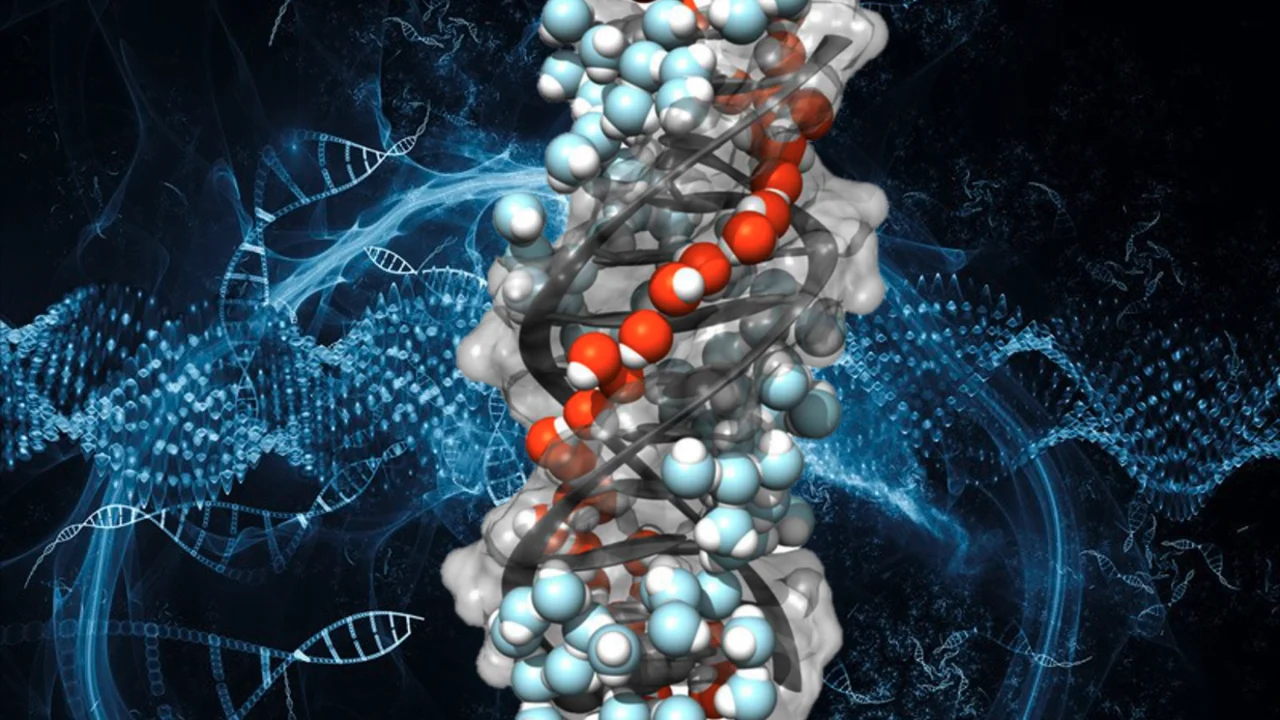
Researchers at the University of Notre Dame have observed for the first time a chiral water superstructure templated around a biomolecule. Although many studies have demonstrated the direct interaction of water with highly important macromolecules like DNA, the latest study is a final confirmation that water forms a unique and enduring super-structure around the DNA double helix — stabilizing the molecular conformation, mediating its functionality and interaction with important information intermediaries like RNA polymerase.
The Role of Water in Biological Functions
Taken in consideration with other recent reports, such as the direct mapping of molecular couplings and energy exchange between DNA backbone vibrations and water with femtosecond infrared spectroscopy, it is becoming increasingly difficult to ignore the central role of water in some of the most important of biological functions. Water is not just a passive medium but actively participates in the complex dance of life. It forms hydration patterns around biomolecules via hydrogen bond interactions—a phenomenon that is so crucial in organizing and orchestrating the cellular environment that researchers like Gerald Pollack have even highlighted its importance as the possible progenitor to the cellular membrane. This suggests that water could have been instrumental in giving birth to the first cells of life.
As we delve deeper into the mysteries of life, the role of water emerges as a key element in biological processes. Its unique properties allow it to stabilize the structures of proteins and nucleic acids, facilitating the biochemical reactions necessary for life. The ability of water to form complex networks through hydrogen bonding is not just a chemical curiosity but a foundational aspect of cellular life. This intricate network may well have provided the stability and flexibility needed for early cellular structures to evolve, adapt, and eventually thrive. As such, water’s role extends beyond the mere facilitation of reactions; it is an active participant in the very essence of what makes life possible.
Advanced Techniques in Molecular Imaging
The groundbreaking study employed coherent nonlinear vibrational microscopy (CNVM) to achieve unprecedented vibrational imaging speeds and molecular spatial resolution. This advanced technique allowed researchers to observe DNA molecules and their associated hydration patterns in exceptional detail under near-physiological conditions (room temperature and 100 mM NaCl solution). The research team discovered that DNA molecules imprint their chirality—their inherent “handedness” or asymmetrical molecular orientation—onto the surrounding water molecules, leading to the formation of a macroscopic super-structure of water templated along the DNA double helix.

Using ultrafast pump-probe spectroscopy combined with sophisticated molecular dynamics simulations, the team demonstrated that this water super-structure extends significantly beyond the first hydration shell, reaching up to several nanometers from the DNA surface. The observed chiral water structure showed remarkable stability, persisting for timescales longer than previously thought possible—on the order of picoseconds rather than femtoseconds. This extended temporal stability suggests these water structures may play crucial roles in biological processes, including protein-DNA recognition and gene regulation.
The study’s findings have significant implications for our understanding of biomolecular interactions in living systems. The researchers concluded that the chiral water super-structure likely serves as a “molecular beacon” for protein recognition and may influence the mechanics of DNA-protein binding. Looking ahead, the team suggested that future research should focus on investigating how these water structures might influence epigenetic modifications and gene expression, potentially opening new avenues for drug design and delivery systems that could target these water-mediated interactions. Their work also established CNVM as a powerful tool for studying similar phenomena in other biomolecular systems, potentially revolutionizing our understanding of water’s role in cellular processes.
A Convergence of Discoveries
These discoveries add to a growing body of evidence suggesting that water’s role in biological systems may be far more sophisticated than previously understood. The findings raise intriguing questions about the extent to which water’s structural properties influence genetic processes and cellular function.
While it is known that the specific template patterning of water molecules along the DNA molecule is important for recognition of gene promoter sequences by interacting proteins (see for example the study ‘interfacial water as a hydration fingerprint‘), the complete biological relevance of a chiral spine of hydration is unknown. Although, it does lend support for controversial findings like that of Luc Montagnier — in which the Nobel laureate and his research team, including the theoretical physicist Emilio Del Giudice and Giuseppe Vitiello who pioneered work on the quantum field theory of condensed soft matter, especially water — performed a series of experiments that suggests DNA sequences can be reconstituted from water memory. The study is detailed in the report “transduction of DNA information through water and electromagnetic waves“.
Quantum Fields and Coherently Structured Water
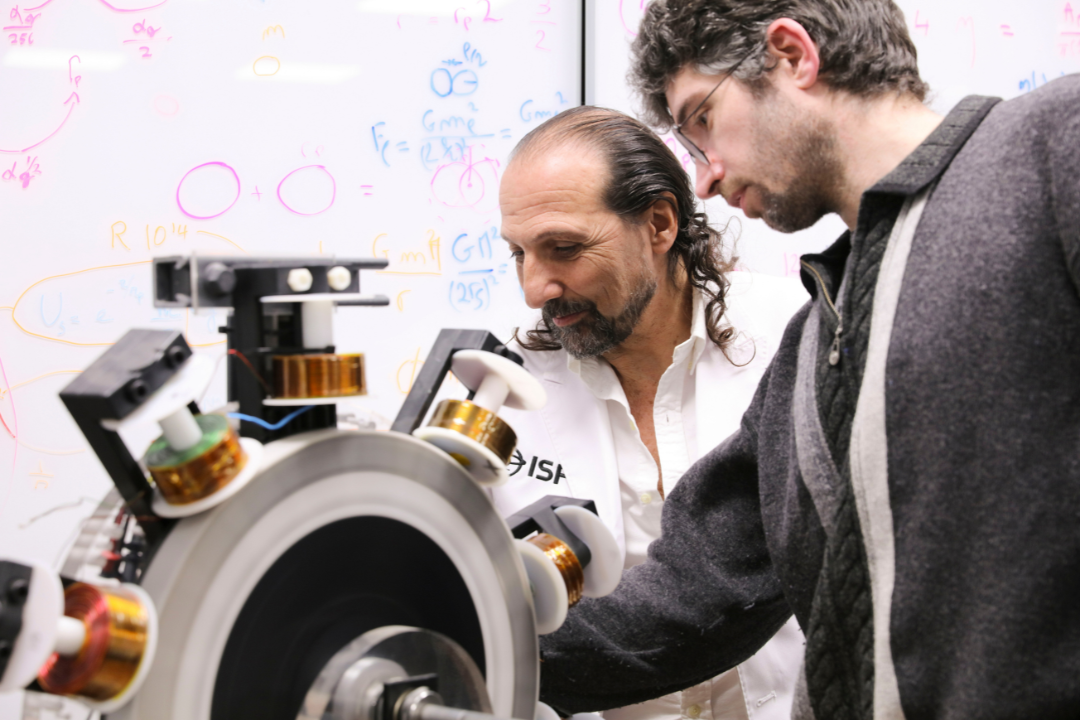
In my work with physicist Nassim Haramein at the International Space Federation, we have been exploring an even more fundamental aspect of water’s role in biological systems by examining its potential coupling to quantum fields and spacetime geometry. Our research proposes a profound connection between coherently structured water and the microscopic architecture of spacetime itself.
Our theoretical framework demonstrates that water’s unique molecular properties—particularly its electric dipole moments—serve as a bridge between biological systems and quantum field phenomena. We’ve shown that water molecules’ dipoles couple directly to quantum electromagnetic fields at the Planck scale, where spacetime exhibits extreme curvature and complex topology. At this fundamental level, spacetime is characterized by what physicist John Wheeler termed “quantum foam,” where quantum fluctuations create a multiply-connected geometry of microscopic wormholes.
This geometric structure at the Planck scale has significant implications for our understanding of water’s role in biological information processing. Our theory suggests that water molecules, through their coupling to quantum electromagnetic fields, can interact with this micro-wormhole network, potentially facilitating nonlocal information transfer. The coherent electromagnetic emissions that result from these interactions could modulate the behavior of cellular biomolecules, creating a direct link between quantum-scale phenomena and macroscopic biological processes.
While we continue to work on experimental validation of these ideas, they represent a promising direction in understanding water’s fundamental role in living systems. Our proposed mechanism provides a physical basis for long-range coherence in biological systems and may help explain some of the more puzzling aspects of water’s behavior in cellular environments.
Historical Perspectives and Future Implications
The ability to directly detect water’s interaction and pivotal role in biomolecular functions is an exciting development of advanced spectroscopic technologies and molecular biology and will provide revelatory insights into the biophysics and physico-chemical properties at the molecular level of life.
We conclude with some thoughts from Phillip Ball on “water as an active constituent in cell biology”:
When Szent-Gyorgyi called water the “matrix of life”, he was echoing an old sentiment. Paracelsus in the 16th century said that “water was the matrix of the world and of all its creatures.” But Paracelsus’s notion of a matrix — an active substance imbued with fecund, life-giving properties — was quite different from the picture that, until very recently, molecular biologists have tended to hold of water’s role in the chemistry of life. Although acknowledging that liquid water has some unusual and important physical and chemical properties — its potency as a solvent, its ability to form hydrogen bonds, its amphoteric nature [a molecule that can react both as an acid and a base] — biologists have regarded it essentially as the backdrop on which life’s molecular components are arrayed. It used to be common practice, for example, to perform computer simulations of biomolecules in a vacuum.
Partly this was because the computational intensity of simulating a polypeptide chain was challenging even without accounting for solvent molecules too, but it also reflected the prevailing notion that water does little more than temper or moderate the basic physicochemical interactions responsible for molecular biology. What Gerstein and Levitt said 9 years ago remains true today: “When scientists publish models of biological molecules in journals, they usually draw their models in bright colors and place them against a plain, black background”.
Curiously, this neglect of water as an active component of the cell went hand in hand with the assumption that life could not exist without it. That was basically an empirical conclusion derived from our experience of life on Earth: environments without liquid water cannot sustain life, and special strategies are needed to cope with situations in which, because of extremes of either heat or cold, the liquid is scarce. The recent confirmation that there is at least one world rich in organic molecules on which rivers and perhaps shallow seas or bogs are filled with nonaqueous fluid — the liquid hydrocarbons of Titan — might now bring some focus, even urgency, to the question of whether water is indeed a unique and universal matrix of life, or whether on the contrary it is just the one that happens to pertain on our planet. – Phillip Ball, Water as an Active Constituent in Cell Biology