

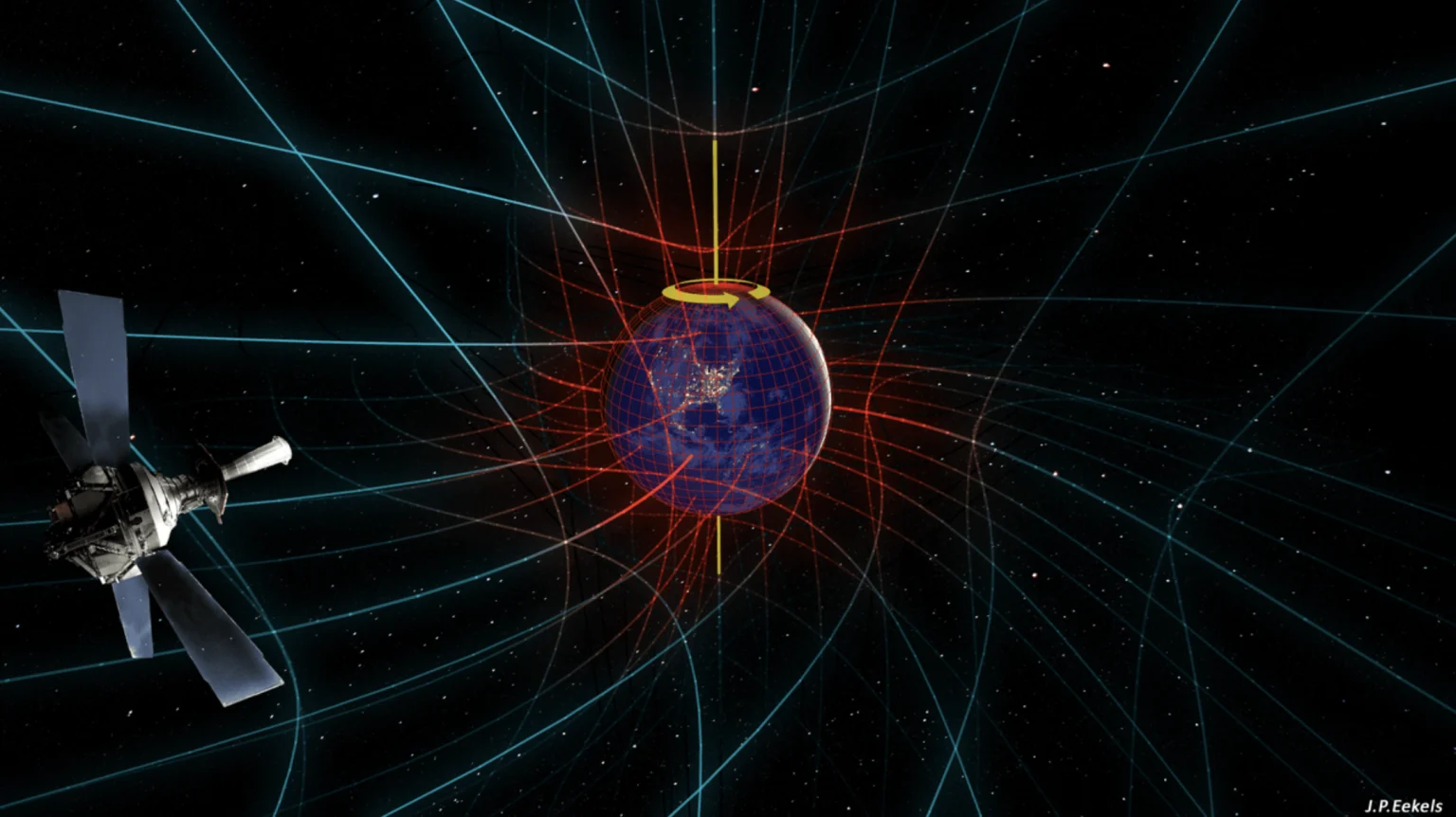
When a massive astrophysical object, such as a boson star or black hole, rotates, it can cause the surrounding spacetime to rotate along with it due to the effect of frame dragging. In a new paper, physicists have shown that a particle with just the right properties may stand perfectly still in a rotating spacetime if it occupies a “static orbit”—a ring of points located a critical distance from the center of the rotating spacetime.
The physicists, Lucas G. Collodel, Burkhard Kleihaus, and Jutta Kunz, at the University of Oldenburg in Germany, have published a paper in which they propose the existence of static orbits in rotating spacetimes in a recent issue of Physical Review Letters.
“Our work presents with extreme simplicity a long-ignored feature of certain spacetimes that is quite counterintuitive,” Collodel told Phys.org. “General relativity has been around for a bit more than a hundred years now and it never ceases to amaze, and exploring the ways that different distributions of energy can warp the geometry of spacetime in a non-trivial way is key to a deeper understanding.”

In their paper, the physicists identify two criteria for a particle to remain at rest with respect to a static observer in a rotating spacetime. First, the particle’s angular momentum (basically its own rotation) must have just the right value so that it perfectly cancels out the rotation due to frame dragging. Second, the particle must be located precisely in the static orbit, a ring around the center of the rotating spacetime at which the particle is neither pulled toward the center nor pushed away.
A key point is that not all astrophysical objects with rotating spacetimes have static orbits, which in the future may help researchers distinguish between different types of astrophysical objects. As the physicists explain, in order to have a static orbit, a rotating spacetime’s metric (basically the function that describes spacetimes in general relativity) must have a local minimum, which corresponds to the critical distance at which the static orbit is located. In a sense, a particle may then be “trapped” at rest in this local minimum.
The physicists identify several astrophysical objects that have static orbits, including boson stars (hypothetical stars made of bosonic matter that, like black holes, have immense gravity but do not emit light), wormholes, and hairy black holes (black holes with unique properties, such as additional charge). On the other hand, Kerr black holes (thought to be the most common kind of black hole) do not have metrics with local minima, and so do not have static orbits. So evidence for a static orbit could provide a way to distinguish between Kerr black holes and some of the less common objects with static orbits.
While the physicists acknowledge that it may be unlikely to expect a particle with just the right angular momentum to exist at just the right place in order to remain at rest in a rotating spacetime, it may still be possible to detect the existence of static orbits due to what happens nearby. Particles initially at rest near the static orbits are predicted to move more slowly than those located further away. So even if researchers never observe a particle standing still, they may observe slowly moving particles in the vicinity, indicating the existence of a nearby static orbit.
“Acknowledging the existence of the static ring helps us appreciate better what to plan and expect from future observations,” Collodel said. “For instance, we can search for the ring in order to identify possible exotic objects, such as the boson star, or even assure with confidence (upon observing the ring) that an AGN [active galactic nucleus] is not powered by a Kerr black hole. In the future we plan to investigate how the presence of the ring might affect accretion disks, which are at this stage much easier to observe, and if it could shield some objects from infalling matter.”
Article: How a particle may stand still in rotating spacetime
More information: Lucas G. Collodel, Burkhard Kleihaus, and Jutta Kunz. “Static Orbits in Rotating Spacetimes.” Physical Review Letters. DOI: 10.1103/PhysRevLett.120.201103