

Imaging Tool Flags New Proteins, Lipids and DNA to Track Metabolic Changes in Animals
Imaging tools like X-rays and MRI have revolutionized medicine by giving doctors a close up view of the brain and other vital organs in living, breathing people. Now, Columbia University researchers report a new way to zoom in at the tiniest scales to track changes within individual cells.
Described in Nature Communications, the tool combines a widely used chemical tracer, D2O, or heavy water, with a relatively new laser-imaging method called stimulated Raman scattering (SRS). The technique’s potential applications include helping surgeons quickly and precisely remove tumors, to helping to detect head injuries and developmental and metabolic disorders.

“We can use this technology to visualize metabolic activities in a wide range of animals,” said the study’s senior author Wei Min, a chemistry professor at Columbia University. “By tracking where and when new proteins, lipids and DNA molecules are made, we can learn more about how animals develop and age, and what goes wrong in the case of injury and disease.”
The Role of Heavy Water in Metabolic Studies
The breakthrough involves the use of heavy water as a chemical tracer. Made by swapping water’s hydrogen atoms with their heavier relative, deuterium, heavy water looks and tastes like regular water and in small doses (no more than five tablespoons for humans) is safe to drink. Once metabolized by cells in the body, heavy water is incorporated into newly made proteins, lipids and DNA, where the deuterium forms chemical bonds with carbon.
When these carbon-deuterium bonds are hit with light, they vibrate at varying frequencies, the researchers discovered, allowing each macromolecule to be identified as a protein, lipid or DNA. From these frequency signatures, they could track the growth of new proteins, lipids and DNA in the animal’s brain, skin, gut and other organs.
Though heavy water is already used to label proteins and lipids to track metabolic changes, analysis is currently done on a mass spectrometer, on cells extracted from the body. This method now makes it possible to visualize subcellular changes in real time and space. “We get a continuous picture of what’s happening inside living animal cells. Previously, we had only a snapshot,” said the study’s co-lead author, Lingyan Shi, a postdoctoral researcher at Columbia.
In the study, the researchers diluted regular water with D2O and gave it to roundworms, mice and zebrafish embryos to drink. Aiming the SRS laser at a variety of tissue, they watched over hours and days as new deuterium-tagged proteins, lipids and DNA built up.
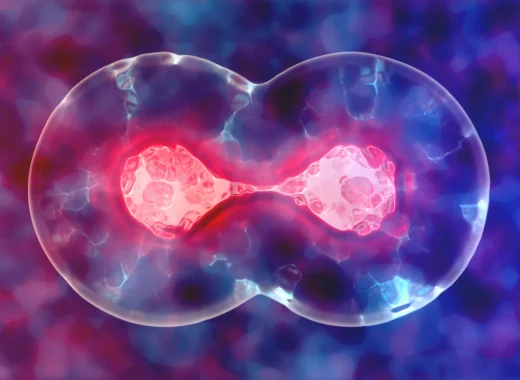
In one experiment, they watched a bright line emerge around fast-growing brain and colon tumors in the mice. As the cancerous cells divided, more deuterium was incorporated into their newly made proteins and lipids. “This method creates a sharp line between healthy and cancerous tissue, making it much easier to remove the tumor,” said Shi.
The experiments also offered new insights into cell development and aging.

Tracking Brain Development and Myelination in Real-Time
- In the roundworm, they watched fat production rise and fall in the worm’s reproductive system as it aged. Fat helps the worm’s eggs to mature, and once this added fat was no longer useful, fat formation slowed, they found. They also saw clumps of new protein form in the older worm’s body, suggesting that deuterium-labeled SRS imaging could be used to track protein deposits, and thus aging-related disease.
- In the developing brains of baby mice, they observed the formation of a layer of insulating fat, called the myelin sheath, around each cell. Watching the process in real time suggested to the researchers that deuterium-labeled SRS imaging could be used to tell if a child’s brain is developing properly, or if patients suffering from multiple sclerosis, a disease that attacks the brain’s myelin and disrupts information flow, might be recovering.
- In the sweat gland cells of mice, they watched as new lipids formed in cells at the outer edges of the sweat glands, pushing older cells inward. When those old cells finally reached the center of the glands, they died and were expelled in a process thought to moisturize the skin and hair above.
Video Caption: As sweat glands cells turn over, older cells are gradually pushed to the center of the glands and expelled from the body. Here, deuterium-labeled SRS imaging highlighted newly made lipids at the outer edges of a mouse’s sweat glands (upper left and lower right). Older cells in an interior sweat gland (lower left) showed less growth of new lipids, suggesting the technique could be used to detect aging-related disease like Alzheimer’s. (Min lab/Columbia)
“The beauty of this mapping method is its simplicity,” says Eric Potma, a chemistry professor at University of California at Irvine who was not involved in the study. “It produces vivid images of metabolic activity in tissues with seemingly minimal effort. As the SRS microscope continues to get smaller, deuterium-labeled SRS imaging may help to catch tumors at much earlier stages.”
Acting on a hunch that the element hydrogen came in a heavier form, Harold Urey, then a chemistry professor at Columbia, succeeded in separating deuterium from liquid hydrogen in 1931. The discovery won him a Nobel Prize in chemistry three years later. In addition to serving as a tracer in mass spectroscopy, deuterium today is used to track changes in ocean circulation, study the formation of stars, and modulate chemical reactions in making nuclear power.
The other authors of the study are co-lead author Chaogu Zheng, Yihui Shen, Zhixing Chen, Edilson Silveira, Luyan Zhang, Mian Wei, Chang Liu, Carmen de Sena-Tomas and Kimara Targoff. The study was funded by the National Institute of General Medical Sciences, National Heart, Lung, and Blood Institute, National Institutes of Health, U.S. Army Research Office, Alfred P. Sloan Foundation and Camille and Henry Dreyfus Foundation.
Study: Optical imaging of metabolic dynamics in animals
DOI 10.1038/s41467-018-05401-3
—Kim Martineau
Story provided by: University of Columbia News