

Water-like anomalies as a function of tetrahedrality
Water is the most common and yet least understood material on Earth. Despite its simplicity, water tends to form tetrahedral order locally by directional hydrogen bonding. This structuring is known to be responsible for a vast array of unusual properties, e.g., the density maximum at 4 ◦C, which play a fundamental role in countless natural and technological processes, with the Earth’s climate being one of the most important examples. By systematically tuning the degree of tetrahedrality, we succeed in continuously interpolating between water-like behavior and simple liquid-like behavior. Our approach reveals what physical factors make water so anomalous and special even compared with other tetrahedral liquids. —John Russo,Kenji Akahane, and Hajime Tanaka. Water-like anomalies as a function of tetrahedrality. PNAS, March 26, 2018.
The properties of water have fascinated scientists for centuries, yet its unique behavior remains a mystery.
Published this week in the journal Proceedings of the National Academy of Sciences, a collaboration between the Universities of Bristol and Tokyo has attempted a novel route to understand what makes a liquid behave like water.
When compared to an ordinary liquid, water displays a vast array of anomalies. Common examples include the fact that liquid water expands on cooling below 4 C, which is responsible for lakes freezing from the top rather than the bottom.
In addition, the fact that water becomes less viscous when compressed, or its unusually high surface tension, allows insects to walk on water’s surface.
These and many other anomalies are of fundamental importance in countless natural and technological processes, such as the Earth’s climate, and the possibility of life itself. From an anthropic viewpoint, it is like the water molecule was fine-tuned to have such unique properties.
Starting from the observation that the properties of water seem to appear fine-tuned, a collaboration between Dr John Russo from the University of Bristol’s School of Mathematics and Professor Hajime Tanaka from the University of Tokyo, harnessed the power of powerful supercomputers, using computational models to slowly “untune” water’s interactions.
This showed how the anomalous properties of water can be changed and eventually reduced to those of a simple liquid. For example, instead of floating on water, the density of ice can be changed continuously until it sinks, and the same can be done with all water anomalies.
Dr Russo said: “With this procedure, we have found that what makes water behave anomalously is the presence of a particular arrangement of the water’s molecules, such as the tetrahedral arrangement, where a water molecule is hydrogen-bonded to four molecules located on the vertices of a tetrahedron.
“Four of such tetrahedral arrangements can organise themselves in such a way that they share a common water molecule at the centre without overlapping.
“It is the presence of this highly ordered arrangement of water molecules, mixed with other disordered arrangements that gives water its peculiar properties.
“We think this work provides a simple explanation of the anomalies and highlights the exceptional nature of water, which makes it so special compared with any other substance.”
Article:
Understanding the strange behavior of water
Explore further:
Tetrahedrality is key to the uniqueness of water
Original article; PNAS:
Water-like anomalies as a function of tetrahedrality
Abstract:
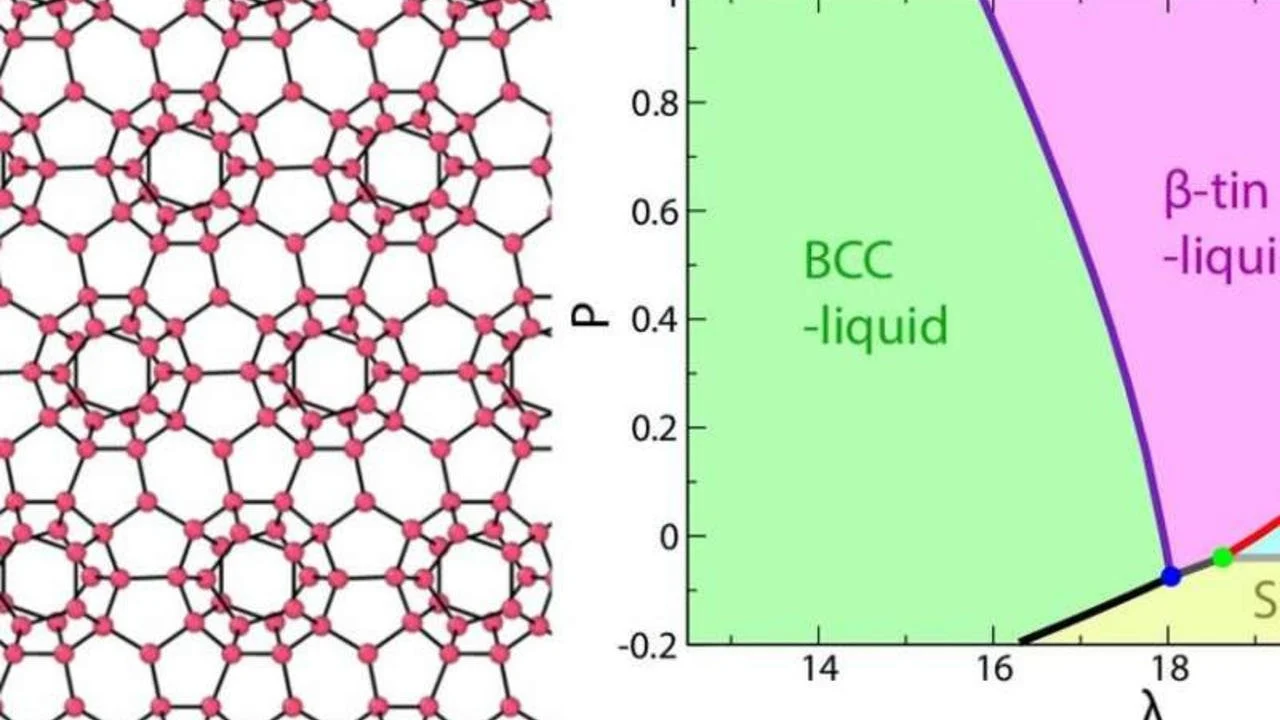
Tetrahedral interactions describe the behavior of the most abundant and technologically important materials on Earth, such as water, silicon, carbon, germanium, and countless others. Despite their differences, these materials share unique common physical behaviors, such as liquid anomalies, open crystalline structures, and extremely poor glass-forming ability at ambient pressure. To reveal the physical origin of these anomalies and their link to the shape of the phase diagram, we systematically study the properties of the Stillinger–Weber potential as a function of the strength of the tetrahedral interaction λ. We uncover a unique transition to a reentrant spinodal line at low values of λ, accompanied with a change in the dynamical behavior, from non-Arrhenius to Arrhenius. We then show that a two-state model can provide a comprehensive understanding on how the thermodynamic and dynamic anomalies of this important class of materials depend on the strength of the tetrahedral interaction. Our work establishes a deep link between the shape of the phase diagram and the thermodynamic and dynamic properties through local structural ordering in liquids and hints at why water is so special among all substances.