

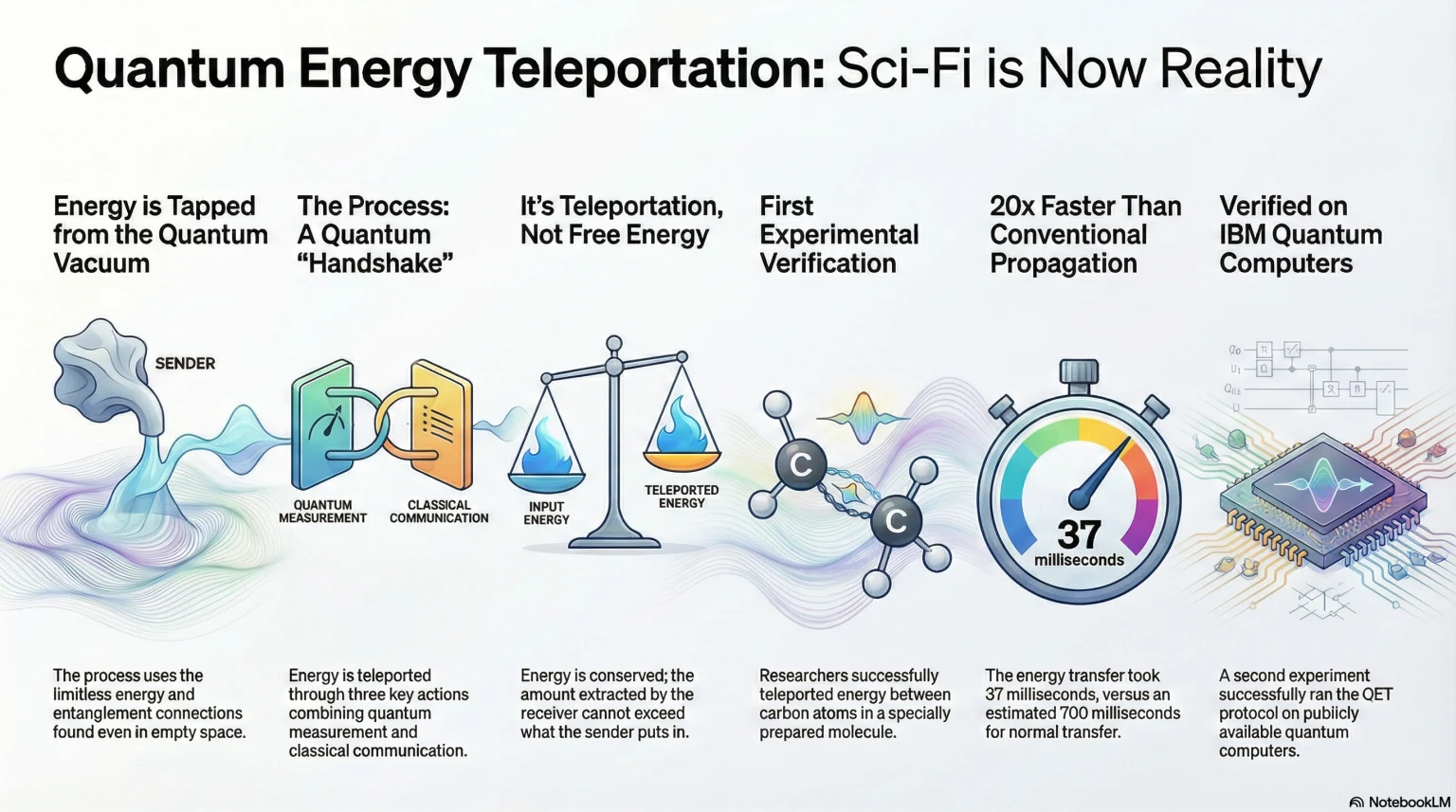
In a remarkable development that sounds like science fiction but is now scientific reality, researchers have demonstrated the ability to teleport energy between quantum systems by harnessing the mysterious properties of quantum entanglement. This remarkable achievement doesn’t just push the boundaries of what we thought possible – it shatters them entirely. By tapping into the intricate web of quantum correlations that exists even in empty space, scientists have shown that energy can be instantaneously transferred between two distant locations, opening up tantalizing possibilities for future technologies. From revolutionizing how we distribute power to enabling new forms of quantum communication, this discovery represents a fundamental shift in our understanding of energy transfer. As you delve into the fascinating details below, you’ll discover how researchers accomplished this feat, why it matters, and what it could mean for the future of human civilization.
Understanding the Entanglement Nexus of the Quantum Vacuum
It has been widely proven that the information of quantum states can be transported to remote locations through quantum teleportation. As such, it is well established that information states can be effectively teleported between two quantum systems, but what about other properties, like energy? Now, recent experiments have directly demonstrated the teleportation of energy by utilizing the spatial entanglement of quantum vacuum zero-point energy fluctuations. In addition to being a direct demonstration of the ability to leverage the intrinsic entanglement state of the quantum vacuum to teleport energy, the protocols have potential applications in a wide variety of quantum devices and quantum information technologies, like entanglement harvesting, considerations of the parallel of quantum energy teleportation with wormhole-qubit teleportation (ER = EPR), understanding quantum thermodynamics with applications in maintaining robust qubit entanglement in quantum computers via cooling of many-body quantum systems, and even greater understanding of black hole entropy, thermodynamics, and information.
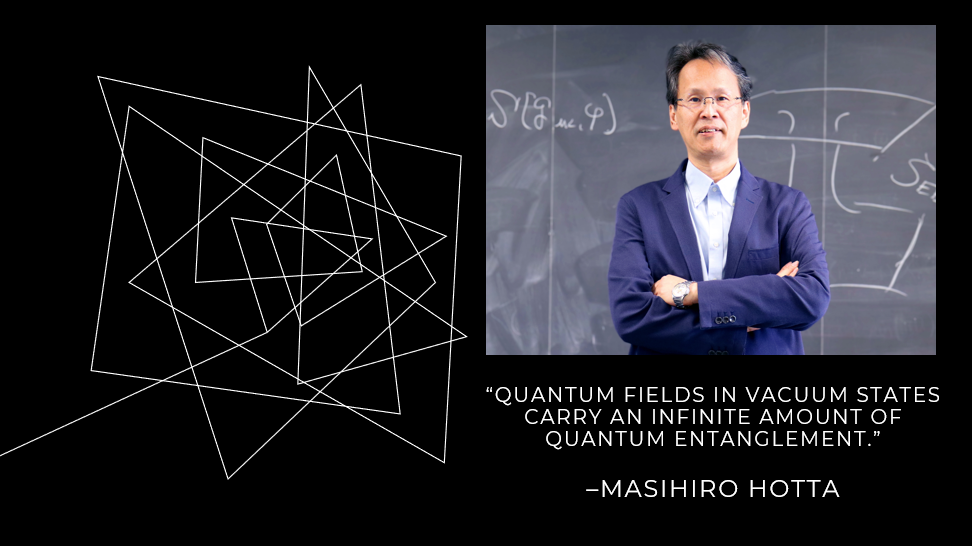
The theoretical physicist and assistant professor at Tohoko University in Japan, Masihiro Hotta, has stated that “quantum fields in vacuum states carry an infinite amount of quantum entanglement.” Given this fact, more than 15 years ago he developed a ‘quantum energy teleportation protocol’ by which energy could be transferred, metaphorically referred to as “teleported”, from one quantum system to another by leveraging the intrinsic and limitless quantum entanglement of the quantum vacuum. Now, in recent experiments this protocol has been empirically verified and the entanglement of the vacuum state of quantum systems has been used to “teleport” energy from one quantum system to another.
In previous articles we have discussed the substantive and energetic nature of space, in which there are constitutive energetic fluctuations even in a complete vacuum—what is called zero-point energy or quantum vacuum fluctuations (the real and substantive nature of quantum vacuum fluctuations have been validated via the Casimir effect, Casimir torque, and the repulsive Casimir force). Of highest salience to the study discussed here, the Casimir effect has even been leveraged to engineer functional Casimir devices, like Casimir diodes, such that the quantum vacuum energy can be utilized for the non-reciprocal or unidirectional transfer of energy between two system (see our article on quantum-vacuum-mediated non-reciprocal transfer of energy between two micromechanical oscillators).
We have also discussed experiments that have directly demonstrated the ability to draw energy and even matter from the quantum vacuum fluctuations (Experiment Generates Particles from the Vacuum). An additional important consideration is the intrinsic spatial entanglement of zero-point or quantum vacuum fluctuations. The importance of this nonlocal entanglement network has been discussed in detail in our publication The Entanglement Nexus of Awareness [1] and is actively utilized in quantum experiments where entanglement is literally harvested or farmed from the quantum vacuum to strongly correlate systems without them ever having to come into direct interaction [2,3].
Considering the spatial entanglement of quantum vacuum fluctuations, it should be possible for an observer who accesses information about the zero-point fluctuations in their local vicinity to simultaneously gain information about local fluctuations around a distant observer via the nontrivial correlation between the two observers induced by the vacuum-state entanglement. For reasons that we will explore, such an instantaneous accession of information between nonlocal systems / observers requires a classical communication channel between the observers as well as local operations to access the vacuum-state correlations in their local region.
A version of this is already used to teleport information between two systems in what is called quantum teleportation, however there are other potential quantum teleportation case scenarios, like the teleportation of physical quantities by utilization of the universal entanglement of the field— such as teleportation of energy between two systems / observers via the vacuum-state entanglement of their local regions. This is called quantum energy teleportation (QET).
Consider for example two observers who want to teleport a quantity of energy between themselves using the entanglement nexus of quantum vacuum fluctuations, lets call them Alice and Bob. As we have discussed, the field possesses zero-point fluctuations, and nontrivial correlation of the field is induced by vacuum-state entanglement— so if Alice obtains information about a local fluctuation around her through a measurement, she simultaneously obtains some information about a local fluctuation around Bob via the correlation. Although the average value of the vacuum energy density in Bob’s region remains zero after Alice’s measurement, Bob’s local field in the post-measurement state carries positive or negative energy, depending on Alice’s measurement result. When the result indicates the positive-energy case, and Alice sends Bob a message indicating so, he can time his local operation to extract energy from the field after receiving the information from Alice via a classical channel of communication.
 Figure 1: Alice and Bob teleport energy by extraction from the quantum vacuum energy density with a local measurement (by Alice) and a local operation (by Bob). This scenario requires Alice to communicate information about the measurement to Bob via a classical communication channel (like a phone call), and only has significant energy extraction at short distances. Image reproduced from [8].
The extraction of energy from the vacuum leads to a local negative energy density in the field, however this is correlated with the positive energy density that was generated by the excitation of the field produced by Alice’s measurement at a remote location. Therefore, the process is based in part on the fact that the vacuum can obtain a negative energy density, like that observed in the Casimir effect and the Unruh effect (see our articles on utilization of the Unruh effect here) and because of the entanglement network of the vacuum structure, a local negative energy density is balanced nonlocally by a positive energy density at a distant location.
This process is not full-on extraction of zero-point energy from quantum fluctuations but instead teleportation of energy because Bob can’t extract more energy than what Alice put in—the total energy remains conserved. And, like qubit teleportation, there is no violation of the relativity of simultaneity because Bob lacks the necessary knowledge to extract the energy until Alice’s text arrives, so no effect travels faster than light. That is quantum energy teleportation in a nutshell.
Initialization of the Quantum Energy Teleportation Protocol
The protocols of QET consist of local operations and classical communication. By measuring the local fluctuation induced by a zero-point oscillation in the ground state of a many-body quantum system and by announcing the measurement result to distant points, energy can be effectively teleported without breaking any physical laws including causality and local energy conservation…
Quantum fields in vacuum states carry an infinite amount of quantum entanglement. -Hotta [6]
This protocol for teleporting energy was developed more than 15 years ago by Masahiro Hotta, a theoretical physicist and assistant professor at Tohoko University in Japan. The QET protocol explores the question: is it possible to extract energy from zero-point fluctuations? Interestingly, the answer is more affirmative than many would initially presume, as Hotta et alia demonstrated theoretically that zero-point energy density can be activated using quantum informational tools, like information teleportation among qubits.
As such, the QET protocol can be realized experimentally by using a multipartite quantum system that has an entangled (strongly correlated) ground state, like a resonance chain of spin entangled atoms, and localized negative-energy excitation [4]. The issue with energy extraction from the entangled ground state of a multipartite quantum system, as opposed to information teleportation, is that any local action taken on a single subsystem (like one atom in the resonance chain) to extract energy will result in energy spreading through the entanglement network, merely raising the total energy of the system—this restriction has a specific moniker, referred to as strong local passive (SLP) states.
 Figure 2: (a) A quantum state is defined to be strong local passive (SLP) with respect to a subsystem if no general local quantum operation (G) applied on the subsystem can extract energy from the system. (b) Breaking strong local passivity with local operations and classical communication: (1) a local measurement at a subunit (atom) and (2) classical communication of that measurement outcome to a distal subunit (U) enables (3) an informed local operation based on the classically communicated information, overcoming strong local passivity and extracting energy from the correlated vacuum oscillation of the quantum system. Image reproduced from [5].
However, there is a way to activate entangled ground states of a multipartite quantum system in such a way that energy injected into the system can be extracted from a single distal subsystem via the local vacuum energy density and the intrinsic entanglement of the vacuum-state, and indeed researchers have recently succeeded in performing this quantum energy teleportation empirically. Eduardo Martín-Martínez, a spacetime engineer (featured in the video above describing the procedure of entanglement harvesting), and his research team have presented the first experimental activation of strong local passive states and the first empirical demonstration of quantum energy teleportation [5] as originally proposed by Hotta [6].
Their experiment confirms for the first time that establishment of entanglement in the ground state of a multipartite quantum system and performing the local operation and classical communication (LOCC) protocol allows for the activation of localized zero-point energy density without energy transfer through the system— the energy can be accessed freely and instantaneously via the intrinsic entanglement of the field, essentially a teleportation of the physical quantity of energy of the quantum system.
Experimental Verification of the QET and Extracting Energy from the Entanglement of Vacuum Oscillations
The experiment performed by Eduardo Martín-Martínez, and his fellow researchers, used nuclear magnetic resonance to induce quantum entanglement between carbon atoms in an organic polymer molecule (see Figure 3, below). When the organic polymer molecule is specifically resonated with magnetic fields and radio pulses from the nuclear magnetic resonance device the researchers were able to induce the ground state of the atoms in the molecule to become quantum entangled. This mimics the intrinsic state of spatial correlation in the entanglement nexus of the quantum vacuum.

Figure 3. The organic polymer molecule utilized by Eduardo Martín-Martínez et al. in their QET protocol experiment. Image reproduced from [5].
First, a finely tuned series of radio pulses from the nuclear magnetic resonance device entangles the ground state of the carbon atoms indicated by “A” (for Alice) and “B” (for Bob). The intermediary carbon atom, “An”, could then function metaphorically as a “messenger” between A and B by transferring the entanglement state of A to An via resonance transfer with a secondary radio pulse. A final pulse aimed at B and the intermediary atom An simultaneously transmitted the information of the excited ground state of A to B, enabling B to access the excited ground state of A via the nonlocal entanglement network, breaking the SLP state (recall Figure 2) and releasing energy from B.
 Figure 4. After repeated measurements, a curve is generated showing the amount of energy extracted from the carbon atom B (-ΔEB) versus the coupling strengths (Κ / h, the strength of entanglement) between carbon atoms A and B. Image reproduced from [5].
As seen in Figure 4 above, after repeated measurements the researchers reported an average decrease in the energy of the carbon atom B, demonstrating that the energy had been extracted from the entanglement network and released into the environment. To really get a sense of how the energy was essentially teleported it is salient to consider the time frame involved in the entire QET process. While it would normally take almost 700 milliseconds for the energy to travel via normal dispersion from A to B along the atomic chain of the polymer molecule, with the QET protocol it is reported to have taken no longer than 37 milliseconds for the entire energy transfer process, about 20 times faster than the classical case-scenario of energy propagation along the molecule.
To further demonstrate the validity of the theory of energy teleportation— showing that it is not science fiction, but real physics— a second experiment soon followed Eduardo Martín-Martínez et alia’s QET protocol experiment. Designed and performed by Kazuki Ikeda, a former student of Hotta’s, Ikeda demonstrated quantum energy teleportation with actual cloud quantum computers, utilizing several of IBM’s superconducting quantum computers, like ibmq_lima, to perform quantum gate operations on the available quantum circuits [7].
 Figure 5. Ikeda’s quantum circuits for QET protocol on IBM’s quantum computers. If one was so inclined, these quantum gate operations could be reproduced on the free-use superconducting quantum computers to perform Ikeda’s QET protocol (see his paper [7] for the detailed description if you are interested in doing this yourself).
In his paper, Ikeda establishes the quantum circuits that makes QET possible with real quantum computers and quantum networks. He achieves QET using IBM superconducting quantum computers by applying quantum error mitigation and the results were consistent with the exact solution of the theory. It is interesting to know that IBM’s quantum computer are available for free to everyone in the world, such that anyone can reproduce the results of this study using the quantum circuits that Ikeda has provided. This allows a real-time verification of the QET protocol.
Implications and Potential Future Applications
There are some key differences between Hotta’s original QET protocol proposal and the experimental set-ups that have validated the postulations of quantum energy teleportation. In Hotta et alia’s original postulations the spatial correlation of quantum vacuum oscillations was the underlying medium through which local vacuum energy density could be extracted for the teleportation of energy. In Eduardo Martín-Martínez et al.’s experiment, however, the intrinsic entanglement network of the vacuum was not directly involved, but rather was simulated via directed entanglement of the ground state of the organic polymer molecule (via the specifically timed radio pulses of the NMR machine).
Ideally, to truly realize Hotta’s original quantum energy teleportation protocol zero-point energy would be harvested from systems whose ground states naturally features entanglement in the same way the fundamental quantum fields that permeate the universe do. This would enable some exciting possibilities, like long range quantum energy teleportation, a method that Hotta described utilizing an exotic quantum phenomenon known as a squeezed vacuum [8].

Figure 6. Schematic diagram of (a) vacuum-state quantum energy teleportation (QET) protocol and (b) long-distance squeezed-state QET. Image reproduced from [8].
Under a minimal QET protocol the energy that can be extracted is limited by the distance between two protocol users; the upper bound of the energy being inversely proportional to the distance. In a 2014 publication Hotta et al. described a methodology for QET protocol that introducing squeezed vacuum states with local vacuum regions between two protocol users to overcome the limitation of distance, allowing energy teleportation over practical distances.
As Hotta et al. describe it— “from an informational viewpoint, the spatial correlations of the zero-point fluctuations, including quantum entanglement, decay as the distance becomes large, and hence the amount of information for distant control of a quantum fluctuation becomes small and only weak strategies for extracting energy out of the distant zero-point fluctuation are available. From a physical viewpoint, the localized negative energy induced by a QET protocol cannot be separated from the positive energy injected by the measurement device; otherwise, the negative energy excitation would exist without any positive-energy excitations. To make the total energy of the field non-negative, the negative-energy excitation requires a sufficient amount of positive energy at a close distance.” [8].
By inducing a squeezed-vacuum state, the spatial correlation of the quantum fluctuations with zero energy is maintained even if the distance between the sender and receiver of QET is very large. The negative energy induced by the extraction of positive energy via QET is sustained not by the positive energy injected by the measurement but instead by the excitation energy in the squeezed region of the state. Experimental realizations of this proposal, by adopting a spatial expansion method (see figure 9), would not only further validate the QET protocol but contribute to quantum device applications and provide a veritable revolution in quantum communication technology.
 Figure 9. Method for achieving vacuum-state squeezing via spatial expansion modality. The schematic shows abrupt expansion of the space where quantum fluctuations of the field become severely stretched. The upper figure depicts quantum fluctuation in the vacuum state before the expansion, while the lower figure depicts the stretched quantum fluctuation. to sustain the negative-energy excitation generated by extraction of energy (EBf) at B’, additional positive energy of the field must be placed near the negative energy excitation. In this protocol, the negative energy is sustained by the positive energy of the squeezed region, and long-distance entanglement is realized by the abrupt expansion of the subspace between A’ and B’.
Indeed, this is one such application that Ikeda has described following his successful QET protocol utilizing quantum circuits of IBM’s superconducting quantum computers. Ikeda describes a world in which physical quantities are freely and instantaneously teleported to remote locations connected by a large-scale Quantum Internet (network). Ikeda gives an example of the already long-distance (~158km) SBU/BNL quantum network in Long Island, New York [9]. Realizing QET on a quantum network, which is expected to be in practical use around the 2030s, would be a milestone toward realizing QET on a worldwide quantum network in which physical energy can be nearly instantaneously exchanged (teleported) between any sender and receiver, regardless of spatial distance.
Unified Science in Perspective
To this day, scientists and popular commentators alike are still inclined to refer to the vacuum as empty, and nothing, despite the myriad theoretical and empirical demonstrations of the substantive nature of the quantum vacuum—examples that we have mentioned in this article like the Casimir effect, Schwinger effect, and now quantum energy teleportation. Taken together these numerous experimental results are verifying that the energy predicted by quantum field theory to permeate all of space is very real and is significant, we can even tap into it.
At this point, is time to stop referring to space as empty and the vacuum as nothing, even if it gives an air of mystique to these experiments like quantum energy teleportation, in which popular commentators can exclaim that physicists have pulled energy “out of nothing”, it promulgates a common yet erroneous notion of the fundamental nature of our reality. It is time to acknowledge the paramount logical conclusion: nothing does not exist. It is time for scientists and engineers to begin taking the quantum vacuum energy seriously and further exploring ways in which we can harness the nearly limitless energy potential of zero-point energy density for spacetime engineering, quantum communications (including potential nonlocal communications), and of course, energy generation technologies.
As an additional interesting consideration, we have discussed before the teleportation of information and its equivalence to transit through a traversable wormhole, in our article traversable wormhole teleportation protocol. The traversable wormhole protocol demonstrated how teleportation of a quantum state was equivalent to sending a qubit through a traversable wormhole, and many viewed this as a metaphorical holographic equivalency. However, the teleportation of energy certainly obeys the holographic correspondence conjecture ER = EPR just as thoroughly as the case with teleporting information, yet here we have a physical quantity—the energy of a quantum system, being sent through the micro-wormhole network of the entanglement nexus of Spacememory. So, we see that the equivalency is perhaps not as “metaphorical” or “holographic” as many minimizers would claim, and could be the initial-most steps towards real macroscopic teleportation, or wormhole travel. Certainly, another reason to continue the study and experimentation of QET, like the long-distance quantum energy teleportation that has yet to be fully experimentally realized.
References
[1] W. Brown, “Unified Physics and the Entanglement Nexus of Awareness,” NeuroQuantology, vol. 17, no. 7, pp. 40–52, Jul. 2019, doi: 10.14704/nq.2019.17.7.2519
[2] J. Trevison, K. Yamaguchi, and M. Hotta, “Pure State Entanglement Harvesting in Quantum Field Theory,” Progress of Theoretical and Experimental Physics, vol. 2018, no. 10, Oct. 2018, doi: 10.1093/ptep/pty109
[3] E. Martin-Martinez, E. G. Brown, W. Donnelly, and A. Kempf, “Sustainable entanglement production from a quantum field,” Phys. Rev. A, vol. 88, no. 5, p. 052310, Nov. 2013, doi: 10.1103/PhysRevA.88.052310
[4] M. Hotta, “Quantum Energy Teleportation in Spin Chain Systems,” J. Phys. Soc. Jpn., vol. 78, no. 3, p. 034001, Mar. 2009, doi: 10.1143/JPSJ.78.034001
[5] N. A. Rodríguez-Briones, H. Katiyar, R. Laflamme, and E. Martín-Martínez, “Experimental activation of strong local passive states with quantum information.” arXiv, Mar. 30, 2022. Accessed: Feb. 27, 2023. [Online]. Available: https://arxiv.org/abs/2203.16269
[6] M. Hotta, “A protocol for quantum energy distribution,” Physics Letters A, vol. 372, no. 35, pp. 5671–5676, Aug. 2008, doi: 10.1016/j.physleta.2008.07.007
[7] K. Ikeda, “First Realization of Quantum Energy Teleportation on Superconducting Quantum Hardware”. https://arxiv.org/pdf/2301.02666
[8] M. Hotta, J. Matsumoto, and G. Yusa, “Quantum energy teleportation without a limit of distance,” Phys. Rev. A, vol. 89, no. 1, p. 012311, Jan. 2014, doi: 10.1103/PhysRevA.89.012311
[9] D. Du, P. Stankus, O.-P. Saira, M. Flament, S. Sagona-Stophel, M. Namazi, D. Katramatos, and E. Figueroa, An elementary 158 km long quantum network connecting room temperature quantum memories, arXiv:2101.12742 (2021) https://arxiv.org/abs/2101.12742
By International Space Federation scientists Dr. Inés Urdaneta & William Brown