
By using this site, you agree to the Privacy Policy.
Accept
The International Space Federation (ISF)The International Space Federation (ISF)The International Space Federation (ISF)
  • Science News
    • All Articles
    • Physics
    • Astronomy
    • Biology
    • Technology
    • Other
  • Research
    • Research Papers
    • Physicists Testimonials
  • Technology
  • About
    • About us
  • ISF News
  • Events
    • Events
  • Get Involved
    • Invest
    • Donate – Zero Point Foundation
  • Careers
  • Contact Us
Reading: Acoustic Tractor Beam Can Grab Objects From Behind Obstacles
Share
The International Space Federation (ISF)The International Space Federation (ISF)
Search
  • Science News
    • Physics
    • Astronomy
    • Biology
    • Technology
  • Research Papers
    • Physicists Testimonials
  • About
    • ISF News
  • Events
  • Get involved
    • Invest
  • Translations
    online pharmacy https://worldneurologyonline.com/ no prescription pharmacy
Follow US
© 2022 International Space Federation. All Rights Reserved.
The International Space Federation (ISF) / Explore / Physics / Acoustic Tractor Beam Can Grab Objects From Behind Obstacles
Physics

Acoustic Tractor Beam Can Grab Objects From Behind Obstacles

An acoustic tractor beam that can bend sound around an obstacle to levitate an object on the other side has been created by researchers in the UK. Dubbed SoundBender, the device combines an ultrasound transducer array with an acoustic metamaterial.

Dr. William Brown
Last updated: 2024/04/11 at 2:47 PM
Dr. William Brown
Share
5 Min Read
SHARE

An acoustic tractor beam that can bend sound around an obstacle to levitate an object on the other side has been created by researchers in the UK. Dubbed SoundBender, the device combines an ultrasound transducer array with an acoustic metamaterial.

In recent years, researchers have used transducer arrays to build sonic tractor beams that can create complex acoustic holograms to manipulate objects in mid-air. Acoustic metamaterials are engineered materials with structural properties that do not usually occur naturally. They have been used to produce acoustic holograms, bend beams of sound and create static acoustic levitation devices. But the team behind the SoundBender, based at the University of Sussex, say that these technologies have key limitations.
Devices based on transducer arrays cannot bypass obstacles that lay between them and the levitating object. Furthermore, the complexity, or resolution, of the sound fields they produce is constrained by the physical size of the transducers. An important drawback of using acoustic metamaterials is that the shapes of the sound fields they create are static and cannot be adjusted.

Dynamic, real-time control

By combining a transducer array with acoustic metamaterials, the researchers say, you can move past these limitations. The metamaterial produces a more complex field of sound than possible with a transducer array, while the array of transducers adds dynamic, real-time control to the metamaterial’s static hologram.

“A metamaterial is passive (like a lens for light), so we can theoretically put more energy in the sound,” Gianluca Memoli tells Physics World. “Each unit cell in the metasurface becomes like an additional source, which encodes phase engineering on the sound going through – just like an holographic plate. The only problem is that metamaterial-based holograms are static.”

SoundBender was unveiled earlier this month at the 31st ACM User Interface Software and Technology Symposium in Berlin. It comprises a metamaterial created from 16 different 3D-printed bricks on top of a programmable array of 16×16 off-the-shelf loudspeakers, operating at 40 kHz. The metamaterial provides a low modulator pitch to create high resolution – but static – acoustic fields. The transducer array adds dynamic amplitude and phase control of the field.

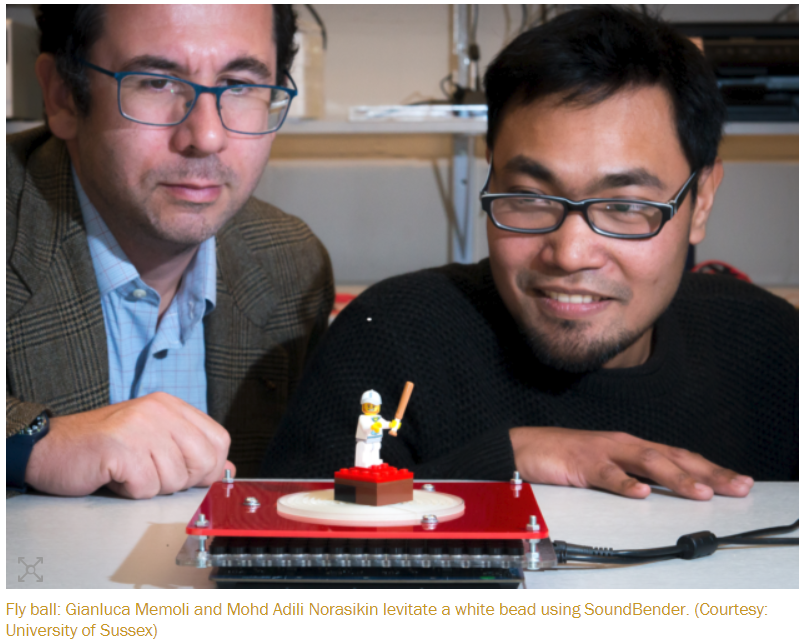
The team used SoundBender to create self-bending beams of sound that can bypass obstacles to create acoustic holograms. One experiment involved creating a pressure point to provide haptic feedback above a solid object. The team also levitated a polystyrene bead above a LEGO baseball figure and passed sound around the flame of a candle (see video).

If we start thinking of sound like light, imagination becomes the limit

Gianluca Memoli

The sound field can also be stretched and steered, which allowed the team to move the haptic feedback point. They could also shift the position of the levitated bead by 2 cm on the horizontal axis and 8 cm up and down they were even able to adjust the angle of the candle flame.

“Controlling where sound goes is [currently] expensive and limited in capability, and therefore we need tens of speakers to have sound that goes behind obstacles – like while blasting tumours with ultrasound behind the ribs,” Memoli says. “In a world where sound management is becoming a key aspect of our everyday life, we show that control can be achieved at the source, augmenting existing sound technologies with metamaterials. If we start thinking of sound like light, imagination becomes the limit.”

Asier Marzo, a researcher at the University of Bristol, who was not involved in Soundbender, but has worked with some of the Sussex team in the past, says, “A metamaterial can achieve better focusing since the elements are smaller than the ultrasonic emitters of a phased-array. Combining metamaterials and arrays seems like a great idea, I would like to see if this combination improves the focusing at all points or just at certain positions. Levitating around an object has interesting applications in medicine and human-computer-interaction. Perhaps metamaterials could be applied to remove the annoying side lobes – undesired secondary focal points – that are generated by most of the phased-arrays.”

PhysicsWorld: Directional acoustic levitation

More to explore on RSF News

SCIENTISTS CREATED AN ACOUSTIC TRACTOR BEAM

Learn more in our free Unified Science Course

Sign Up For Daily Newsletter

Be keep up! Get the latest breaking news delivered straight to your inbox.
loader

loader

loader

By signing up, you acknowledge the data practices in our Privacy Policy. You may unsubscribe at any time.
En vous inscrivant, vous reconnaissez les pratiques en matière de données dans notre politique de confidentialité. Vous pouvez vous désinscrire à n'importe quel moment.
Al registrarse, reconoce las prácticas de datos en nuestra política de privacidad. Puedes darte de baja en cualquier momento.
Share This Article
Facebook Twitter Copy Link Print
By Dr. William Brown
William Brown is a biophysicist, investigating the physics operational at the cellular and molecular level of the biological system. He presents lectures (Unified Science Review), talks, and Q&A forums to teach the syncretic theories of unified science. He is a part of the research team at The International Space Federation where he applies his extensive knowledge of cellular and molecular biology to an exploration of the biological system from a unified physics perspective; developing an understanding of life from the most fundamental level.
Previous Article New Mathematic Insight of the Shape of Wormholes
Next Article New Advanced Light Tractor Beam Moving Atoms

Stay Connected

981k Like
18.7k Follow
7.7k Follow
7.3k Subscribe

Categories

  • Astronomy106
  • Biology69
  • ISF News25
  • ISF Research14
  • Other22
  • Physics168
  • Technology36

You Might also Like

Physics

Gravitational Waves Leave Their Mark on Atomic Light: A New Window into Vacuum Field Physics

22. April 2026.
BiologyPhysics

Do Cells Use a Quantum Compass to Heal Wounds?

2. December 2025.
Physics

Space-Memory Experiments: Quantum Memory Matrix Results Explained

3. October 2025.
Physics

From Bit to Quanta: New Theory Links Entanglement to Particle Creation

17. September 2025.
The International Space Federation (ISF)The International Space Federation (ISF)

Harnessing quantum vacuum energy for sustainable solutions – a unified approach to science, technology and education.

Quick links

  • About
  • Research Papers
  • Events
  • Invest

Explore

  • ISF Research
  • Physics
  • Technology
  • Astronomy
  • Biology
  • ISF News

Sign Up for Our Newsletter

Subscribe to our newsletter to get our newest articles instantly!

loader

Follow US
© 2023 International Space Federation. All Rights Reserved. INTERNATIONAL SPACE FEDERATION is a trademark of ISFS SA. The mark is registered in the United States under Registration No. 7772313. The ®️ symbol is used exclusively in the U.S.
  • Press
  • Careers
  • Privacy policy
  • Carrieres
  • Presse
  • Prensa
Join Us!

Subscribe to our newsletter and never miss our latest news.

loader

Welcome Back!

Sign in to your account

Lost your password?