
By using this site, you agree to the Privacy Policy.
Accept
The International Space Federation (ISF)The International Space Federation (ISF)The International Space Federation (ISF)
  • Science News
    • All Articles
    • Physics
    • Astronomy
    • Biology
    • Technology
    • Other
  • Research
    • Research Papers
    • Physicists Testimonials
  • Technology
  • About
    • About us
  • ISF News
  • Events
    • Events
  • Get Involved
    • Invest
    • Donate – Zero Point Foundation
  • Careers
  • Contact Us
Reading: New Sodium Battery for a Cost-Effective Power Storage
Share
The International Space Federation (ISF)The International Space Federation (ISF)
Search
  • Science News
    • Physics
    • Astronomy
    • Biology
    • Technology
  • Research Papers
    • Physicists Testimonials
  • About
    • ISF News
  • Events
  • Get involved
    • Invest
  • Translations
    online pharmacy https://worldneurologyonline.com/ no prescription pharmacy
Follow US
© 2022 International Space Federation. All Rights Reserved.
The International Space Federation (ISF) / Explore / Physics / New Sodium Battery for a Cost-Effective Power Storage
Physics

New Sodium Battery for a Cost-Effective Power Storage

Finding a new energy storage material is a great challenge and sodium is showing great promise. Being one of the two main ingredients in the salt, it is very abundant, non-toxic and cheap. However, it is very difficult to produce a sodium based battery.

Olivier Alirol
Last updated: 2024/04/10 at 12:24 PM
Olivier Alirol
Share
3 Min Read
SHARE


Finding a new energy storage material is a great challenge and sodium is showing great promise. Being one of the two main ingredients in the salt, it is very abundant, non-toxic and cheap. However, it is very difficult to produce a sodium based battery. The problem is, when exposed to air, the metals in a sodium battery’s cathode can be oxidized, decreasing the performance of the battery or even rendering it completely inactive.

In the last years, research on the development of sodium-ion batteries have been making great progress in terms of performance utilizing layered transition-metal oxides and polyanions. It appears that the sodium compounds can be promising compared with their lithium analogs. Combining, the layered metal oxides with polyanions will offer a good compromise between high energy densities and stable cycle life.

Structure of Na2C6O6 and its electrochemical behaviour in Na cells under different conditions showing inconsistent phase transition with chemical and crystal structures.

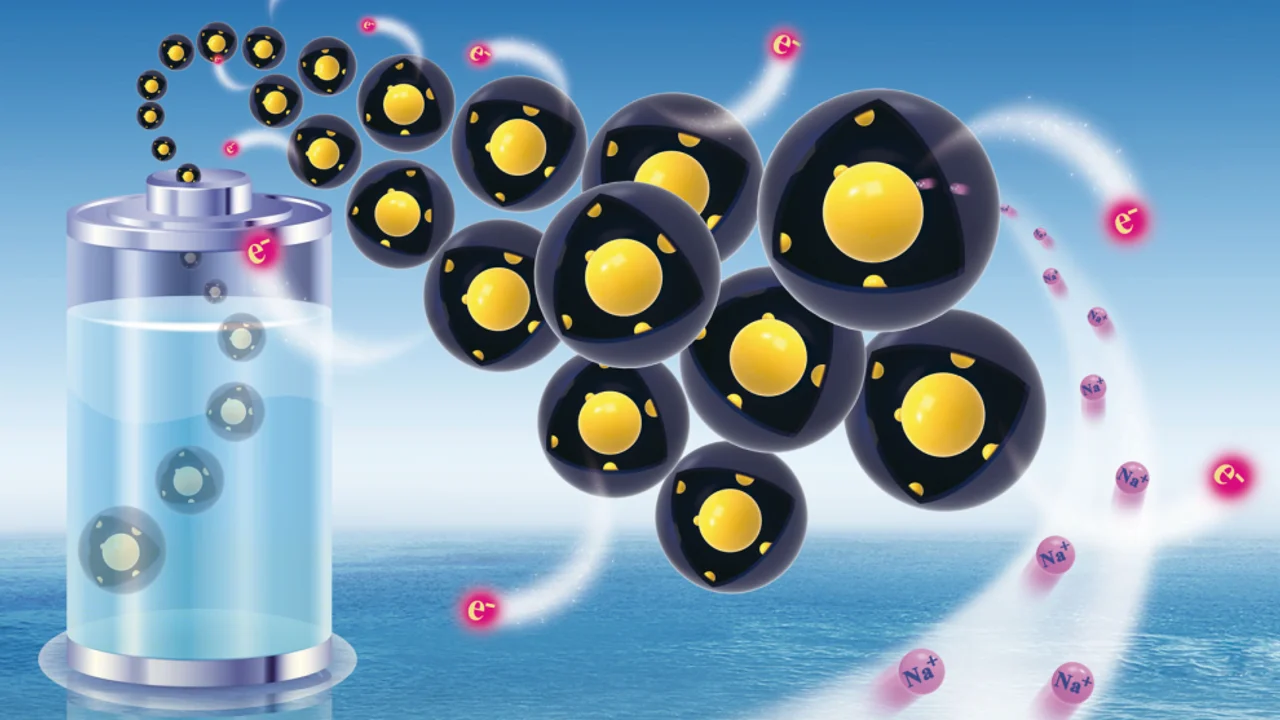
Using sodium-ion batteries for grid-scale applications will need an active material that combines a high-energy density with sustainability. Given the highly specific theoretical capacity and Earth abundance of disodium rhodizonate (Na2C6O6), it is one of the most promising cathodes for these new sodium-ion batteries. However, technical difficulties have been encountered due to in part at a lower reversible capacity than expected. To address this difficulty a team from Stanford University the phase transformation of the disodium rhodizonate during cycling. They discovered that the cause of the deteriorating redox activity of the cathode. The active-particle size and electrolyte conditions were identified as key factors to decrease the activation barrier. On the basis of this understanding, they modified the four-sodium storage of the cathode improving the energy efficiency and the cycle retention.

Morphological changes during reversible phase transformation and proposed redox mechanism for sodium storage of disodium rhodizonate (Na2C6O6). A schematic of the proposed de/sodiation mechanism of Na2C6O6.

Thanks to this better understanding of the redox mechanism associated with structural and morphological changes during cycling, the team achieved a full utilization of their new battery. Unexpectedly, spontaneous formation of nanostructures enabled facile phase transformation in the cycles, which provided a mechanism for realizing high-rate capability of electrode materials. The resulting electrochemical performances of the new sodium electrode surpass any reported performances of other cathode candidates for sodium-ion batteries.

“This is already a good design, but we are confident that it can be improved by further optimizing the phosphorus anode.”

Yi Cui, Department of Materials Science and Engineering, Stanford University, California

Continue reading at: https://phys.org/news/2017-10-battery-based-sodium-cost-effective-storage.html

Learn more in our free Unified Science Course

Sign Up For Daily Newsletter

Be keep up! Get the latest breaking news delivered straight to your inbox.
loader

loader

loader

By signing up, you acknowledge the data practices in our Privacy Policy. You may unsubscribe at any time.
En vous inscrivant, vous reconnaissez les pratiques en matière de données dans notre politique de confidentialité. Vous pouvez vous désinscrire à n'importe quel moment.
Al registrarse, reconoce las prácticas de datos en nuestra política de privacidad. Puedes darte de baja en cualquier momento.
Share This Article
Facebook Twitter Copy Link Print
Previous Article Missing Matter In The Sun’s Interior
Next Article Graphene could contain an unlimited “clean” energy source

Stay Connected

981k Like
18.7k Follow
7.7k Follow
7.3k Subscribe

Categories

  • Astronomy106
  • Biology69
  • ISF News25
  • ISF Research14
  • Other22
  • Physics168
  • Technology36

You Might also Like

Physics

Gravitational Waves Leave Their Mark on Atomic Light: A New Window into Vacuum Field Physics

22. April 2026.
BiologyPhysics

Do Cells Use a Quantum Compass to Heal Wounds?

2. December 2025.
Physics

Space-Memory Experiments: Quantum Memory Matrix Results Explained

3. October 2025.
Physics

From Bit to Quanta: New Theory Links Entanglement to Particle Creation

17. September 2025.
The International Space Federation (ISF)The International Space Federation (ISF)

Harnessing quantum vacuum energy for sustainable solutions – a unified approach to science, technology and education.

Quick links

  • About
  • Research Papers
  • Events
  • Invest

Explore

  • ISF Research
  • Physics
  • Technology
  • Astronomy
  • Biology
  • ISF News

Sign Up for Our Newsletter

Subscribe to our newsletter to get our newest articles instantly!

loader

Follow US
© 2023 International Space Federation. All Rights Reserved. INTERNATIONAL SPACE FEDERATION is a trademark of ISFS SA. The mark is registered in the United States under Registration No. 7772313. The ®️ symbol is used exclusively in the U.S.
  • Press
  • Careers
  • Privacy policy
  • Carrieres
  • Presse
  • Prensa
Join Us!

Subscribe to our newsletter and never miss our latest news.

loader

Welcome Back!

Sign in to your account

Lost your password?