

Fault tolerance is the ability of a system to continue operating during the advent of errors that lead to a fault in one or more components of the system. In a previous ISF article, I discussed quantum cat states and how they help in the realization of fault-tolerant quantum computers. In this article, we will look at another aspect that helps achieve somewhat a similar goal, i.e., making a quantum system less prone to errors. We’ll be talking about non-Abelian anyons or simply non-abelions that essentially advance this idea.
Anyons are generally defined as quasiparticles existing in 2D systems, with properties distinct from both fermions and bosons, the two statistical classes of particles we know of based on quantum mechanics. They were first proposed and named by Nobel laureate Franck Wilczek who seemed to be unconvinced with the notion that there could be only two classes of particles in the universe. One then may associate anyons with a third statistical class. Essentially, anyons can be classified into two types: abelian and non-abelian. While the former plays a crucial role in the fractional quantum Hall effect, the latter is of interest in quantum computation which we will be highlighting here. (Note: quasiparticles behave as certain excitations within a solid and since they possess characteristics like normal particles, they may tend to approximate them)
A peculiar aspect of anyons that makes them captivating is their ability to drift from their original quantum states, unlike bosons and fermions. Consider the scenario wherein one anyon moves around another. As a result, the quantum state of the anyon changes and it would require some work before they return to the original state. This deviation from the original state acts like a memory of the anyon’s journey and essentially makes them a robust tool for encoding data.

A mathematical description of anyons in terms of fermions and bosons. Here, α is the statistical parameter of anyons. Image credit: ICFO-The Institute of Photonic Sciences
In previous investigations, physicists opened the path to the realization that probing anyons could help achieve quantum computation without requiring much error correction. The quantum computer that works using anyons is called a topological quantum computer. However, the proper employment and discernment of anyons for viable topological quantum computing were one of the major challenges faced by physicists as it required finding these strange particles in the first place by exploring the peculiar quantum statistical law which they follow. This was essentially achieved in 2021 using the charge interferometry technique [1].
In a recent work, physicists have simulated non-abelions and showed that they could be utilized to minimise the errors that appear during the creation of quantum computers [2]. This realization is important since it is principally quite cumbersome to create non-abelian topological order, a state that displays stunning physical properties, and this is the first-time physicists have succeeded in explicitly creating as well as controlling such a state using Quantinuum’s trapped ion quantum processor.
Up until now, physicists knew with precision that creating as well as sustaining abelian topological order was quite feasible given its simplicity. However, with this new work it has become explicit that non-abelian topological orders can also be empirically generated with high accuracy, and this essentially is tantamount with its abelian counterpart. Such a breakthrough is quite promising for the development and scalability of future quantum computers.
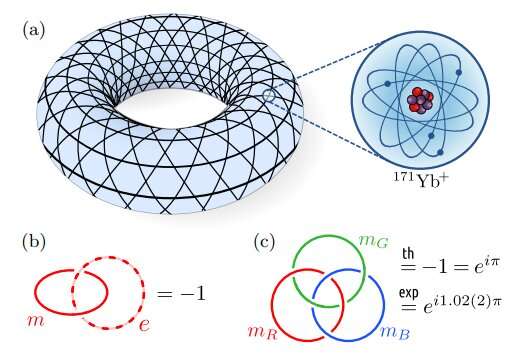
Creating and controlling non-Abelian wavefunctions. (a) We entangle 27 ions to create the ground and excited states of a Hamiltonian with D4 topological order on a Kagome lattice with periodic boundary conditions. (b) Its excitations go beyond Abelian anyons, whose spacetime braiding depends only on pairwise linking, as exemplified by the e- and m-anyons of the toric code. (c) We create and control non-Abelian anyons which can detect Borromean ring braiding via anyon interferometry. Image and Description: arXiv (2023)
Highlights:
In the work highlighted in this article, toroidal geometry plays an important part as can be seen in the figure (a) above. In the original paper, it has been explicitly stated that braiding non-abelions and tunnelling them around a torus result into the production of several ground states as well as an excited state with just an isolated anyon. This is an atypical signature of non-Abelian topological order.
Interestingly, toroidal dynamics plays a special part in physicist Nassim Haramein’s generalized holographic model and its applications to different physical systems, a black hole for instance. The model suggests that the structure of a black hole is more like a torus, allowing information to collapse and then emerge from the central singularity. Furthermore, the black hole dynamics replicates a dual torus structure, which was well supported by astrophysical observations made through the Hubble space telescope. Look at this ISF article which describes that work.
Haramein’s research as well boldly suggests that the toroidal energy dynamics is inherent to and manifested at all the scales in nature namely atoms, trees, planets, stars, galaxies etc. Remarkably, according to his theory even the entire universe can be viewed as a gigantic torus. Thus, we have seen that toroidal dynamics is crucial when it comes to describing nature at different levels and its role in non-abelian topological orders that now has culminated into the development of robust quantum computers.
References:
[1] Wei, Z., et al. Thermal Interferometry of Anyons in Spin Liquids. Physical Review Letters (2021). doi.org/10.1103/PhysRevLett.127.167204
[2] Mohsin Iqbal et al, Creation of Non-Abelian Topological Order and Anyons on a Trapped-Ion Processor, arXiv (2023). DOI: 10.48550/arxiv.2305.03766