


A vortex is a physical phenomenon in fluid dynamics wherein flows in a region of a fluid revolve around a fixed axis. On the macroscopic level, vortices are easily observed as whirlpools, tornadoes, and smoke rings. However, they also form on microscopic regimes as quantized objects. In the former case, classical laws completely govern the dynamics of vortices but in the latter, there is a deviation from classical to quantum behavior since the temperature at which quantum fluids exist is low enough that the laws of quantum mechanics predominate.
Classical vs. Quantum Vortices
Vortices display dynamical motion and such vortices are also characterized by certain physical properties like mass, energy as well linear and angular momentum. Previous work has revealed multiple facets of vortices and their interactions in different physical conditions. Citing a few instances – physicists have discovered vortex tubes in quantum fluids that reveal interesting information about turbulence [1]. Furthermore, vortices have also been produced from single atoms [2], and recently researchers have reported that the structure of black holes could be modelled as that of a vortex [3].
Apart from the discoveries related to vortices mentioned above, vortices have also been observed in quantum gases. However vortices possessing quantum properties hadn’t been observed in dipolar gases made of strong magnetic substances up until now.
Breakthrough in Dipolar Quantum Gases
In order to achieve the new breakthrough, researchers from the University of Innsbruck, Austria developed a novel method wherein some key directional property of quantum gases was employed. To be explicit about the process, this is done in a way that a magnetic field is applied to the quantum gas under consideration and this gas which was primarily round in shape, is compressed elliptically through an effect called magnetostriction. Originally, the idea was proposed by a team of scientists from Newcastle University and one of the lead authors happens to be on the paper which describes this new work published in nature physics [4].
The scientists involved in the study believe that the observation of quantized vortices in the quantum gas is clear proof of superfluid behavior, which is a low temperature effect commonly described as the flow of a fluid without the involvement of any friction. In this regard an important aspect of this realization is that the technique could be employed in the investigation of superfluidity in several different states of matter, one of which has been mentioned by the researchers is a super-solid state wherein solid and liquid phases coexist concurrently.

Highlights:
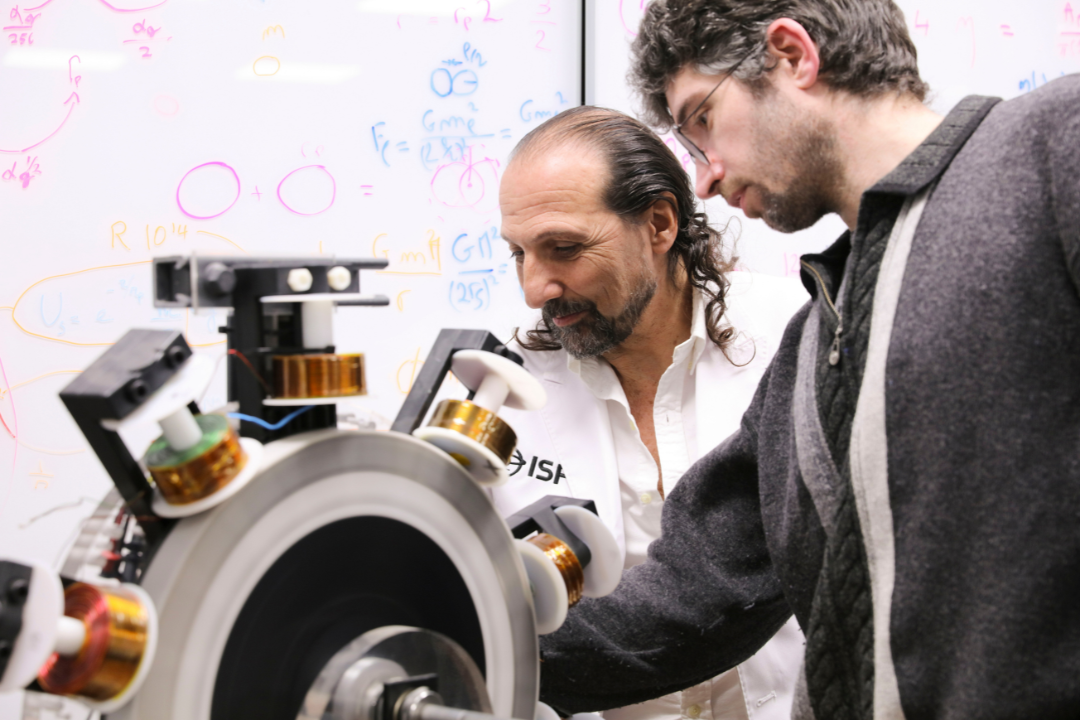
Vortices are quite a global and diverse phenomenon, which is advocated by the available data. Interestingly, these objects and their ubiquitous nature are a direct implication of physicist Nassim Haramein’s Generalised Holographic Model.
In a previous ISF article by Dr. Ines Urdaneta, certain features of vortices and their dynamics suggested by the GHM have been well addressed. For instance, the model predicts the formation of large vortexes at multiple scales in a way that it expresses scale-invariant behavior.
Furthermore, Haramein discovered an exact solution of Einstein field equations called the Haramein-Rauscher metric according to which spacetime is itself curling at all the scales and this rotation is the source of spin from the microscopic to the cosmological scales. A consequence of this solution among other things is the formation of vortex structures universally. Thus, it is quite germane to say that the study of vortexes would form a very crucial part of our quest for the unification of fields and reconciliation of quantum mechanics with gravitational phenomena. Perhaps we would have more clear insights about the same once the new paper entitled “Scale Invariant Unification of Forces, Fields and Particles in a Quantum Vacuum Plasma” is published.
References
[1] Wei Guo et al, Superdiffusion of quantized vortices uncovering scaling laws in quantum turbulence, Proceedings of the National Academy of Sciences (2021). DOI: 10.1073/pnas.2021957118
[2] Alon Luski et al, Vortex beams of atoms and molecules, Science (2021). DOI: 10.1126/science.abj2451
[3] Gia Dvali, Florian Kühnel, and Michael Zantedeschi, Vortices in Black Holes, Physical Review Letters (2022). DOI: 10.1103/PhysRevLett.129.061302
[4] Francesca Ferlaino, Observation of vortices and vortex stripes in a dipolar condensate, Nature Physics (2022). DOI: 10.1038/s41567-022-01793-8