

“The existence of a zero-point energy of size 1/2 hv [is] probable.” –Albert Einstein and Otto Stern (1913) [1].
The journey to understanding zero-point energy began in the early 20th century, intertwined with the birth of quantum physics itself. The story of its discovery is a testament to the power of scientific inquiry to reveal the hidden workings of the universe, even when they challenge our most fundamental assumptions about reality. Around the turn of the 19th century, new technologies like the light bulb were bringing significant interest to how materials interacted with radiation. Engineering and developing efficient light bulbs required understanding how energy is absorbed and emitted by material bodies, like the filament in a light bulb. In the early 1890s the German Bureau of Standards asked the physicist Max Planck (Figure 1) to make light bulbs more efficient so that they would give off the maximum light for the least amount of electrical power. What we will see is that the birth of quantum theory began with Planck’s work on optimization to the engineering of early 20th century lightbulbs, and this would turn out to be a momentous event for modern science and physics.

Planck wanted to find a theory that could describe the experimental results of Gustav Kirchhoff—a physicist and mathematician who developed fundamental theory in electrical circuits, spectroscopy, and emission of radiation by heated objects [2]. Planck wanted to extend this work of Kirchhoff’s in the exploration of the interaction between electromagnetic waves (light) and matter (a material body) to find what the optimal temperature for filaments in light bulbs was to maximize energy efficiency. It was a very pragmatic objective: maximize the efficiency of light bulbs by finding the optimal temperature so when heated to that temperature they radiated almost entirely in the visible spectrum with little-to-no emission of electromagnetic energy in the ultraviolet and the infrared portions of the spectrum (Figure 2).

Attempts by Lord Rayleigh and Sir James Jenas to describe the behavior of emissivity and absorption of heated materials that Kirchhoff had observed for matter in interaction with thermal electromagnetic radiation—resulting in the Rayleigh-Jeans law—led to results that were obviously contradicted by observation because the formulation said that there would be infinite energy radiated at short wavelengths of EM radiation in the ultraviolet spectrum. This led to what is known as the ultraviolet catastrophe. As well, because the formulation often involved considering an idealized material that perfectly absorbed all wavelengths, which would be black since it does not reflect any wavelengths, and hence was referred to as an idealized black body (Figure 3), this crisis in thermodynamics and classical physics was also referred to as the black body problem.

Essentially, classical physics, particularly the Rayleigh-Jeans law, predicted that the intensity of radiation emitted by a black body, the idealized material that perfectly absorbs and emits energy in the form of radiation, would increase without bounds as the frequency increased (corresponding to a decreasing wavelength), leading to an infinite amount of total energy radiated. To understand the concept of a black body, consider the simple example of wearing different colored clothes: wearing a black shirt on a sunny day will result in a significant amount of EM energy being absorbed and the shirt will get hot, while a white shirt would not absorb the same amount of radiation (it reflects wavelengths and is not a perfect absorber). The black shirt in this example is like the idealized black body, which radiates thermodynamically as it gets hot, in the case of the filament of a lightbulb eventually emitting visible light.
This divergence in the Rayleigh-Jeans law (an output of infinite radiated energy at small wavelengths) was in direct contradiction to experimental observations, since materials when heated, like the filaments for lightbulbs, obviously did not radiate infinite energy when approaching high temperatures (Figure 4); this was also known as the Rayleigh-Jeans divergence problem.

Planck’s solution to this conundrum was revolutionary. In 1900, by assuming that a hypothetical electrically charged oscillator in a cavity that contained black-body radiation could only change its energy in a minimal increment, later denoted h (called Planck’s constant), that was proportional to the frequency of its associated electromagnetic wave, Planck had discovered that energy is not emitted continuously, as classical physics assumed, but in discrete packets or discrete quantities—also called quanta—thus the name “quantum” theory. This quantization of energy was the first step towards the development of the physics theory that would go on to describe matter and interactions at the atomic level as harmonic oscillators exchanging packets of energy called quanta: called quantum mechanics (QM). However, unexpectedly revealed within Planck’s formulation was an even more profound insight: the discovery of zero-point energy.
As Planck himself stated following his discovery of quantized emission of radiation by what he described as oscillating cavities in the material (oscillators later being described as atoms that compose the material), “the 1/2 hv energy remains with the oscillator even at the absolute of zero temperature because the material oscillator will not emit energy so long as the total average energy is smaller than hv” [3]. This meant that although his equation was giving the correct relationship between the frequency of light emitted for any temperature (see graph above in Figure 3), the equation implied that even at zero Kelvin where thermal agitation should be completely halted, the oscillator still carried a finite amount of potential energy. This residual energy, which was clearly an indelible part of Planck’s equation for black body absorption and emission that resolved the ultraviolet catastrophe, and which is inextricably present even as absolute zero temperature is approached was the first hint of the existence of zero-point energy. One could even make the remark that he eliminated an infinity by replacing it with another one. However, this zero-point energy, or ZPE as it is known in modern notation, unlike the ultraviolet catastrophe has been confirmed experimentally. Thus, one could state that the energy potential manifesting as an infinite ultraviolet emission in the Rayleigh-Jeans earlier approach was rectified to show that it is in fact the ground state of the electromagnetic field, or ZPE, which describes the correct mechanics.
The significance of this discovery cannot be overstated. It suggested that even in the most extreme conditions imaginable—a system cooled to as near absolute zero as is possible—there would still be some irreducible amount of energy present. This flew in the face of classical thermodynamics, which held that all molecular motion should cease at absolute zero temperature.
The Rayleigh-Jeans law for black-body radiation is given by the formula:

where:
- I(v) is the intensity of radiation at frequency v,
- c is the speed of light,
- k is the Boltzmann constant, and
- T is the temperature of the black body.
According to this formula, the intensity increases with the square of the frequency, predicting that high-frequency radiation (ultraviolet region) should dominate and result in an infinite amount of energy emitted by a black body.
As we saw, Planck’s investigation into the optimization of lightbulb efficiency led to the discovery of the “quantum of action” (the constant h) and enabled Planck to write the equation for the radiative energy density of a black body without incurring a divergence (prediction of infinite radiative power) in the ultraviolet spectrum.
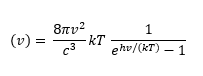
This formula not only explained the observed black-body radiation spectrum but also incorporated quantized energy levels, preventing the divergence at high frequencies predicted by classical physics. It was a crucial step in the development of quantum mechanics and marked a departure from classical physics.
This first law resolved the UV-catastrophe with a finite spectrum at high frequencies and the corresponding radiative energy density giving the Stefan-Boltzmann law, which is the formulation for the intensity of energy radiated at a given temperature per unit surface area per unit time. However, it raised a new issue as the internal energy U should reduce to kBT as predicted by the equipartition theorem (the equipartition theorem relates the temperature of a system to its average energies) in the classical limit of high temperatures:

What we see in Planck’s formulation, which resolved the ultraviolet catastrophe and matched prediction to experiment, is that the energy of the system (U) does not go to zero value (U ≠ 0) as the temperature approaches zero Kelvin (T → 0), but rather, and most salient for our consideration of the first mathematical derivation of the concept of zero-point energy, when temperature approaches zero Kelvin, T → 0, there remains an energy of E = ½ hv, (as T → 0, U → ½ hv). This part of Planck’s equation ET → 0 = ½ hv, is zero-point energy. Therefore, from consideration of the relationship of entropy to the average energy of an elementary radiator (a material oscillator) we see in Planck’s equation the inception of zero-point energy, for even at zero temperature (the nullpunkt, or zero-point), there is still a quantum of energy in the material oscillator of ET → 0 = ½ hv. As Planck himself stated: “the ½ hv energy remains with the oscillator even at the absolute of zero temperature because the material oscillator will not emit energy so long as U is smaller than hv“.
Note, the ever-present fluctuating energy at the ground state of a material oscillator (or as we will see a quantum field as well) was discovered before the Heisenberg indeterminacy principle, so contrary to popular belief ZPE is not a prediction of Heisenberg’s uncertainty. We will discuss this in more detail later.
Planck’s formula not only explained the observed black-body radiation spectrum but also incorporated quantized energy levels, preventing the divergence at high frequencies predicted by classical physics. It was a crucial step in the development of quantum mechanics and marked a departure from classical physics.
The ultraviolet catastrophe highlighted the limitations of classical physics in describing certain phenomena at the atomic and subatomic levels, paving the way for the revolutionary concepts of quantum mechanics in the early 20th century, most notable perhaps the discovery of zero-point energy.
This result from theoretical considerations is observable in many instances of the behavior of material systems under super-cooled conditions: from Bose-Einstein condensates, electron Cooper pairs in superconductors, to superfluidity. For example, liquid helium will not freeze regardless of temperature at standard atmospheric pressure due to the zero-point energy, U → 1/2 hν, that remains even as T → 0—instead, when cooled below its Lambda point (the critical temperature) helium becomes a superfluid. Note, this has relevance to considerations of the nature of the quantum vacuum as in some approaches in theoretical physics, like that of superfluid vacuum theory (Bose-Einstein condensate vacuum theory) the vacuum is modeled as a superfluid [4, 5], and the quantum vacuum harmonic oscillators with zero-point energy and the spectrum of energetic modes down to wavelengths of the Planck length and frequencies of the Planck frequency can be thought of as a Planck fluid plasma (as described in The Origin of Mass and the Nature of Gravity, by Haramein et. al. [6]).

An important equivalency that seems to have gone largely unnoticed is that a black hole is a perfect black body, it absorbs electromagnetic radiation with almost 100% efficiency (non-withstanding Hawking radiation). When the quantum vacuum is considered in the curved spacetime region of a black hole’s event horizon, calculations show that there is a very particular effect on the quantum vacuum state of the electromagnetic field—zero point energy being a primary constituent of the electromagnetic field in the vacuum state—it thermalizes emitting photons that are correlated with the black hole itself. This is called Unruh-Hawking radiation and is a primary focus for fundamental theoretical physics because of issues like the information loss paradox that is associated with black hole evaporation due to excitation of the zero-point field of the quantum vacuum causing the emission of observable photons. Indeed, much like a black body, the thermodynamics of a black hole event horizon can be described by the same Stefan-Boltzman relationship (the Stefan-Boltzmann law of blackbody radiation) of surface area to temperature; in the case of the black hole characterizing its Unruh-Hawking emission spectrum. As such, it is interesting to consider that since black holes are near-perfect black body systems, in a certain sense zero point energy and quantum mechanics were discovered by modeling matter as a black hole (a black body being an idealized perfect absorber and a black hole being the closest thing to such an object in nature).
At the Zero Point: is this Ubiquitous Energy Accessible?
If there is a ubiquitous non-zero ground-state energy all around us in this zero-point field, a veritable “sea of energy”, then why don’t we notice it in our quotidian experience? It has been empirically demonstrated that quantum vacuum energy is there, in such experiments as the Casimir effect (Figure 6), an effect in which a force is generated from changing boundary conditions in the oscillating fluctuations of the quantum vacuum, first predicted in 1948 by physicists Casimir and Polder [7] and experimentally verified in 1997 [8]. So, there is no doubt that the zero-point field is real and has observable effects—in fact it is the basis of quantum mechanics because quantum systems are comprised of quantum fluctuations of the vacuum state. This means that the properties of matter are not intrinsic but arise due to interactions with the zero-point field.

Visualizing the Casimir Effect Induced by Quantum Vacuum Fluctuations– A Water Wave Analog
Although zero-point energy has real tangible effects and can be demonstrably accessed via methodologies like the Casimir effect, it is still a common erroneous assumption that the ubiquitous energy of the quantum vacuum and associated zero-point energy field cannot be utilized technologically to generate work. The reasons for this erroneous assumption are multivariate, however a common one is that it is incorrectly thought that harnessing the quantum vacuum energy density arising from zero-point fluctuations would violate thermodynamics: the objections generally being along the lines that it would be like trying to draw heat from an ice cube. The conventional perspective generally holds that zero-point energy is the ground state of any system (or field), also called the vacuum state, which is an equilibrium state and the laws of thermodynamics holds that energy cannot be extracted from an equilibrium state or flow from low energy to high energy; hence any energy at this zero-point is unavailable because it is at equilibrium and locked in the lowest energy state. This, however, is wrong, and we will look at examples in which work is technologically extracted from the quantum vacuum energy density. First, however, we can dispel this error quickly with an example from nature.
Zero Point Energy: The Gecko and the Casimir Force
The animal the Gecko, a remarkable little lizard, is able to walk right up walls and across ceilings of almost any material. The way this is accomplished is not via suction or electrostatic adhesion, but rather via an interaction with quantum vacuum fluctuations that are sourced in the zero-point energy of the electromagnetic field (the zero-point field). The Gecko’s feet are covered with millions of microscopic hairs (Figure 7) that when brought close to the surface of almost any material will change the energy of the quantum vacuum fluctuations and result in an attractive force between the hairs and the surface, in what are called van der Waals forces, a microscopic form of the bulk effect known as the Casimir force, which is due to quantum fluctuations [9]. The ability of gecko’s to rapidly adhere and detach at will to veritably any surface is a remarkable form of evolutionary nanotechnology naturally leveraging the ever-present fluctuations of the quantum vacuum [10, Gecko adhesion: Evolutionary nanotechnology]. So ingenious is this natural mechanism, that gecko-like biomimetic adhesives may become the glue of the future [11].

Thus, the humble Gecko extracts work from the zero-point energy of the vacuum field. Walking up walls and being able to hold to the ceiling is work—even with the equivalent of approximately 40kg of weight hanging from the animal (The Force from Nowhere)—it requires a force, and that force would not be possible if it were not for the limitless sea of energy of the zero-point fluctuations of the quantum field that the Gecko draws from. So, if the gecko can utilize vacuum fluctuation energy, why can’t we? In fact, fromThe Origin of Mass and the Nature of Gravity, we can see how the most elementary of physical properties, like mass and force, are sourced in the quantum vacuum fluctuation energy density.
How is it possible, though, for the Gecko to extract work from the ground state or quantum vacuum of the electromagnetic field? Isn’t the ground state the lowest possible energy level, where there should be no usable energy available for work? Well, the first thing to note is that the ground state of a physical system in an equilibrium condition can be a tremendous amount of energy. Consider a multi-nucleon atom: if it is a stable isotope, it is in its lowest energy configuration, i.e., its ground state; it can even be cooled down to its vacuum state and still the potential energy is enough that if the atom were “split” it would release a considerable amount of kinetic and thermal energy.
Analogously, the ground state of the electromagnetic field is a non-zero energy value such that the vacuum of space is starting with a tremendously large energy density, there is no such thing as “empty” space! When we think of the ground state, we tend to think it has no energy, but this is incorrect, as we saw with the example of a stable isotope of an atom. The simple fact is that the ground state of nature does not start from zero, nor can it reach zero because there are always energetic fluctuations, and—importantly—these fluctuations are not from “uncertainty” but from an intrinsic non-zero energy that is ever-present. Planck discovered the zero-point energy of harmonic oscillations (about 15 years before Heisenberg’s uncertainty principle was formalized) and it came directly from matching his equations describing the spectra of emission of a heated object (like a light bulb) to its observed behavior. If a zero-point energy term was not included, the equations describing the radiation of a material like the filament of a light bulb would be wrong (as we will discuss, catastrophically wrong).
The remarkable ability of organisms to leverage almost every property of nature for selective advantage should make it a little wonder that one organism in particular, the humble Gecko lizard, has adaptations that have developed via natural evolution to enable it to utilize the collective attractive forces arising in molecules due to quantum vacuum fluctuations of the zero-point field. In a more general sense, however, the molecules that make up the cells that comprise the biological organism are quantum systems, and despite the meta-stability of these molecules they are at their foundation collective quantum fluctuations, as that is the nature of quantum systems, and why zero-point energy is at the foundation of quantum mechanics.
Therefore, there is reason to theorize that the zero-point field plays a more fundamental and integral role in the biological system than the particular example of the Gecko’s feet. In fact, we are currently preparing a publication in biophysics demonstrating a scaling relationship of energy coupling between quantum vacuum fluctuations and essential molecular architectures in the cell, underlying intercellular metabolism and information processing; ultimately correlated to the neural activity of the brain. Furthermore, researchers have investigated the role of quantum vacuum fluctuations and the zero-point field in driving coherent domains of water [12], and even potentially how long-range synchronization in the brain emerges through a bottom-up orchestration process involving the zero-point field, a key characteristic of this process being the formation, propagation, and synchronization of coherence domains [13]. Zero-point energy is at the root of quantum mechanics, and quantum mechanics is at the root of the molecular function of the biological system, therefore, zero-point energy may be fundamental to both QM and life.
How Much Energy is in the Zero-point Field?
Quantum field theory tells us that at every conceivable point of space there are quantum harmonic oscillators that can adopt very specific angular frequencies of energetic modes. Even in a seeming vacuum, when the quantum harmonic oscillators should be at the lowest or zero-point energy level, the oscillators are undergoing continuous energetic fluctuations; what are called quantum vacuum fluctuations. This quantum vacuum energy is generally not readily apparent in free space because it is decoherent, such that the modes of fluctuations of the oscillators destructively interfere and mask or screen the energy. When, however, the quantum vacuum fluctuations are in a coherent phase the energy of each tiny quantum harmonic oscillator adds constructively together and the collective energy of all modes in even a tiny volume of space is tremendously large. In fact, the unscreened quantum vacuum energy, or vacuum expectation value, in a proton-sized volume is equivalent to the mass-energy of the observable universe. In the International Space Federation study of the quantum vacuum energy density in high-coherence regions, as evaluated by correlations functions of creation-annihilation operators, the energy density of the unscreened quantum vacuum is demonstrated to be approximately 8.90 X 10113 joules per cubic meter.
A common analogy to give a sense of how much energy is contained in the electromagnetic quantum vacuum fluctuations is given as a coffee cup full of ZPE, which is stated as having enough energy to boil all the ocean water on Earth. That is not only a conservative value, it is wrong by some 82 orders of magnitude. It would only take approximately 1027 joules to actually vaporize all the water on Earth, yet there are approximately 10109 (a one with 109 zeroes after it) joules of quantum vacuum energy in the volume of a coffee cup.
So, let’s try and frame how much work could be performed by this amount of quantum vacuum energy, in one coffee cup, since “vaporizing all the oceans on Earth” is an insignificantly small fraction of the total energy available. One joule is the amount of work required to produce one watt of power for one second. Therefore, it takes 100 joules to light a 100-watt light bulb for one second. 10109 joules are enough energy to power a 100-watt light bulb for approximately 10100 years (a googol) … In other words, you could power 100 billion light bulbs (1013 joules) on every planet in the universe—estimated to be around 1024 by NASA (a trillion-trillion planets, which would require a total of ~1037 W)—for the life of the universe (~1017 seconds, which would require approximately 1054 joules) and do that in 1055 universes!
So, you could power approximately 1055 universes, each with:
• 1024 planets,
• 1011 100-watt light bulbs per planet,
• For the entire time our universe has been around (13.8 billion years) for every universe.
This calculation underscores the staggering theoretical energy density of quantum vacuum energy, even in a small volume like a coffee cup!
If there is indeed a multiverse, a coffee cup volume of the energy of coherent (unmasked) quantum vacuum fluctuations could provide sufficient power for a civilization on every planet in a universe for ten quintillion-quintillion-quintillion universes.
The quantum vacuum expectation value comes from quantum mechanics, yet something interesting happens when one considers the effect on spacetime curvature, since Einstein’s field equations in general relativity tells us that energy curves or geometrizes spacetime, so too will the unscreened quantum vacuum energy density. In a high-coherence region of quantum vacuum fluctuations, like what occurs at the Compton wavelength of the proton, spacetime curves so strongly that it encapsulates the quantum fluctuation energy, and it is effectively screened to a much lower energy value. Remarkably, a first screening of the zero-point energy generates the exact condition required for the Schwarzschild condition, or a black hole at the proton scale (the reduced Compton wavelength, see reference Origin of Mass and Nature of Gravity [6])
Therefore, we see that the energy of the vacuum described by quantum field theory curves spacetime— described by general relativity— and results in a black hole with an event horizon radius exactly equal to the Compton wavelength of the proton and the Schwarzschild mass of a proton-sized black hole, which can be thought of as the ‘undressed’ mass of the proton, commonly referred to as the ‘bare’ mass in quantum theory. The Hawking-like radiation from the event horizon of this black hole radiates in an isothermic fashion to the proton charge radius, effectively undergoing a second screening, where it exactly equals the observed mass-energy of the proton rest-mass. We thus see that when quantum mechanics (ZPE) and general relativity are brought together, we can fully understand what a particle is and the source of mass. Most importantly, we see that mass is not an immutable intrinsic property of matter but arises as a result of the correlation between quantum vacuum oscillators and spacetime curvature, or general relativity.
From this approach of the origin of mass resulting from zero-point energy, Einstein’s original formulation, M = E / c2, becomes clear and we see that the relationship between the E term and the M term is quantum vacuum fluctuation energy of the zero-point field.
The very real and tangible nature of zero-point energy and associated quantum vacuum fluctuations have been extensively tested by experimental validation, as delineated in Table 1.
Table 1. List of physical effects based on the ZPE with the theoretical prediction or post-experiment explanation and corresponding experimental validation.
| ZPE-based Effect | Theoretical Prediction/Explanation | Experimental Validation |
| Black Body radiation | Planck (1900-1912) | Kirchhoff (1860) |
| Spontaneous Photon Emission / Lamb Shift | Einstein (1916) / Bethe (1947) | Lamb-Retherford(1947) |
| Electron-Positron pair creation | Dirac (1928) | Anderson (1932) |
| Schwinger effect | Sauter (1931) -Schwinger (1951) | National GrapheneInstitute – Geim (2022) |
| Breit-Wheeler Effect | Breit-Wheeler(1934) | Pike et al (2014) |
| Vacuum Birefringence | Heisenberg – Euler(1936) | STAR experiment(2021) – IXPE (2022) |
| Casimir Effect | Casimir (1948) | Lamoreaux(1997) |
| Casimir Torque | Casimir (1948) | Somers (2018) |
| Functional Casimir Devices | Casimir (1948) | Li et al. (2022) |
| Dynamical Casimir Effect | Moore (1970) | Wilson (2011) |
| Higgs mechanism | Anderson (1962) | LHC (2013) |
| Hawking Radiation-Unruh Effect | Hawking-Zel’dovich(1972-1973) – Unruh (1976) | Wang et al. (2023)Afshordi et al. (2023) |
Other examples include functional Casimir devices (Controlling the Quantum Vacuum for Energy Transfer and Functional Casimir Devices), quantum vacuum harvesting methodologies and even a purported “Quantum Drive” (Spacetime Engineering and Harnessing Zero-point Energy of the Quantum Vacuum).
Technologic Engineering to Harness Quantum Vacuum Fluctuations Sourced in the Zero Point Field
We have seen how the non-trivial energy of the quantum vacuum makes up our quotidian world: as, for example, in The Origin of Mass and the Nature of Gravity [ibid, 6] we have demonstrated matter is made of vacuum fluctuations, and we have applied this understanding to reveal how particle masses arise. We have also seen that this constitutive fluctuation of the energy density of space, on very short distances and timescales, is not just theoretical—its effects have been empirically observed and characterized. The most well-known effect of which is the Casimir force, which in its simplest form produces an attraction between objects that are at sub-micron distances from each other, due to how the objects cancel out certain modes of the quantum vacuum fluctuations, generating a force—but which has also been used to generate repulsive forces (for levitation), has released photons from the vacuum through the dynamical Casimir effect, and has also been utilized to realize nonlinear oscillation [14], quantum trapping [15], phonon transfer [16] and dissipation dilution [17].
As can be seen, there are many potential technological applications of the Casimir effect, not least of which is a levitation force when the correct geometry is applied (Chirality Turns the Casimir Force Repulsive [18, 19]). There is also the burgeoning field of functional Casimir devices, with one team of researchers having engineered Casimir diodes and Casimir transistors. The Casimir Diode is a non-reciprocal device based on quantum vacuum fluctuations, that can affect unidirectional transfer of energy, like a diode. In a publication in the journal Nature Nanotechnology in 2022, the team reported a quantum-vacuum-mediated non-reciprocal transfer of energy between two micromechanical oscillators [20].
The research team that published the study, headed by Tongcang Li of Purdue Quantum Science and Engineering Institute at Purdue University, was one of the first groups to demonstrate an ingenious breakthrough in utilizing quantum vacuum fluctuations to regulate energy transfer at the nanoscale and build functional Casimir devices. Recall that the conventional perspective on ZPE and quantum vacuum energy is that it is non-accessible and cannot be harnessed to perform work. Yet, there is an emerging class of devices that leverage the Casimir effect for devices that function by utilizing the energy gradient induced in the ZPF energy density by something as simple as a boundary condition, or in the case of the Casimir diode, an oscillating membrane.
Like the control of electric current with diodes, the research team purports to have developed an efficient “Casimir diode” that can rectify energy transfer coupled by the Casimir interaction. The research team explains that the non-reciprocity, or unidirectional energy transfer, is realized by dynamic modulation of the nonlinear Casimir interaction in a specially constructed optical cavity in which frequency modes of membranes of two micromechanical oscillators are coupled using light and dynamically modulated to a special state of the frequency modulation called the exceptional point (see Figure 8), an optical-mechanical technique. By utilizing the strong nonlinearity of the Casimir interaction and asymmetric structure near the exceptional point to break the time reversal symmetry by modulating the separation between dual cantilevers (the micromechanical resonators) at the desired frequency and amplitude the researchers have realized non-reciprocal energy transfer with the Casimir interaction. Also, the team demonstrated a three-body Casimir effect and designed a Casimir transistor based on this research [21].

Another research group led by Professor Garret Moddel of the University of Colorado Boulder has purported to developed devices that produce power from zero-point energy quantum fluctuations based on the formation of a Casimir cavity on one side of a metal–insulator–metal (MIM) tunneling device (Figure 9).

The research team have published results demonstrating that such a MIM Casimir cavity device induces a measurable electrical current between the two metal layers with no applied voltage [22 “Casimir-cavity-induced conductance changes,” and 23 “Optical-Cavity-Induced Current.“] As well the research group have proposed continuous energy extraction from the zero-point field utilizing gas flowing through a Casimir Cavity (Figure 10). As they describe:
“When the gas atoms are pumped into a Casimir cavity, where long-wavelength ZP field modes are excluded, the electrons spin down into lower energy orbitals and release energy in the process. This energy is collected in a local absorber. When the electrons exit the Casimir cavity they are re-energized to their original orbitals by the ambient ZP fields. The process is repeated to produce continuous power. In this way, the device functions like a heat pump for ZP energy, extracting it globally from the electromagnetic quantum vacuum and collecting it in a local absorber. This energy can be used for heating, or converted to electric power.” [24]

The results from the Moddel research group are based on the fact that zero-point energy associated with the vacuum state depends on the structure around it, that is to say that it is geometry-dependent, which is in part how the Casimir effect arises. From a certain consideration, this can be a way that Hawking radiation from a black hole can be explained (see our article Quantum Black Holes for more on Hawking radiation): the change from the surface radius of a star to the surface radius of an event horizon is a change in the boundary condition or geometry around the vacuum and results in thermal photons being emitted from the quantum vacuum fluctuation energy. This is what a Casimir cavity is doing, it is changing the local structure of the vacuum, generating a gradient in the energy density, changing the universal ground state of the sea of zero-point energy so that it is accessible, and this results in work being extracted from the quantum vacuum energy density. In fact, if we were to consider a Casimir resonance cavity with the dimension of a subatomic particle, as was done in the study the Origin of Mass and the Nature of Gravity, so that the Casimir cavity had a radius equivalent to the proton charge radius, the Casimir force that would be generated would equal the observed rest-mass of the proton and equal the strong force interaction required for confinement.
Although the Casimir effect irrefutably demonstrates that energy can be accessed from the vacuum state, in the form of the Casimir force that does work on plates in the experimental set-up, a common criticism for implications of technological application is that the effect is small, i.e., low energy. So most applications are looking at nanoengineering (e.g., friction-free nanomachines), microdevices, and perhaps small-scale levitation. However, there are much more efficient methods to potentially generate a gradient in the quantum vacuum energy density, and not just with geometry alone, but by employing spin. We can see the effects of spin in fluid systems, consider for example planetary atmospheres: when there are high spin systems, like hurricanes and tornadoes on Earth or vortexes like the Great Red Spot on Jupiter, this is associated with strong energy / pressure gradients. Inducing a high angular momentum vortex with plasma coupled to the quantum vacuum may generate an energy gradient far more significant than the little non-conductive plates utilized in the Casimir effect, and while it is based on the same principles it will potentially result in a much greater energy flux from the zero point field and quantum vacuum energy density.
This latter consideration is significant because when we discuss quantum harmonic oscillations that compose the quantum vacuum energy density, we are talking about spinning oscillators. Let’s examine this in more detail to learn why.
Harmonic Oscillators Spin
In quantum mechanics, the reduced Planck constant (ℏ, pronounced as h-bar), also known as the Dirac constant denoting a quantum of angular momentum, which is obtained by dividing Planck’s constant (h, which we saw in the previous equations) by 2ϖ (an angular rotation). Because the reduced Planck constant plays a crucial role in describing a quantum harmonic oscillator it suggests that oscillators can be thought of as involving angular, or rotational, behavior rather than being strictly linear.
The reduced Planck constant, ℏ, represents the smallest possible unit of angular momentum in quantum mechanics. Angular momentum in quantum systems, such as atoms or particles, is quantized, meaning that it exists in discrete units that are integer multiples of ℏ. This concept of quantized angular momentum hints that any oscillator in a quantum state inherently involves angular properties. The quantum harmonic oscillator is a fundamental system in quantum mechanics, often used to model particles in potential wells or vibrations of atoms in molecules. Although, the typical visualization given to physics students describing an oscillator is given by a spring with a weight on the end (Figure 10), it is much more accurate, if one is attempting to understand the dynamics of the universe’s creation of particles, to imagine the harmonic oscillator as a spinning object with pulsation frequency of ω (Figure 10).

So, because E = ℏω in the quantum mechanical treatment, we see that the oscillator’s behavior is described by wavefunctions with discrete energy levels (quantized in units of ℏ, Figure 11), and it is clear from the mathematics that each energy level is connected by angular momentum.

This can be seen when solving the Schrödinger equation for the harmonic oscillator, the system’s energy levels are quantized and spaced by ℏω (where ω is the angular frequency of the oscillator), and the fact that this quantization involves ℏ underscores that the energy of each level is connected to angular momentum, suggesting that the oscillator’s “movement” is related to rotational or cyclic processes rather than just linear back-and-forth motion.
The Spin-Like Nature of Quantum Oscillators
Though it’s tempting to imagine the quantum harmonic oscillator as a purely linear spring, this is ultimately a non-conducive analogy to understanding the real physical state of the system, in which it is clear that the quantization in units of ℏ implies a spin-like or rotational character. Each quantum state has a specific “phase,” a concept closely tied to rotational motion in quantum mechanics. Additionally, harmonic oscillators in quantum fields, such as photons, are associated with rotational symmetries and spin-like behaviors (photons themselves have intrinsic angular momentum, or spin).
The reduced Planck constant, ℏ, indicates that the quantum harmonic oscillator has a fundamentally angular character:
- The quantization in discrete units of ℏ relates the oscillator to rotational rather than linear properties (referring back to figure 10).
- Phase space trajectories are circular, reflecting cyclic or rotational behavior.
- Ladder operators in the harmonic oscillator formalism act as “steps” in a rotational framework (figure 11).
So, while convention likes the analogy of the harmonic oscillators as linear springs, the more physically realistic situation is spinning spheres not little weights on springs and it is clear that in quantum mechanics they are more accurately seen as systems with intrinsic rotational characteristics (Figure 12). This angular nature is why harmonic oscillators, in quantum theory, are inherently related to spin, cycles, and phase—concepts deeply connected to angular momentum.

Einstein, Stern, and Nernst: Discovery of the Zero-point Field (ZPF)
In 1906 Einstein defined quanta of energy radiation by putting forth the heuristic argument that the emission and absorption of Planck oscillators (the resonator cavities he had imagined) changes by discrete intervals which are integral multiples of ℏω (which we saw depicted in Figure 11), essentially beginning the concept of the photon (“On a Heuristic Viewpoint Concerning the Production and Transformation of Light”). Note, Einstein and Stern utilized the notation of the reduced Planck constant ℏ (which we saw in the previous section) and for frequency omega, denoted by the Greek letter ω (recalling that the harmonic oscillators being described are spinning and thus have specific frequency of rotation).
This conjecture of the quantization of emission and absorption at discrete energy levels that are only integral multiples of ℏω (essentially defining the photon) enabled Einstein to make specific predictions from his elucidated photoelectric effect. This effect is important in consideration of the coupling of matter with quantum vacuum fluctuations and ZPE, which are integrally involved with absorption and emission of electromagnetic quanta, such as in the photoelectric effect and spontaneous emission, for which he won the Nobel prize in 1921.
In studying the nature of dipole oscillators, Einstein and Stern applied a zero-point energy to the average energy of a dipole oscillator (U) of U + ℏω. When they applied this zero-point energy factor to dipole oscillators they were able to exactly produce the Planck spectrum (further confirming his discovery). These results were published in a 1913 paper “Some arguments for the assumption of a molecular agitation at the absolute zero point” [25].
Interestingly, Einstein and Stern’s zero-point energy value was twice that previously found by Planck. This is because the total zero-point energy of a linear dipole oscillator of frequency with a field mode of the same frequency (such as a specific wavelength of the electromagnetic field) is ½ ℏω + ½ ℏω = ℏω, even though Einstein and Stern attributed the ℏω value of zero-point energy solely to the material dipole oscillators. In essence, this means that even though they did not realize it at the time Einstein and Stern discovered the zero-point energy associated to all oscillations of a field, the zero-point field—where in their equation the zero-point energy of a dipole oscillator, U + ½ ℏω, is twice that derived by Planck, because the zero-point motion of a material dipole oscillator is coupled to the zero-point oscillations of a quantum field, like the electromagnetic field.
We will see, these zero-point oscillations of the ground state of the electromagnetic field are also referred to as quantum vacuum fluctuations (hence Einstein and Stern, via the work of Planck, also discovered the quantum vacuum). To illustrate this, in considerations of the thermodynamic equilibrium between the electromagnetic field and dipole oscillators within the framework of quantum mechanics, Peter Milonni—a theoretical physicist who deals with quantum optics, laser physics, quantum electrodynamics and the Casimir effect—has demonstrated that a dipole oscillator with a zero-point value of ħω (not just 1/2 ħω) arises because for consistency the fluctuation-dissipation reaction of a radiator must couple to the zero-point energy of the EM field, so that the full zero-point energy contribution becomes 1/2 ħω + 1/2 ħω = ħω [26].
Einstein and Stern would end up retracting their 1913 paper because their work had suggested that specific heat—a measure of the capacity of a material to change temperature with a given amount of energy—did not change as a result of zero-point energy at ultra-low temperatures but in fact, as determined by experimental data, went to zero. As temperature decreases, the thermal energy available in a system is reduced and at very low temperatures, most atoms or particles in a material are in their lowest quantum energy states. In this state, they lack sufficient thermal energy to jump to higher energy levels, so they remain “frozen” in place. This phenomenon leads to the third law of thermodynamics, which states that as temperature approaches absolute zero, the entropy of a system also approaches a minimum, and specific heat approaches zero.
Since zero-point energy is the minimum energy that particles cannot shed or alter, it doesn’t create accessible states for particles to transition between. Consequently, no additional energy is required to maintain the system at a slightly different temperature, resulting in a specific heat that approaches zero. Zero-point energy does contribute to the total energy of the system but not in a way that affects temperature-dependent properties like specific heat. Once a system reaches its zero-point energy level, further reductions in temperature do not lower this energy. Therefore, zero-point energy provides a baseline that doesn’t influence the heat capacity near absolute zero.
Lesser-known contemporaries of Planck and Einstein, like Walter Nernst (Figure 8), known as the grandfather of the quantum vacuum and dark energy [27; Walther Nernst: grandfather of dark energy?], extended the discovery of zero-point energy of mechanical oscillators of material systems (i.e., atoms) to quantum fields like the electromagnetic field. This means that even in a seeming vacuum, where there are no observable photons and the electromagnetic field should have zero energy, there will be constitutive zero-point energy in the field. Hence, space is permeated by a zero-point field, and there is a veritable sea of energy at the base of all things. This means as well that the classical notion of a vacuum—a volume of space seemingly devoid of any particles or energy—is not a physically real state that can ever be achieved. So, the classical notion of a hypothetical vacuum is replaced with the physically real quantum vacuum, which has a non-zero energy value (contrary to a classical vacuum), due to the zero-point energy at the ground state of all modes of the Field (with an extremely large number of modes going down to wavelengths of the Planck length and frequency).

This is a critically significant feature of zero-point energy and the contribution of quantum vacuum fluctuation energy to any material system, because without the coupling of dipole oscillators, such as atoms, to the zero-point field the dipole would radiate fully and collapse. This means that, according to stochastic electrodynamics, the electronic orbitals of atoms are supported by the ambient zero-point field. Without zero-point energy and the quantum vacuum interaction, there would be no stable atomic matter. Einstein would follow Nernst’s work on the non-zero energy of the electromagnetic vacuum— due to the veritable sea of zero-point energy permeating all of space— to formulate a contribution of the quantum vacuum energy density to a cosmological constant term in his general theory of relativity, which would counter-balance the force of gravity. The cosmological constant is though today to be the source of the accelerating expansion of the universe (see Unruh’s paper How the huge energy of quantum vacuum gravitates to drive the slow accelerating expansion of the Universe [28]. So, although Einstein and Stern had retracted their earlier work on ZPE, Einstein inevitably returned to the idea with a zero-point field. The idea that space is empty, which ironically is erroneously attributed to Einstein’s general theory of relativity, would be once-and-for all removed with the discovery of the quantum vacuum and ZPF. In a sense, this was a return to the aether, a 19th century theory that space is permeated by a substantive medium through which light waves propagate, with Einstein stating in 1920:
There is a weighty argument to be adduced in favour of the aether hypothesis. To deny the aether is ultimately to assume that empty space has no physical qualities whatever. The fundamental facts of mechanics do not harmonize with this view … according to the general theory of relativity space is endowed with physical qualities; in this sense, therefore, there exists an aether. According to the general theory of relativity space without aether is unthinkable; for in such space there not only would be no propagation of light, but also no possibility of existence for standards of space and time (measuring-rods and clocks), nor therefore any space-time intervals in the physical sense. But this aether may not be thought of as endowed with the quality characteristic of ponderable media, as consisting of parts which may be tracked through time. The idea of motion may not be applied to it. Einstein, Albert (1922) [29].
Many might be surprised to hear Einstein talk about aether, in association with ZPF in such a direct manner, stating unequivocally that space must have a tangible medium because space has physical qualities (and must have non-zero energy). Yet, even modern day Nobel prize recipients in physics, like Frank Wilczek, are quite clear on this point as well: see Wilczek’s lecture on the Materiality of a Vacuum. Frank Wilczek is direct on stating the fact of the materiality of the vacuum—the non-zero energy density arising from ZPE of the quantum field—because he knows that it is integral and indelible in current formulations of quantum electrodynamics (QED) and quantum chromodynamics (QCD).
For example, in QED the quantum vacuum electromagnetic energy density is critical for the treatment of bare mass (or naked mass, the mass before the particle is “dressed” in virtual particle pairs of the quantum vacuum) and bare charge of elementary particles. This is because in the Standard Model elementary particles are point-like (literally conceived as 1D objects), so “undressed” values output infinite mass and charge, and the non-zero vacuum state energy of the QCD vacuum, which deals with the color force and nuclear confinement in the Standard Model, is what gives the hadron its mass. This is because only approximately 1 to 5% is accounted for by the Higgs mechanism acting on quarks and the rest is thought to come from the confinement energy of the color force, which arises from the quark-gluon condensate of the QCD vacuum.
So, the significance to quantum theory of this discovery by Eistein, Planck, and others of zero-point energy cannot be overstated. However, despite having been the originators of zero-point energy, neither Planck nor Einstein and Stern ever suggested that there might be a zero-point field, and as we saw, the first discussion of this possibility would be attributed to Walther Nernst in 1916. Nevertheless, the early derivations by Planck, Einstein, and Nernst on the interaction between light and matter yielding the ZPE density are at the roots of quantum mechanics
Quantum mechanics would soon be extended to describe all particles, such as bosons like photons and fermions like electrons, as field-like, in which so-called “particles” are just excitations of the quantum harmonic oscillators in a localized region of the field, which fills all of space. Importantly, all of these quantum harmonic oscillators that fill each point of space throughout the field have zero-point energy fluctuations in the vacuum state, hence forming the quantum vacuum. This ever-present fluctuating zero-point energy of the quantum vacuum is integral to quantum mechanics and its formalisms, and as well to cosmology in explaining the phenomenon of dark energy associated with accelerating expansion of the universe [31].
The foundations of Quantum Mechanics and the uncertainty principle are firmly rooted in the dynamics of ZPE vacuum fluctuations
In quantum field theory (QFT), the electromagnetic field is described as a quantum field that can exist in discrete quanta known as photons. The field is quantized, meaning that each possible mode (or frequency) of the field can be described as a quantum harmonic oscillator, which we saw in Figure 6 are energy levels that are multiples of the reduced Planck constant, ℏ, and the field’s frequency, ω.
In classical electrodynamics, the electromagnetic field is represented by oscillating electric and magnetic field components. In QFT, however, each mode of the electromagnetic field (corresponding to a specific frequency and wavelength) is quantized and treated as an independent quantum harmonic oscillator.
The quantized electromagnetic field can be expressed as a sum of all these oscillating modes. For each mode, there are creation and annihilation operators, a†a (in quantum mechanics, an operator is a mathematical tool that “acts on” a function or state to produce another function or state, usually associated with measuring a specific physical quantity like position, momentum, or energy). The creation and annihilation operators, part of the energy operator that tells us about the energy of the system, add or remove quanta of the field (i.e., photons). This quantized structure allows us to think of the field as being made up of discrete photon excitations rather than a continuous wave, i.e., composed of virtual photons (but don’t assume that the term virtual here means non-real, these virtual photons have real measurable effects that integral to particle properties and behaviors).
In QFT there is a thing called the “Hamiltonian” (what we just saw is the energy operator, corresponding to the total energy of a system under consideration), don’t worry about exactly what this means as we will just examine a few parts of it to illustrate the significance of ZPE in QM, which is so often misrepresented (for example, by simply stating the ZPE arises from Heisenberg uncertainty). The Hamiltonian for each mode of the quantized field is given by:
H = ℏω (a†a + ½)
where a†a is the number operator representing the number of photons in that mode, and the term ½ ℏω represents the zero-point energy. The zero-point energy of a mode is the energy that exists even when there are no photons present in that mode (remember, mode is just a term referring to the oscillatory behavior of the harmonic oscillator, e.g., its frequency). It arises from the fact that the quantum harmonic oscillator has a minimum energy level (the ground state) of ½ ℏω rather than zero, which, as we saw, was first elucidated by Planck. Thus, Planck’s ZPE term directly stipulates that the field cannot have precisely zero energy because the electric and magnetic field components must retain some minimal fluctuations.
In the context of the entire electromagnetic field, every mode of the field across all frequencies contributes a zero-point energy of ½ ℏω. Since there are infinitely many modes in the field (corresponding to all possible frequencies), the total zero-point energy of the electromagnetic field is formally infinite. This energy is referred to as the vacuum energy of the field.
Vacuum State Fluctuations, Zero-Point Energy, and Non-Commutativity
The vacuum state of the electromagnetic field is the state with no photons (i.e., all modes are in their ground state). However, due to the zero-point energy in each mode, the vacuum is not truly empty; instead, it is characterized by constant fluctuations arising from the zero-point energy. While this non-zero vacuum state energy density is often removed in QM and QFT calculations, this does not mean that the zero-point energy vanishes from the system. In fact, the non-zero value of the vacuum state of the quantized electromagnetic field results from the non-commutative relationship of the creation and annihilation operators (a†a).
This is non-trivial, as the conjugate variables of the creation and annihilation operators for the quantum harmonic oscillators of the electromagnetic field are essential for the mathematical consistency of quantum theory. Without it, calculations that involve operators, like position and momentum of a particle, will not give correct results (if an order of operation does not respect that a measurement of position will change the precision with which a measurement of momentum can be made then disregarding their non-commutativity will result in incorrect modeling). To understand the importance of this, we must first clarify what a “non-commutative operator” is, and from this it will be much clearer how this mathematical operation retains consistency in quantum mechanics via ZPE.
Non-commutativity in quantum mechanics refers to the property that certain physical observables, such as the afore mentioned position and momentum or angular momentum, cannot be interchanged without consequence when you perform mathematical operations on them. In other words, the order in which you measure or perform operations on these observables can affect the outcome, leading to non-commutative behavior, which means that the order of operations matter.
A highly salient factor in considering non-commutative operations is the non-commutativity of absorption and emission processes (remember the entire foundation of QM began by elucidating the processes of absorption and emission of energy quanta). For example, using a dipole model of an atom it is clear that without ZPE, the system would collapse due to radiative damping. The key equation describing this system includes both a description of the process of radiation of the dipole oscillator (the atom) and a zero-point energy source term. The important thing to note is that if the zero-point energy source term is not included the solution predicts a rapid collapse of the dipole length. However, when ZPE is included as a source term the solution maintains stability and, crucially, preserves the non-commutative relationship [x̂,p̂] = iℏ that is fundamental to quantum mechanics.
Going back to our example of a linear spring oscillator, we can picture this as exciting the weight on the spring and watching it oscillate and slowly dissipate the kinetic energy (dampen) and cease oscillation. However, ZPE acts as a hand constantly “pumping” the weight (at a resonant frequency) perpetually maintaining the oscillation. This is how atoms and ZPE quantum harmonic oscillators function in nature! Thus, in terms of the non-commutativity of operators like absorption and emission or position and momentum, contrary to the often stated yet nevertheless erroneous misconception, the Heisenberg uncertainty principle emerges from the vacuum fluctuations of the ZPE, and not the other way around.
Moreover, as we saw with Milonni’s analysis of the significance of ZPE to modern quantum formalisms, without the constitutive contribution of zero-point energy to a dipole oscillator, like the atom (the negatively charged electron cloud spinning around the positively charged nucleus) would quickly dissipate all energy and collapse [33]. Thus, zero-point energy is a source term necessitated for the stability of matter, counterbalancing the radiative damping of the dipole—a situation akin to the classical electron in continual acceleration in orbit radiating all of its energy and falling into the nucleus—and hence, while ZPE can be mathematically removed from the Hamiltonian (the sum of the kinetic and potential energy of a quantum system) as is done in common practice, in reality it can never completely vanish from the system without a complete collapse. The result is that all matter and particles in general would have never been able to make it pass a fraction of an attosecond (a millionth of a fraction of 10−18 or 1⁄1 000 000 000 000 000 000, one quintillion, of a second) after the Big Bang.
This process of mathematically removing zero-point energy density from the Hamiltonian of a system or curtailing its divergence—as the sum of all modes of quantum vacuum fluctuations results in an infinite energy density for the vacuum expectation value (VEV)—is a process that is referred to as “renormalization”. While many theorists are perfectly content with applying renormalization to resolving all kinds of instances of divergence problems (results going to infinity), the attempts to resolve the divergence problems induced in quantum mechanics by ZPE (leading to a prediction of infinite energy density for the VEV) all the while utilizing it to define the fundamental fields of particles and forces, have not been successfully resolved by the renormalization process. This, in turn, led to very strong statements by some of the fathers of quantum mechanics:
Paul Dirac:
Most physicists are very satisfied with the situation. They say: ’Quantum electrodynamics is a good theory and we do not have to worry about it any more.’ I must say that I am very dissatisfied with the situation because this so-called ’good theory’ does involve neglecting infinities which appear in its equations, ignoring them in an arbitrary way. This is just not sensible mathematics. Sensible mathematics involves disregarding a quantity when it is small – not neglecting it just because it is infinitely great and you do not want it! Dirac, 1975 [34].
Richard Feynman:
The shell game that we play is technically called ’renormalization’. But no matter how clever the word, it is still what I would call a dippy process! Having to resort to such hocus-pocus has prevented us from proving that the theory of quantum electrodynamics is mathematically self-consistent. It’s surprising that the theory still hasn’t been proved self-consistent one way or the other by now; I suspect that renormalization is not mathematically legitimate. Feynman, 1985 [35].
While initially, a vacuum expectation value of infinite zero-point energy density may seem to be a non-physical result, there are theoretical (as well as observational) reasons to believe that the vacuum state truly does have an extremely large zero-point energy density. In fact, this realization has come from a number of different considerations: for example taking Einstein’s statement seriously that spacetime must have a substantive nature, which is one-and-the same with the early conception of the aether: we can see tremendous “latent” energy density just by considerations of what a substantive, materiality of the vacuum would entail. As early as 1907 Oliver Lodge had calculated values for the density of the æther—the quantum vacuum being a transmogrified æther—of 1026 J/cm-3 or (by the E = mc2 equivalency) 10,000 tons cm-3 [36]. As he described the energy density of space: “This is equivalent to saying that 3 X 10¹⁷ kWh, or the total output of a million-kilowatt power station for 30 million years, exists permanently, and at present inaccessibly, in every cubic millimeter of space” [37]. Regarding the extremely large energy density values he calculated (given the early and limited conceptions of the nature of the Field) Lodge further commented that:
“There is nothing paradoxical, nor, so far as I can see, improbable, about these figures… and the inertia [i.e., mass] of matter must be a mere residual fraction of the inertia of the continuous incompressible complex fluid, of which it is hypothetically composed, and in which it moves.”
Lodge’s calculation of the energy density of free space was based on the then presumptive properties of the ubiquitous æther medium and the æthereal constants of magnetic permeability and the electric inductivity of free space, so it is interesting to see that while he calculated a seemingly extremely large energy density, it is still some ~1087 times smaller than contemporaneous VEV calculations (when the Planck length is utilized as a cut-off value for allowable field modes of the ZPE field). Significantly, with the two primary pillars of fundamental physics stating that there is a non-zero energy density of the vacuum: in the form of the cosmological constant in general relativity and VEV in quantum field theory, we can consider what effect this ubiquitous zero-point energy will have on the curvature of spacetime; a consideration of unified physics and quantum gravity.
Quantum Geometrodynamics and Spacetime Foam
So, from the discovery of zero point energy by Max Planck to engineer the optimally efficient lightbulb (the optimal temperature of which is still utilized to this day over one hundred years after Planck’s investigation) and its foundation in the subsequent development of quantum theory—e.g., explaining why the radiative dipole of an atom does not spontaneously collapse— to its application in quantum field theory where it results in the prediction of a tremendous energy density of the quantum vacuum, we can follow its progression to unified physics where the quantum vacuum fluctuations of zero point energy have significant effects on the geometry of spacetime. To understand the effect on the gravitational field and the spacetime structure associated with energy density levels resulting from a non-zero vacuum energy (i.e., ZPE) we can begin by looking at the work of Charles Misner and John Archibald Wheeler in early unified field theory.
Since Einstein’s general relativity equations demonstrate that all energy sources will geometricize spacetime, and curved spacetime geometry is gravity, the VEV of the zero-point energy density should result in a highly curved spacetime and strong gravitational action. This seems to be at odds with the vacuum energy expectation value of cosmology that predicts an energy density of space on the order of 10-9 J/m3, which is an almost flat spacetime curvature and possibly even a repulsive gravitational force, being closely associated with the concept of dark energy or quintessence, which is thought to drive the accelerating expansion of the universe.
The comparatively tiny vacuum energy value in cosmology (the small value of the cosmological constant) is in substantial disagreement with the much larger theoretical value of the quantum vacuum zero-point energy density suggested by QFT, a disparity in prediction between QED and cosmology for the energy density of the vacuum that is known as the Vacuum Catastrophe or the cosmological constant problem (see Haramein & Baker’s study Resolving the Vacuum Catastrophe [38]). However, the standard cosmological model’s characterization of the universe as being flat is probably incorrect as recent evidence points to a curved geometry of the universe on the largest scale [39], and at the micro-scale the fine structure of spacetime geometry is highly curved (in a multiply connected geometry, a non-trivial complex topology of micro-wormholes). Nowhere is this better exemplified than in Wheeler’s quantum spacetime foam postulate.
Wheeler and Charles Misner had already utilized Einstein-Maxwell geometrodynamics to describe how gravitation, electromagnetism, charge, and mass (the Wheeler and Misner already-unified field theory) arise from curved space with a multiply connected topology (a simply connected topology is like a smooth continuous surface, Wheeler described how space at the fundamental scale has a complex topology composed of bridge-like structures better known as wormholes, hence not smooth and continuous) [40]. In the quantization of relativity into quantum geometrodynamics Wheeler then demonstrated that the gravitational field would have constitutive fluctuations at the scale of (ℏG/c3)1/2 = 1.6 X 10⁻³⁵ m (the Planck scale), with energies of the order of (ℏc5/G)1/2 = 2.18 X 10⁻⁵ g [41].
The order of this radius and mass-energy obeys the Schwarzschild solution, which is a wormhole metric. Taken all together the mass-energy fluctuations of the gravitational field at the Planck scale (~10-35 m) have highly curved geometries and multiply-connected Einstein-Rosen (ER) bridge topology, what Wheeler termed quantum spacetime foam—a dynamical fluctuating micro-wormhole network at the Planck scale that is generated by the extremely high energy density of the quantum vacuum ZPE at the microscale. Note, this multiply connected geometry of spacetime arising from ZPE and QVFs resolves the information loss paradox (see our article An Eventful Horizon) and the “spooky action at a distance” of Einstein-Podolsky-Rosen correlation (EPR), also known as quantum entanglement via the equivalence with Einstein-Rosen bridges (ER = EPR, see our article Traversable Wormhole Teleportation Protocol).
Here, we see the first steps towards a unification of zero-point energy with spacetime geometry, leading Wheeler to describe elementary particles as self-sustaining structures of energy formed entirely by the curvature of spacetime itself, what he called “geons”, providing a purely geometric and field-based description of particles. A geon (short for “gravitational-electromagnetic entity”) is a localized, stable configuration of gravitational and electromagnetic fields. Rather than particles being fundamental, they emerge as curvatures or “bubbles” of spacetime shaped by energy, specifically by the energy from gravitational and electromagnetic fields.
The geon concept builds on Einstein’s idea that mass and energy can curve spacetime but goes further to suggest that elementary particles might be described entirely by this curvature without needing any underlying “substance” as particles are typically thought to have. Wheeler thus proposed that self-sustained structures from ZPE and spacetime curvature are at the basis of all matter, because the intrinsic ZPE of the electromagnetic field could interact with spacetime in a way that it essentially “traps” itself, creating a self-contained region of intense energy. Wheeler imagined that the energy required to sustain this structure could come from zero-point energy, which provides a natural source of fluctuations and energy density in the vacuum: a condition that are recent work for the first time rigorously and analytically demonstrates.
Quantum spacetime foam is still a primary postulate within quantum gravity, and as such we see that there is a fine-structure discretized highly curved geometry of space due to zero-point energy density and the extremely large energy of the VEV from quantum field theory is not in contradiction—the extremely large energy does curve space at the Planck scale into a multiply-connected Einstein-Rosen bridge topology. Hence, we see that the vacuum energy of zero-point fluctuations is associated with microscale discretized spacetime geometry, the quantum foam, a key facet of quantum gravity.
Significantly, in quantum geometrodynamics and the conception of quantum spacetime foam we see that zero-point energy and vacuum fluctuations are driving the formation of black holes at the Planck scale. What is elucidated in The Origin of Mass and the Nature of Gravity and some of our other studies is that all black holes are forming this way. Black holes from the Planck to the hadron to the cosmological scale are coherent oscillations of quantum vacuum fluctuations, including the zero-point energy of the electromagnetic field, and hence black holes form from this ubiquitous energy density (when it is in coherent phases of the fluctuations as can be demonstrated by correlation functions in organized matter).
The Origin of Mass and the Nature of Gravity
In my 3-decades of research I have demonstrated that zero-point energy and quantum vacuum fluctuations are the fundamental source of mass and confining forces at both the hadronic scale and larger scales (see my publications at ISF-Research).
At the hadronic scale:
- The study shows that the proton’s rest mass can be precisely calculated from the correlation functions of creation-annihilation operators of the electromagnetic field’s vacuum state at the characteristic frequency of the proton given by the interaction time, or the time that the confining force interacts with the proton.
- Also, this could be stated as the time light takes to go around the circumference of a proton or the time it takes a proton to rotate once at the speed of light.
- It is, as well, congruent with the rho meson lifetime, which is thought to be the particle that mediates the confining force in the Standard Model.
- This indicates that the proton’s mass emerges directly from coherent oscillations of quantum vacuum fluctuations, sourced in ZPE.
- The strong nuclear force that confines quarks within hadrons is shown to arise from a pressure gradient in the quantum vacuum fluctuations, rather than from gluon exchange as in standard QCD models.
At larger scales:
- The same quantum vacuum fluctuation mechanism that generates mass and the strong force at the hadronic scale is demonstrated to produce Newtonian gravity at macroscopic scales.
- Gravity emerges as a residual effect of the pressure gradients in quantum vacuum energy density that occur at larger scales.
- This unifies the origin of mass, the strong force, and gravity as different manifestations of the same underlying quantum vacuum dynamics.
Key points:
- Only the electromagnetic field is needed, rather than separate fields for each particle type as in the Standard Model.
- Mass and forces emerge through a “screening” process as the Planck-scale vacuum energy dissipates to lower energy densities at larger scales.
- This screening occurs through geometrodynamic encapsulation, where Planck-scale vacuum pressure induces spacetime curvature.
- The total mass-energy of the observable universe is accounted for without need for dark matter or dark energy.
Our work provides a unified explanation for mass and fundamental forces based solely on the dynamics of electromagnetic quantum vacuum fluctuations, arising from the indelible zero-point energy of the EMF, across different scales. This represents a significant departure from standard particle physics models and resolves long-standing issues in physics like the hierarchy problem, the source of mass and forces, and the cosmological constant problem.
Significance of Zero-Point Energy in the Study’s Framework
The study’s use of zero-point energy challenges conventional views by proposing that:
- The mass of the proton arises from quantum vacuum interactions rather than purely from quark and gluon dynamics.
- The nuclear confining forces are a manifestation of zero-point energy effects, providing a novel explanation for nuclear confinement without the need for gluon exchange.
- Gravity and other fundamental forces are unified under a framework where they emerge from the quantum vacuum field rather than as distinct, fundamental forces.
The Profound Implications of Zero-Point Energy
Zero-point energy stands as a cornerstone concept in fundamental physics, with far-reaching implications that extend from the quantum realm to cosmological scales. Its importance cannot be overstated, as it underpins our understanding of quantum mechanics, quantum field theory, and even the nature of the vacuum itself.
At the most fundamental level, ZPE explains why absolute zero temperature is unattainable, as quantum systems always retain a residual energy. This insight has profound consequences for our understanding of matter and energy. The discovery that particles like electrons in atoms do not spiral into the nucleus due to their interaction with the zero-point field revolutionized our model of atomic structure. Furthermore, the realization that the vacuum is not empty but teeming with energy has led to a paradigm shift in how we conceptualize space itself.
In quantum field theory, ZPE plays a crucial role in explaining phenomena such as the Casimir effect, spontaneous emission, and the Lamb shift. These effects, once considered theoretical curiosities, have now been experimentally verified, providing robust evidence for the reality of quantum vacuum fluctuations. The concept of ZPE has also found its way into cosmology, where it has been proposed as a potential explanation for dark energy and the accelerating expansion of the universe.
The technological applications of harnessing zero-point energy are nothing short of revolutionary. If successfully developed, they could fundamentally transform our world in several ways:
- Energy Production: The ability to tap into the vast sea of zero-point energy could provide an essentially limitless, clean energy source. This would solve the world’s energy crisis, eliminate dependence on fossil fuels, and dramatically reduce our carbon footprint.
- Space Exploration: ZPE-based propulsion systems could make interstellar travel feasible by providing continuous acceleration without the need for propellant mass.
- Quantum Computing: Manipulating ZPE could lead to new quantum computing architectures, potentially surpassing current limitations in quantum information processing.
- Materials Science: Understanding and controlling ZPE at the nanoscale could lead to the development of new materials with extraordinary properties, such as room-temperature superconductors or materials with zero coefficient of friction.
- Medical Applications: ZPE-based technologies might enable non-invasive imaging and treatment methods far beyond our current capabilities.
- Communications: Quantum vacuum engineering could potentially lead to instantaneous communication systems, revolutionizing global telecommunications.
- Gravity Control: As our understanding of the relationship between ZPE and gravity deepens, we may develop technologies for gravity manipulation, with implications ranging from construction to space habitation.
In conclusion, zero-point energy represents a frontier where fundamental physics meets transformative technology. It challenges our classical intuitions about the nature of empty space and energy and offers tantalizing possibilities for technological revolutions. As we continue to explore and understand this phenomenon, we may be on the brink of unlocking one of the universe’s most profound secrets, with the potential to reshape our world in ways we can scarcely imagine.
Hope for the Future
Zero-point energy stands as a cornerstone of fundamental physics, bridging quantum mechanics, field theory, and our understanding of the nature of space itself. Its significance extends far beyond theoretical constructs, as it underpins the very fabric of reality, from the stability of matter to the behavior of the cosmos. The discovery that even the vacuum of space contains a non-zero energy density has profound implications for our understanding of the universe and opens up tantalizing possibilities for technological innovation. As researchers continue to develop methods to harness this ubiquitous energy source, we stand on the brink of a potential revolution in energy production and utilization. Successful implementation of zero-point energy technologies could lead to a paradigm shift in how we power our world, potentially providing an inexhaustible, clean energy source that could address global energy challenges and mitigate environmental concerns. Moreover, the ability to manipulate quantum vacuum fluctuations could usher in new frontiers in propulsion, communication, and computing technologies. While significant challenges remain, the ongoing research into zero-point energy represents one of the most exciting frontiers in physics, with the potential to transform our understanding of the universe and revolutionize our technological capabilities in ways we can only begin to imagine.
References
[1] A. Einstein, O. Stern (1913). Einige Argumente für die Annahme einer molekularen Agitation beim absoluten Nullpunkt. Annalen der Physik, vol. 345, Issue 3, pp.551-560. https://doi.org/10.1002/andp.19133450309.
[2] Kirchhoff, G. (1860). “Ueber das Verhältniss zwischen dem Emissionsvermögen und dem Absorptionsvermögen der Körper für Wärme and Licht”. Annalen der Physik und Chemie. 109 (2): 275–301.
[3] J. Mehra, The Golden Age of Theoretical Physics: (Boxed Set of 2 Volumes). WORLD SCIENTIFIC, 2001. doi: 10.1142/4454.
[4] Sinha, K. P.; Sivaram, C.; Sudarshan, E. C. G. (1976). “Aether as a superfluid state of particle-antiparticle pairs”. Foundations of Physics. Springer Nature. 6 (1): 65–70. doi:10.1007/bf00708664.
[5] Sinha, K. P.; Sivaram, C.; Sudarshan, E. C. G. (1976). “The superfluid vacuum state, time-varying cosmological constant, and nonsingular cosmological models”. Foundations of Physics. Springer Nature. 6 (6): 717–726. doi:10.1007/bf00708950.
[6] N. Haramein, C. Guermonprez, and O. Alirol, “The Origin of Mass and the Nature of Gravity,” Sep. 2023, doi:10.5281/zenodo.8381114.
[7] Casimir, H. B. G.; Polder, D. (15 February 1948). “The Influence of Retardation on the London–van der Waals Forces”. Physical Review. 73 (4): 360–372. doi:10.1103/PhysRev.73.360.
[8] Lamoreaux, S. K. (1997). “Demonstration of the Casimir Force in the 0.6 to 6 μm Range”. Physical Review Letters. 78 (1): 5–8. doi:10.1103/PhysRevLett.78.5.
[9] K. Autumn et al., “Adhesive force of a single gecko foot-hair,” Nature, vol. 405, no. 6787, pp. 681–685, Jun. 2000, doi: 10.1038/35015073.
[10] K. Autumn and N. Gravish, “Gecko adhesion: Evolutionary nanotechnology. Philos Trans A Math Phys,” Eng Sci., vol. 2008, pp. 1575–1590.
[11] W. Wang, Y. Liu, and Z. Xie, “Gecko-Like Dry Adhesive Surfaces and Their Applications: A Review,” J Bionic Eng, vol. 18, no. 5, pp. 1011–1044, Sep. 2021, doi: 10.1007/s42235-021-00088-7.
[12] I. Bono, E. Del Giudice, L. Gamberale, and M. Henry, “Emergence of the Coherent Structure of Liquid Water,” Water, vol. 4, no. 3, pp. 510–532, Jul. 2012, doi: 10.3390/w4030510.
[13] J. Keppler, “Laying the foundations for a theory of consciousness: the significance of critical brain dynamics for the formation of conscious states,” Front. Hum. Neurosci., vol. 18, p. 1379191, Apr. 2024, doi: 10.3389/fnhum.2024.1379191.
[14] H. B. Chan, V. A. Aksyuk, R. N. Kleiman, D. J. Bishop, and F. Capasso, Nonlinear micromechanical Casimir oscillator, Phys. Rev. Lett. 87, 211801 (2001).
[15] R. Zhao, L. Li, S. Yang, W. Bao, Y. Xia, P. Ashby, Y. Wang, and X. Zhang, Stable Casimir equilibria and quantum trapping, Science 364, 984 (2019).
[16] K. Y. Fong, H.-K. Li, R. Zhao, S. Yang, Y. Wang, and X. Zhang, Phonon heat transfer across a vacuum through quantum fluctuations, Nature 576, 243 (2019).
[17] J. M.Pate, M.Goryachev, R.Y.Chiao, J. E.Sharping, and M.E. Tobar, Casimir spring and dilution in macroscopic cavity optomechanics, Nature Physics 16, 1117–1122 (2020).
[18] A. E. R. Lopez and V. Giannini, “Casimir nanoparticle levitation in vacuum with broadband perfect magnetic conductor metamaterials.” arXiv, Jun. 27, 2023. https://arxiv.org/abs/2210.12094.
[19] J. N. Munday and F. Capasso, “REPULSIVE CASIMIR AND VAN DER WAALS FORCES: FROM MEASUREMENTS TO FUTURE TECHNOLOGIES,” Int. J. Mod. Phys. A, vol. 25, no. 11, pp. 2252–2259, Apr. 2010, doi: 10.1142/S0217751X10049529.
[20] Z. Xu, X. Gao, J. Bang, Z. Jacob, and T. Li, “Non-reciprocal energy transfer through the Casimir effect,” Nat. Nanotechnol., vol. 17, no. 2, Art. no. 2, Feb. 2022, doi: 10.1038/s41565-021-01026-8.
[21] Z. Xu, P. Ju, X. Gao, K. Shen, Z. Jacob, and T. Li, “Observation and control of Casimir effects in a sphere-plate-sphere system,” Nat Commun, vol. 13, no. 1, p. 6148, Oct. 2022, doi: 10.1038/s41467-022-33915-4.
[22] G. Moddel, A. Weerakkody, D. Doroski, D. Bartusiak, Casimir-cavity-induced conductance changes. Physical Review Research, 3, L022007 (2021); DOI: 10.1103/PhysRevResearch.3.L022007. [23] G. Moddel, A. Weerakkody, D. Doroski and D. Bartusiak, Optical-Cavity-Induced Current. Symmetry, 13(3), 517; doi.org/10.3390/sym13030517 (2021).
[24] O. Dmitriyeva and G. Moddel, “Test of Zero-point Energy Emission from Gases Flowing Through Casimir Cavities,” Physics Procedia, vol. 38, pp. 8–17, 2012, doi: 10.1016/j.phpro.2012.08.007.
[25] Einstein, Albert; Stern, Otto (1913). “Einige Argumente für die Annahme einer molekularen Agitation beim absoluten Nullpunkt” (“Some arguments for the assumption of a molecular agitation at the absolute zero point”). Annalen der Physik (in German). 345 (3): 551–560. doi:10.1002/andp.19133450309.
[26] P. W. Milonni, “Quantum mechanics of the Einstein–Hopf model,” American Journal of Physics, vol. 49, no. 2, pp. 177–184, Feb. 1981, doi: 10.1119/1.12552.
[27] H. Kragh, “Walther Nernst: grandfather of dark energy?,” Astronomy & Geophysics, vol. 53, no. 1, p. 1.24-1.26, Feb. 2012, doi: 10.1111/j.1468-4004.2012.53124.x.
[28] Q. Wang, Z. Zhu, and W. G. Unruh, “How the huge energy of quantum vacuum gravitates to drive the slow accelerating expansion of the Universe,” Phys. Rev. D, vol. 95, no. 10, p. 103504, May 2017, doi: 10.1103/PhysRevD.95.103504.
[29] Einstein, Albert (1922). Jeffery, G. B.; Perrett, W. (eds.). Sidelights on Relativity: Ether and the Theory of Relativity. New York: Methuen & Co. pp. 1–24.
[30] Nernst, W. (1916) über einen Versuch, von quantentheoretischen Betrachtungen zur Annahme stetiger Energieänderungen zurückzukehren (“about an attempt to return from quantum theoretical considerations to the assumption of continuous energy changes”). Verhandlungen der Deutschen Physikalischen, 18, 83-116.
[32] Peebles, P. J. E.; Ratra, B. (2003). “The Cosmological Constant and Dark Energy”. Reviews of Modern Physics. 75 (2): 559–606. arXiv:astro-ph/0207347.
[33] P.W. Milonni, and M. -L. Shih (1991). Zero-point energy in early quantum theory. American Journal of Physics, 59, 684 (1991); doi: 10.1119/1.16772. https://dx.doi.org/10.1119/1.16772.
[34] P. A. M. Dirac (1927). “The Quantum Theory of the Emission and Absorption of Radiation”. Proceedings of the Royal Society of London A. 114 (767): 243–65. doi:10.1098/rspa.1927.0039.
[35] Richard P. Feynman (2014). “QED: The Strange Theory of Light and Matter”, p.128, Princeton University Press.
[36] Lodge, O. Modern Views of the Ether. Nature 75, 519–522 (1907). https://doi.org/10.1038/075519a0.
[37] Sir Oliver Lodge (1907) XXXIX. The density of the æther, The London, Edinburgh, and Dublin Philosophical Magazine and Journal of Science, 13:76, 488-506, DOI: 10.1080/14786440709463624.
[38] Haramein, N & Val Baker, A. K. F. (2019). Resolving the Vacuum Catastrophe: A Generalized Holographic Approach, Journal of High Energy Physics, Gravitation and Cosmology, Vol.05 No.02(2019), Article ID:91083, 13 pages.
[39] E. Di Valentino, A. Melchiorri, and J. Silk, “Planck evidence for a closed Universe and a possible crisis for cosmology,” Nat Astron, vol. 4, no. 2, pp. 196–203, Feb. 2020, doi: 10.1038/s41550-019-0906-9.
[40] Misner, Charles W; Wheeler, John A (1957). “Classical physics as geometry”. Annals of Physics. 2 (6): 525–603. doi:10.1016/0003-4916(57)90049-0.
[41] J. A. Wheeler, “On the nature of quantum geometrodynamics,” Annals of Physics, vol. 2, no. 6, pp. 604–614, Dec. 1957, doi: 10.1016/0003-4916(57)90050-7.