

Ripples in the Fabric of Space
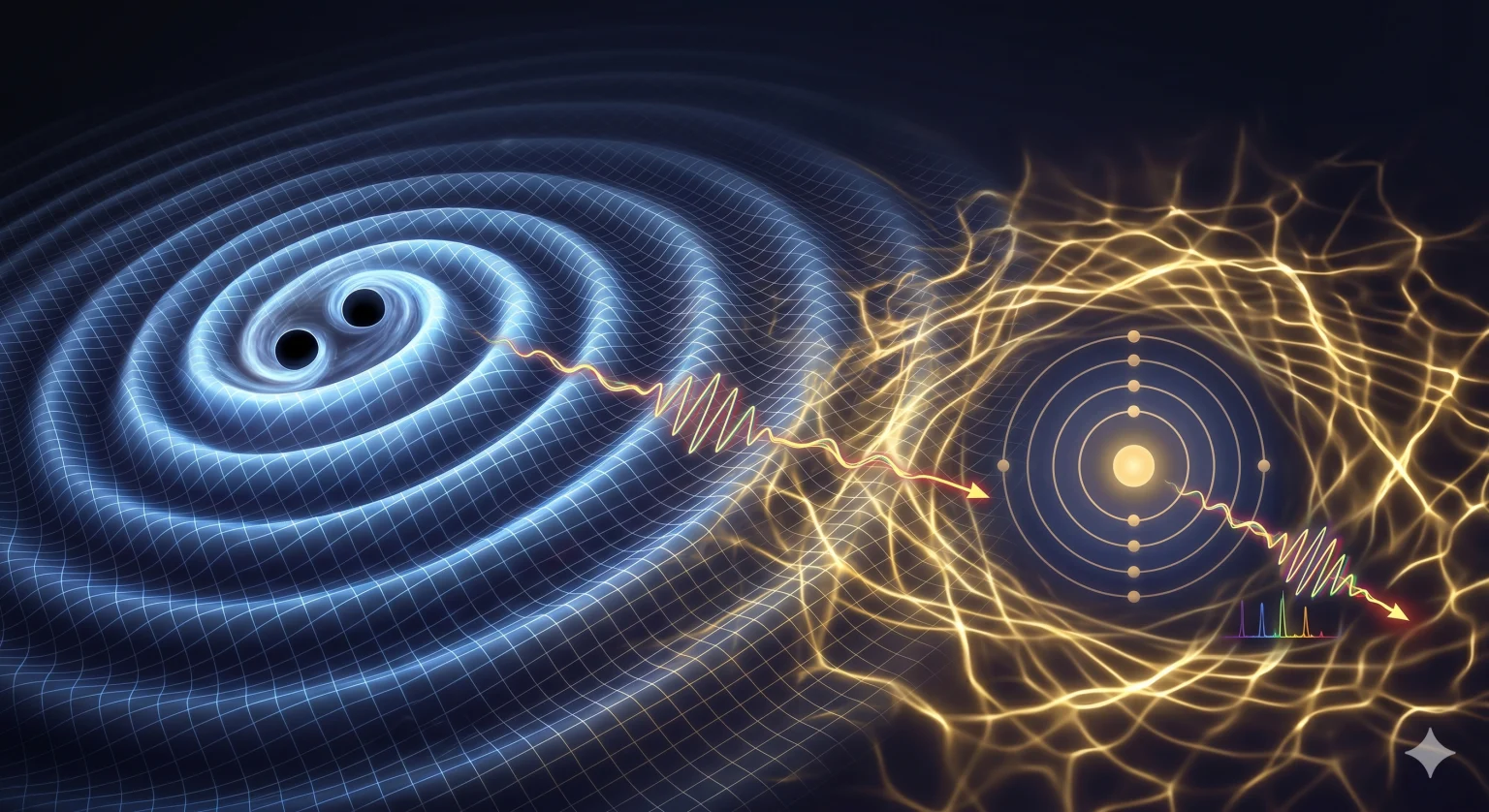
Whenever a massive system undergoes accelerated, non-spherical motion — two black holes spiraling into one another and merging being the most dramatic example — the disturbance sends ripples propagating outward through the fabric of spacetime itself. These are gravitational waves, first predicted by Einstein in 1916 and directly detected a century later by the LIGO and Virgo collaborations. These waves stretch and compress space as they pass, and to date every method of detecting them has relied on measuring that stretching: the tiny change in distance between mirrors in a kilometer-scale laser interferometer, the drift in timing of millisecond pulsars, or proposals for space-based observatories like LISA.
We have previously explored the frontier of gravitational wave science on this platform — from efforts to detect the gravitational memory effect, which would represent a permanent imprint left by passing waves on the structure of spacetime, to recent theoretical proposals for gravity control via wave resonance, which explore how gravitational wave interactions with matter might eventually be harnessed. These lines of research share a common thread: gravitational waves are not merely signals to be passively recorded — they actively reshape the physical environment through which they propagate, including the quantum fields that permeate all of space.
A new result, published in March 2026 in Physical Review Letters, now demonstrates just how deep that reshaping goes — all the way down to the quantum vacuum itself.
Gravitational Waves Modify Spontaneous Emission
In a paper titled “Gravitational Wave Imprints on Spontaneous Emission,” a team led by Jerzy Paczos and Magdalena Zych at Stockholm University, together with colleagues at Nordita and the University of Tübingen, investigated what happens to the light emitted by a single atom when a gravitational wave passes through.
Spontaneous emission — the process by which an excited atom relaxes to its ground state by emitting a photon — is one of the most fundamental processes in quantum optics. It arises from the coupling between the atom and the quantum electromagnetic vacuum: even in otherwise “empty” space, the quantum field possesses zero-point fluctuations that stimulate the atom to radiate. The precise character of that emission — its rate, its spectrum, and its angular distribution — depends on the structure of the vacuum field modes surrounding the atom.
What Paczos et al. demonstrate is that a plane gravitational wave modifies those field modes. Specifically, the GW induces a periodic phase modulation in the solutions to the Klein-Gordon equation on the curved spacetime background. This modulation, in turn, alters the spectrum of emitted photons in a direction-dependent way: the frequencies of photons emitted along certain directions shift relative to the unperturbed case, producing sidebands in the emission spectrum at high GW frequencies, or an angular frequency shift at low GW frequencies. Crucially, the effect exhibits a characteristic quadrupolar pattern — reflecting the spin-2 nature of the gravitational wave — which would allow it to be distinguished from other perturbations.
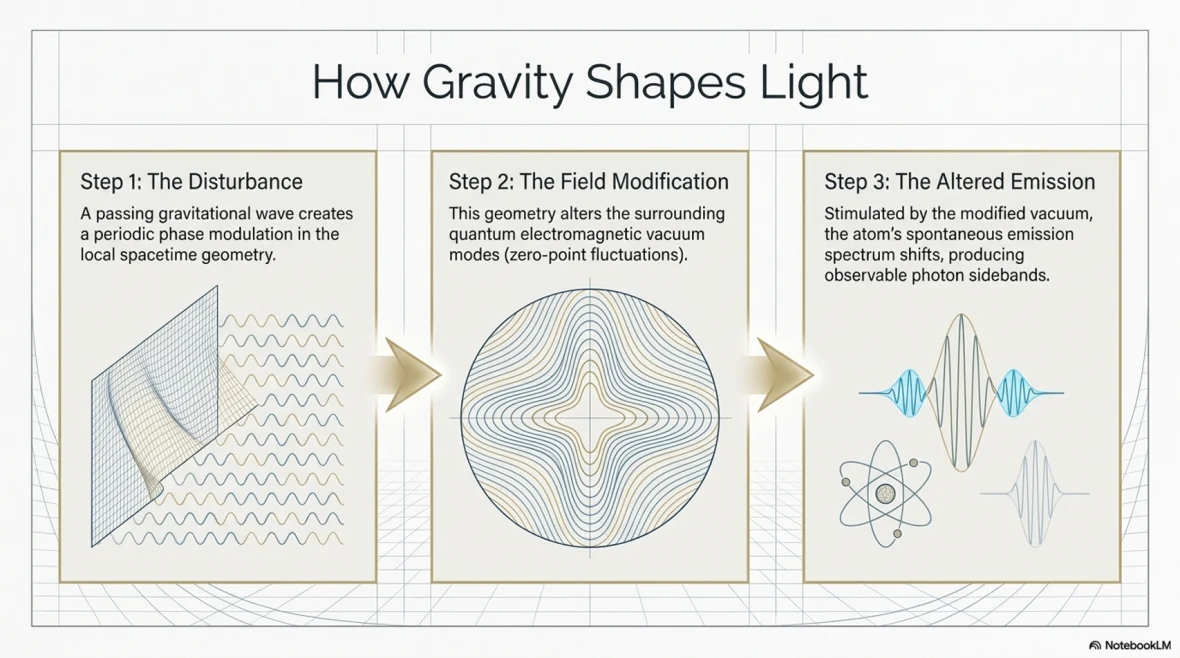
An important subtlety: the total emission rate remains unchanged. No information about the gravitational wave is stored in the atom’s internal state alone. It is the quantum field — an extended system that fills space — that encodes the gravitational wave information. The atom acts merely as a transducer, converting the field’s modified mode structure into a measurable photon signal.
Toward Compact Gravitational Wave Detectors
The team’s analysis of the Fisher information associated with this effect suggests that it could, in principle, be measured with existing cold-atom technology. For millihertz-frequency gravitational waves at the sensitivity levels targeted by LISA (amplitudes of 10⁻²⁰ to 10⁻²¹), photon number measurements from approximately 10⁶ to 10⁸ atoms would be required — numbers that are routine in modern cold-atom experiments.
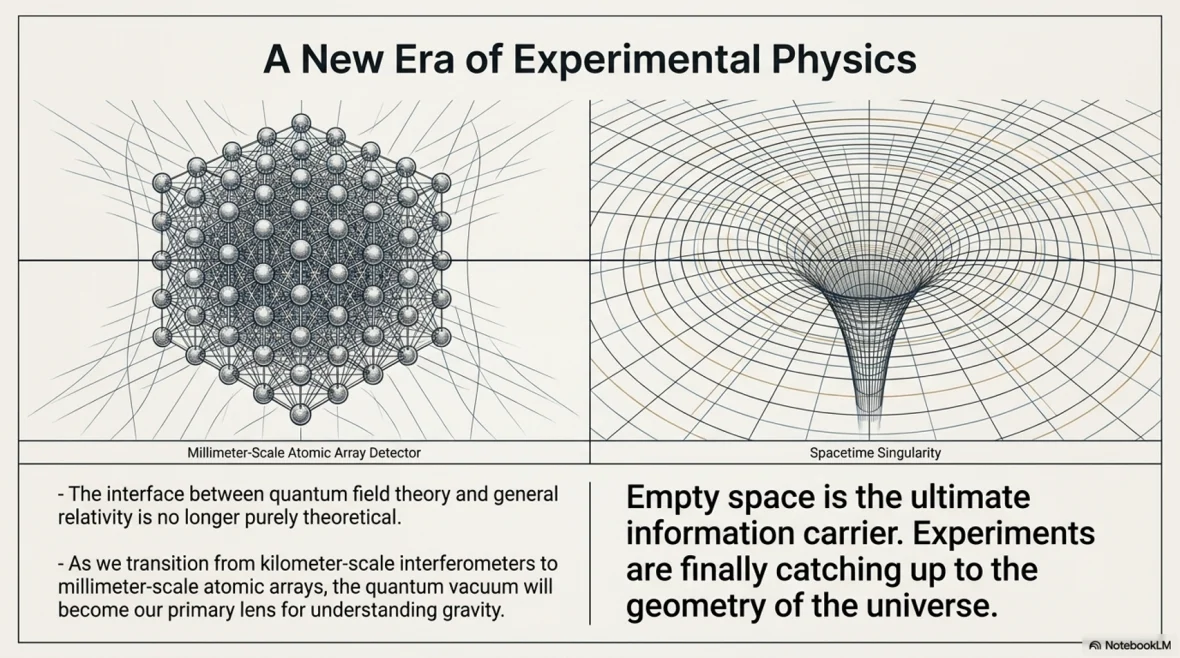
The key advantage lies in the long interaction times available with narrow-linewidth atomic transitions. The ⁸⁷Sr clock transition (¹S₀ ↔ ³P₀), used in the world’s most precise optical atomic clocks, has a natural lifetime of approximately 100 seconds — far longer than the effective interaction time in ground-based interferometers like LIGO (approximately 10⁻³ seconds). This makes atomic emission spectroscopy particularly promising for low-frequency gravitational waves, which lie beyond the reach of current ground-based detectors. As co-author Navdeep Arya noted, this opens a potential route toward compact, millimeter-scale gravitational wave sensing — a dramatic contrast with the kilometer-scale infrastructure currently required.
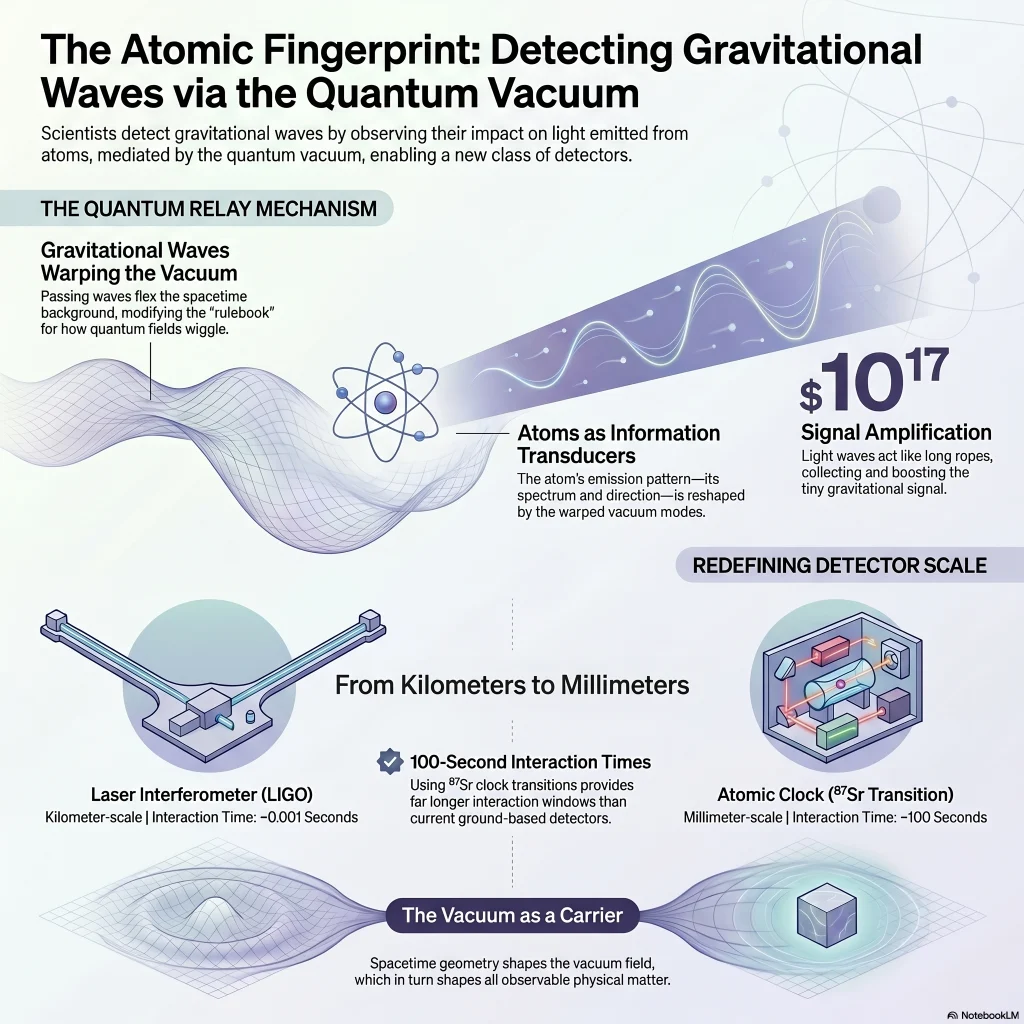
A companion preprint by Arya and Zych (arXiv:2408.12436) extends these ideas to atomic arrays, demonstrating that collective effects in ensembles of atoms could selectively amplify the gravitational wave signal — a form of GW-induced superradiance that could further enhance detection prospects.
It is important to note that this effect has not yet been experimentally demonstrated. The authors emphasize that a thorough analysis of realistic noise sources — readout noise, environmental disturbances, trap-specific noise — is essential before practical feasibility can be assessed. But the theoretical foundations are rigorous, and the numbers are encouraging.
The Core Principle: Vacuum Mode Structure Carries Physical Information
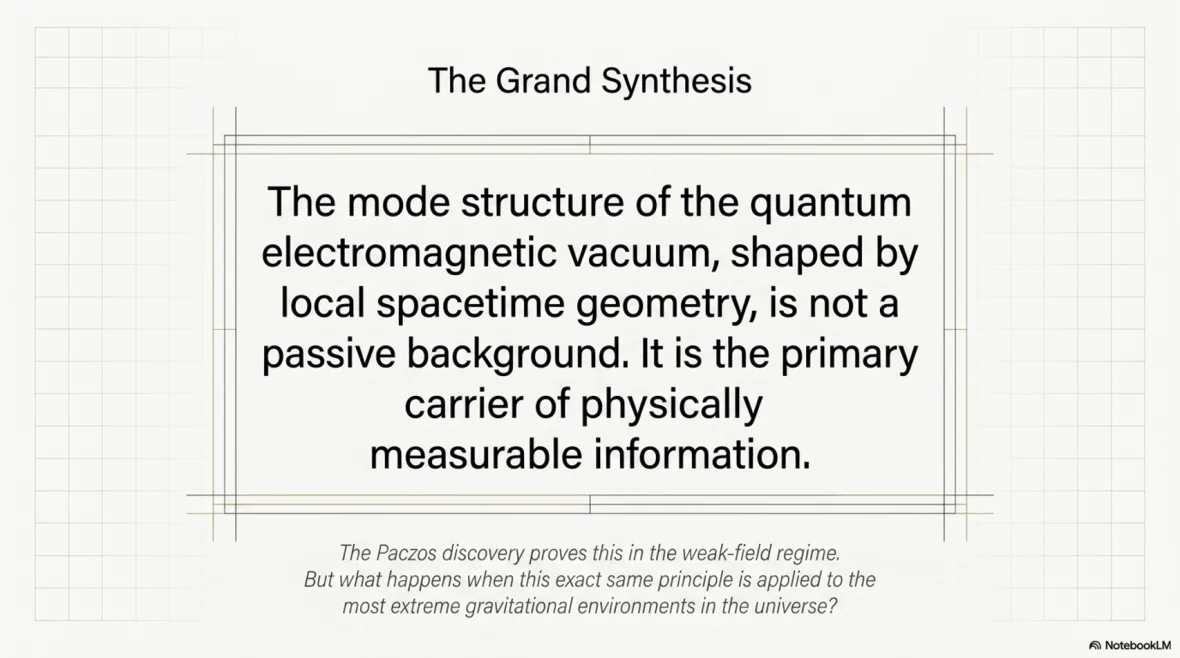
What makes the Paczos et al. result particularly significant — beyond its potential applications in gravitational wave detection — is the physical principle it demonstrates: the mode structure of the quantum electromagnetic vacuum, shaped by the local spacetime geometry, is not a passive background but the primary carrier of physically measurable information about that geometry.
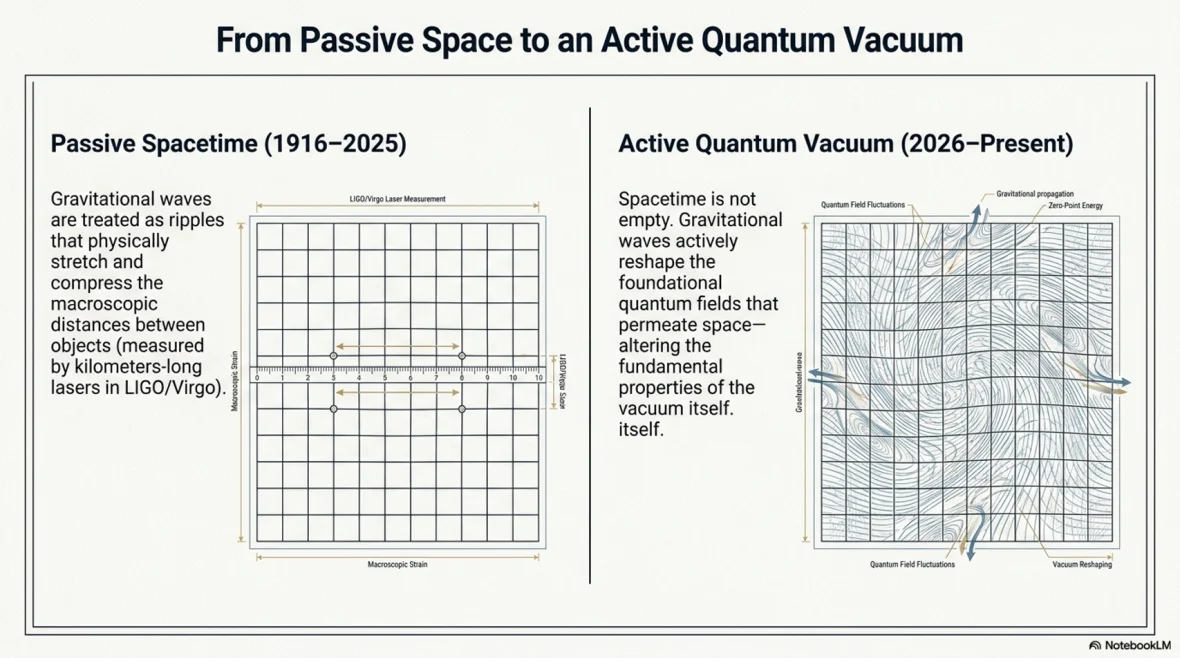
Here is another way to picture what the researchers found. Empty space is not really empty. It is filled with invisible quantum waves, a little like ripples on the surface of a pond. When a gravitational wave rolls by, it gently bends space itself, and those invisible ripples get bent along with it. The study of this and similar phenomena is called quantum field theory in curved spacetime (QFTCS) [Yang, Run-Qiu; Liu, Hui; Zhu, Shining; Luo, Le; Cai, Rong-Gen (2020). “Simulating quantum field theory in curved spacetime with quantum many-body systems”. Physical Review Research. 2 (2) 023107. arXiv:1906.01927].
At the heart of QFTCS sits something called the Klein-Gordon equation. That name sounds intimidating, but the idea behind it is simple: it is the rulebook that tells those invisible quantum ripples how they are allowed to wiggle and travel. Just as there are rules for how sound moves through air or how ripples move across a pond, the Klein-Gordon equation is the rule for how a quantum field moves through space and time. When a gravitational wave passes by and gently bends space, the rulebook still applies, but now it is being followed on a surface that is slowly flexing. The ripples that come out of this flexing rulebook carry a tiny fingerprint of the gravitational wave, and that fingerprint is what the researchers figured out how to read.
Think of it like this. Imagine a very long rope stretched across a room. If someone taps one end of the rope, a tiny wiggle starts traveling down it. Imagine that there is no damping in the rope and the natural oscillation of the rope itself feeds back into the seemingly miniscule vibration as it travels along the rope interacting with it. That wiggle is small at first, but because the rope is so long, the wiggle has lots of room to build up and become easier to see by the time it reaches the other end.
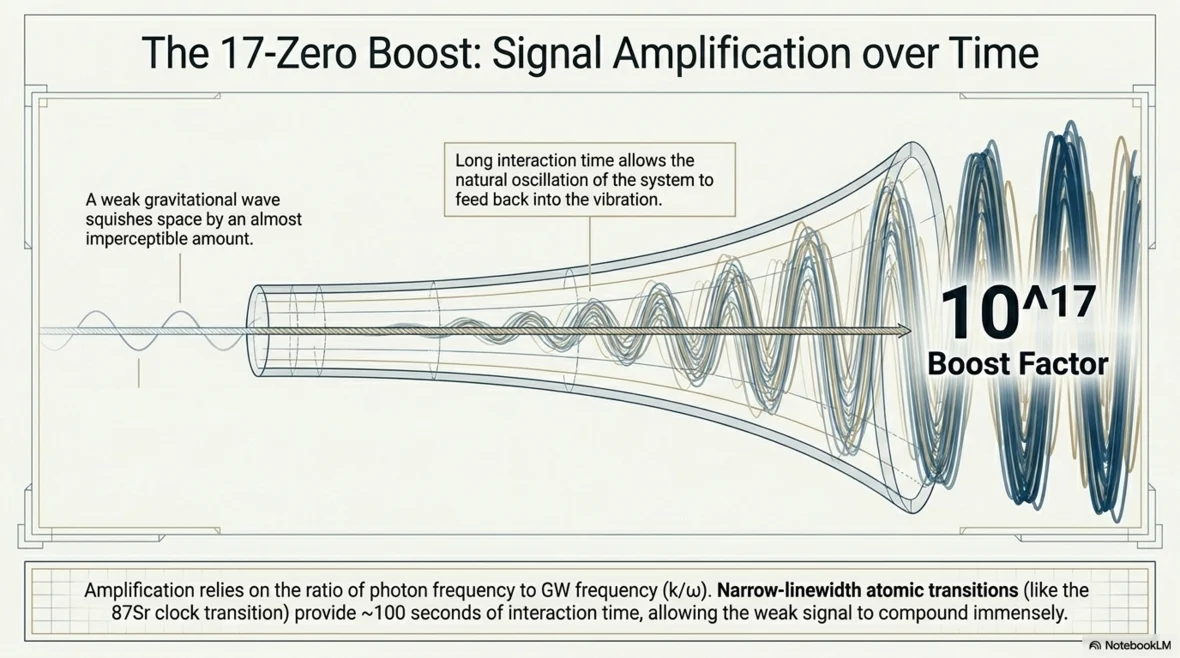
The same thing happens with light and gravitational waves. A gravitational wave is incredibly weak. It squishes space by an amount so tiny it is almost impossible to imagine. But the light waves coming out of an atom act like that long rope. They stretch across space and collect the effect of the gravitational wave along the whole way. By the time we measure the light, the signal has been boosted by a factor of about 100,000,000,000,000,000, which is a 1 followed by 17 zeros.
That huge boost is the reason scientists think they might actually be able to spot something as faint as a gravitational wave just by carefully watching the light that atoms give off.
This principle — that curved spacetime geometry modifies vacuum electromagnetic field modes, and that these modifications produce observable physical consequences — is one that resonates deeply with the theoretical framework developed by Nassim Haramein and colleagues at the International Space Federation.
Parallels with Haramein’s Vacuum Fluctuation Framework
In a preprint published in September 2025, Haramein, Alirol, and Guermonprez present a framework in which electromagnetic quantum vacuum fluctuations serve as the foundational source of mass, gravitational forces, and nuclear confinement — all emerging from the interaction between vacuum field structure and spacetime curvature, as encoded in Einstein’s field equations. The paper, “Extending Einstein-Rosen’s Geometric Vision: Vacuum Fluctuations-Induced Curvature as the Source of Mass, Gravity and Nuclear Confinement,” develops this program in considerable mathematical detail.
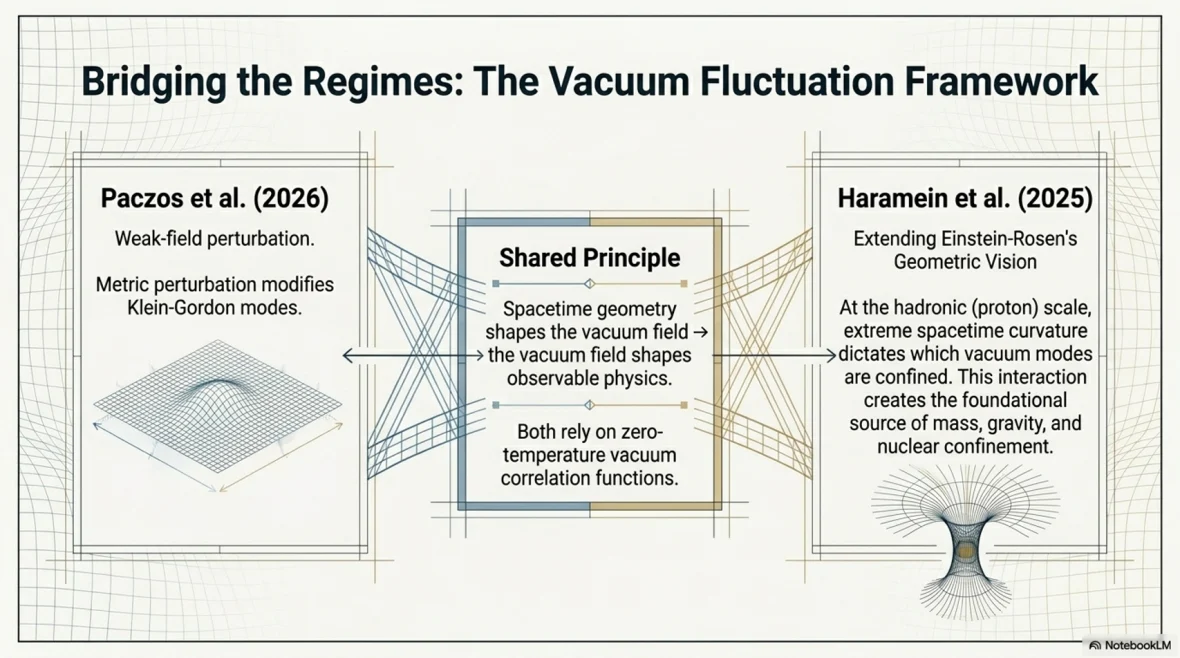
While the scope and ambition of the two papers differ significantly — Paczos et al. demonstrate a specific, experimentally testable prediction within established QFT on curved spacetimes, while Haramein et al. propose a comprehensive reconceptualization of mass and force origins — they share several foundational principles that are worth examining.
The vacuum field as the primary physical actor
In both frameworks, it is the quantum electromagnetic vacuum — not the particle or atom in isolation — that carries the essential physical information about spacetime geometry. Paczos et al. show this explicitly: the total atomic emission rate is unchanged by the GW, and no information is stored in the atom’s internal state. The GW imprint exists entirely in the field. Similarly, the Haramein et al. framework treats vacuum fluctuations as the ontological substrate from which mass-energy and forces emerge, with particles acting as resonant structures that transduce vacuum field properties into observable quantities.
Spacetime curvature modifies vacuum mode structure with measurable consequences
The Paczos result demonstrates that even a weak gravitational perturbation — a GW with amplitude 10⁻²⁰ — produces measurable changes in the vacuum field mode structure. The Haramein framework operates at the opposite extreme of curvature: at the proton scale, the vacuum energy density is posited to exceed the Schwarzschild threshold—specifying a black hole condition—and the resulting extreme curvature establishes boundary conditions that determine which vacuum modes are confined and which propagate. This is analogous to how conducting plates in the Casimir effect modify the vacuum mode spectrum.
In both cases, the essential physics is the same: spacetime geometry shapes the vacuum field, and the vacuum field shapes observable physics. The difference is one of regime — weak-field perturbation theory in one case, strong-field self-gravitating solutions in the other.
Electromagnetic-to-gravitational coupling
Both papers engage with the mechanism by which electromagnetic field energy couples to spacetime curvature. Paczos et al. work within the standard linearized gravity framework where the GW metric perturbation modifies the Klein-Gordon modes. Haramein et al. employ the Gertsenshtein-Zel’dovich-Boccaletti formalism to compute the conversion efficiency of coherent electromagnetic vacuum fluctuations into gravitational wave energy at the proton scale, deriving a screening coefficient χ = ℓ²/r²p ∼ 10⁻⁴⁰ that quantifies how the immense vacuum energy density is reduced to the observed mass-energy scale.
A noteworthy parallel: Paczos et al. find that the GW’s effect on photon statistics is amplified by the ratio k/ω (photon frequency to GW frequency), which reaches ∼10¹⁷ for optical transitions and millihertz GWs. This demonstrates that the coupling between electromagnetic modes and gravitational degrees of freedom can be enormously enhanced by scale ratios — a principle that is central to Haramein’s framework, where the ratio between Planck-scale vacuum energy and observable mass-energy is governed by geometric screening factors spanning ∼40 orders of magnitude.
Correlation functions and black-body radiation at zero temperature
A more specific parallel lies in the mathematical formalism. The Paczos et al. analysis is built on vacuum correlation functions — specifically, the Wightman function of the scalar field, which determines the spontaneous emission rate and spectrum through the coefficients βk. Haramein et al. similarly derive the proton rest mass from the correlation functions of the zero-temperature electromagnetic vacuum, finding that the energy density at the proton’s characteristic timescale τp = rp/c matches the proton rest mass energy density. Both analyses trace observable physical quantities back to the correlation structure of the quantum vacuum, modulated by the relevant spacetime geometry.
A Shared Vision, Different Scales
The Paczos et al. result does not test or validate any specific theoretical framework beyond the standard QFT-on-curved-spacetime formalism from which it is derived. But it does something important for the broader research program: it provides a clean, peer-reviewed, experimentally accessible proof of principle that the quantum vacuum field, shaped by spacetime curvature, carries physically real and measurable information — and that this information can be extracted through atomic spectroscopy.
This principle sits at the foundation of the ISF framework developed by Haramein and colleagues, which extends it to argue that vacuum field structure, modified by extreme spacetime curvature at the hadronic scale, is the origin of mass and nuclear confinement. The Paczos result demonstrates the same principle operating in the weak-field regime, at a scale where it can be tested with current laboratory technology.
As gravitational wave science expands beyond kilometer-scale interferometry and into the domain of quantum systems — cold atoms, optical clocks, atomic arrays — the interface between quantum field theory and general relativity is becoming experimentally accessible in a totally novel fashion (we have explored some of the other modalities by which QFT and GR unified phenomena can be tested like measuring Time Dilation Experiment with Atomic Clock). The question of how spacetime geometry shapes vacuum fluctuations, and how those fluctuations in turn shape the physical world, is no longer purely theoretical. It is a question that experiments may soon begin to answer.
References
J. Paczos, N. Arya, S. Qvarfort, D. Braun, and M. Zych, “Gravitational Wave Imprints on Spontaneous Emission,” Phys. Rev. Lett. 136, 113201 (2026). DOI: 10.1103/1gtr-5c2f
N. Arya and M. Zych, “Selective amplification of a gravitational wave signal using an atomic array,” arXiv:2408.12436.
N. Haramein, O. Alirol, and C. Guermonprez, “Extending Einstein-Rosen’s Geometric Vision: Vacuum Fluctuations-Induced Curvature as the Source of Mass, Gravity and Nuclear Confinement,” Preprints.org (2025). DOI: 10.20944/preprints202509.1835.v1
Yang, Run-Qiu; Liu, Hui; Zhu, Shining; Luo, Le; Cai, Rong-Gen (2020). “Simulating quantum field theory in curved spacetime with quantum many-body systems”. Physical Review Research. 2 (2) 023107. arXiv:1906.01927