

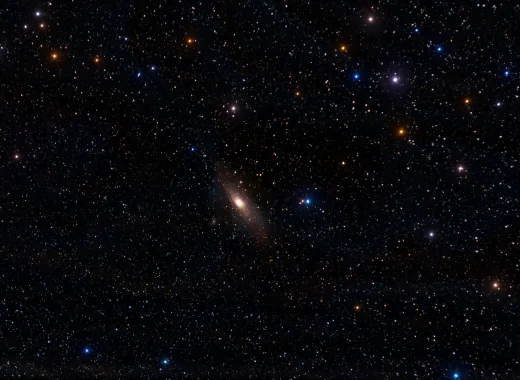
A galaxy cluster is a gravitationally bound system consisting of hundreds or even thousands of galaxies along with plasma and dark mass. Galaxy clusters serve as a crucial component when it comes to understanding the structure and evolution of our universe. Some of the notable clusters in the adjacent universe include the Virgo cluster, the Hercules cluster, and the Coma cluster. A commonality between all the known galaxy clusters is the fact that they are all governed by the laws of standard cosmology otherwise dubbed as the Lambda-cold dark matter model (ΛCDM).
A recent study published in the Astrophysical Journal suggests a departure from the standard cosmological model [1]. One of the key facets of the ΛCDM model tells us that before becoming phenomenal galaxy clusters, there is primarily the formation of individual galaxies. In other words, when we look back at the history of the universe, the appearance of galaxy clusters should be visible at a much later stage in the timeline. However, the latest work shows that when the universe was about half its current age, two clusters jammed together at a high speed. This event occurred too early considering the theoretical analysis.
This galaxy cluster named “El Gordo”, a Spanish honorific (“the Fat One” in English), is humongous and has a mass of more than 2000 trillion times that of our Sun. The latest study provides a renewed estimate of its material content. In the present case, when light from distant stars and galaxies approaches a cluster such as El Gordo, it gets distorted due to the cluster’s gravitational field. This phenomenon is termed weak lensing, and the researchers employed this method to account for the cluster’s mass. An earlier study demonstrated a significant uncertainty in the mass but thanks to the present results, originally obtained using the Hubble space telescope but which also agrees with JWST data, the uncertainty has boiled down to just about 10%.
The effects of foreground galaxy cluster mass on background galaxy shapes. The upper left panel shows (projected onto the plane of the sky) the shapes of cluster members (in yellow) and background galaxies (in white), ignoring the effects of weak lensing. The lower right panel shows this same scenario but includes the effects of lensing. The middle panel shows a 3D representation of the positions of cluster and source galaxies, relative to the observer. Note that the background galaxies appear stretched tangentially around the cluster. Image and Description: Wikipedia
One of the tools employed by the research team to arrive at the results included lightcone tomography according to which when we study distant objects in the universe, we are essentially looking at the light emitted by those objects at an incredibly early stage in the cosmic timeline when the universe was young and developing. The method allows researchers to determine sequentially the development of various cosmic objects by analysing their evolution through different points in time.
The precocious collision of the galaxy cluster El Gordo is essentially at odds with the ΛCDM model. The lead author of the work remarks, “While our earlier findings faced skepticism due to an updated mass estimation of El Gordo, the discrepancies with ΛCDM remain significant. Hundreds of simulations affirm that the observed high-speed collision of El Gordo is implausible under the ΛCDM model.”
Alike El Gordo, there are several other instances to show that the standard cosmological model is filled with inconsistencies and requires modification or perhaps even a replacement with a new model that could do justice to all the cosmological phenomena. One of the instances is that of the Bullet cluster and measurements show that its collision velocity is quite high and although it occurred at a later epoch than El Gordo it still is incompatible with the predictions of ΛCDM model [2]. Furthermore, the latest JWST results have revealed that the rate of formation of individual galaxies is much faster than that predicted by the ΛCDM model. The standard cosmological ΛCDM model provides a reasonable account of some of the cosmic properties such as structure of CMB, abundances of elements like hydrogen and helium, and large-scale structure formation in the entire universe. However, when examining the current findings filled with notable irregularities, it appears that placing complete trust in the ΛCDM model may not be warranted. Does this signify the ultimate demise of the ΛCDM model? Future work will hopefully provide a conclusive answer.
 This Hubble/JWST composite view of the El Gordo galaxy cluster highlights brighter objects (top) and shows which objects have been spectroscopically confirmed, while the lower image (bottom) highlights fainter objects and shows which objects only appear to JWST’s eyes and were invisible to Hubble. Image Credit: J.M. Diego et al. (PEARLS Collaboration), A&A, 2023. Description credit: Big Think
Highlights:
One of the important things that the latest findings have done is to put a serious question mark on the validity of the standard cosmological model or ΛCDM. Considering this scenario, one thing is certain and that is we cannot bet on ΛCDM for all cosmological phenomena. Given the massive number of anomalies found against the model alongside the brand new El Gordo findings, probing alternative theories describing the nature and evolution of universe become a necessity.
Amid this chaos within standard cosmology, the work of physicist Nassim Haramein comes out quite remarkably. He had published a paper on vacuum catastrophe which also dealt with problems related to cosmology such as realizing that the genesis of matter in the universe complies with the varying cosmic mass-energy density [3]. Interestingly, Haramein along with RSF scientists Olivier Alirol and Cyprien Guermonprez are soon coming up with a new review paper focusing on the origin of matter & the nature of gravity.
Furthermore, theories propounded by Nassim Haramein have revealed many interesting features about the formation and evolution of galaxies. Our article discusses this work and shows the importance of Active Galactic Nuclei (AGN) feedback on sculpting the evolution and development of galaxies [4]. The latest empirical results from the JWST are largely in agreement with the predictions of Haramein’s theories and this leads us to a very important conclusion: A coherent model of cosmology should consider the predictions and results emanating from Nassim Haramein’s theories.
References
[1] Elena Asencio et al, “The El Gordo Galaxy Cluster Challenges ΛCDM for Any Plausible Collision Velocity”, The Astrophysical Journal (2023). DOI: 10.3847/1538-4357/ace62a
[2] Lee, Jounghun; Komatsu, Eiichiro. “Bullet Cluster: A Challenge to LCDM Cosmology”. Astrophysical Journal (2010). DOI: 10.1088/0004-637X/718/1/60
[3] Haramein, N & Val Baker, A. K. F. “Resolving the Vacuum Catastrophe: A Generalized Holographic Approach”, Journal of High Energy Physics, Gravitation and Cosmology, Vol. 05 No. 02 (2019).
[4] Ines Urdaneta, Amal Pushp, and William Brown. “Galactic Engines”. Resonance Science Foundation https://www.resonancescience.org/blog/galacticengines