
By using this site, you agree to the Privacy Policy.
Accept
The International Space Federation (ISF)The International Space Federation (ISF)The International Space Federation (ISF)
  • Science News
    • All Articles
    • Physics
    • Astronomy
    • Biology
    • Technology
    • Other
  • Research
    • Research Papers
    • Physicists Testimonials
  • Technology
  • About
    • About us
  • ISF News
  • Events
    • Events
  • Get Involved
    • Invest
    • Donate – Zero Point Foundation
  • Careers
  • Contact Us
Reading: Beyond Science Fiction! Extracting Energy from Black Holes
Share
The International Space Federation (ISF)The International Space Federation (ISF)
Search
  • Science News
    • Physics
    • Astronomy
    • Biology
    • Technology
  • Research Papers
    • Physicists Testimonials
  • About
    • ISF News
  • Events
  • Get involved
    • Invest
  • Translations
    online pharmacy https://worldneurologyonline.com/ no prescription pharmacy
Follow US
© 2022 International Space Federation. All Rights Reserved.
The International Space Federation (ISF) / Explore / Astronomy / Beyond Science Fiction! Extracting Energy from Black Holes
Astronomy

Beyond Science Fiction! Extracting Energy from Black Holes

In 1969, Roger Penrose proposed a method to extract rotational energy of a rotating black hole, and suggested that an advanced civilization could achieve it by lowering and then releasing a mass from a structure that is co-rotating with the black hole.

Dr. Inés Urdaneta
Last updated: 2026/02/19 at 5:07 PM
Dr. Inés Urdaneta
Share
5 Min Read
SHARE

In 1969, Roger Penrose proposed a method to extract rotational energy of a rotating black hole, and suggested that an advanced civilization could achieve it by lowering and then releasing a mass from a structure that is co-rotating with the black hole. The process would occur in the region just outside the event horizon, called the ergosphere, where frame-dragging is at its strongest, being able to tear apart an object; one part would enter the event horizon while the remaining one would be accelerated outwards with an additional impulse given by the rotational energy of the black hole. The excess energy calculated by Penrose was estimated to be 21 percent more than the incoming energy.


The process is brilliantly explained in this video:

Inspired by Penrose’s idea, Yakov Zel’dovich predicted in 1971 that quantum fluctuations and classical electromagnetic waves reflected from a rotating absorbing cylinder would gain energy and be amplified. Though the concept is key to understanding that black holes may amplify quantum fluctuations, it could not be verified experimentally since the cylinder rotation rate must be larger than the incoming wave frequency, making it very challenging when using electromagnetic waves.

However,  these conditions can be satisfied with acoustic waves, as the team of physicists from the University of Glasgow’s School of Physics and Astronomy in Scotland showed by devising an experiment based on Zel’dovich’s work in which instead of using light waves, they used sound waves. The experimental set-up consisted on a ring of speakers and tubes that guide the sound directly onto a rotating foam disk. The ring of speakers was set up to introduce a twist in the sound waves, analogous to the twisted light in Zel’dovich’s experiment. Here, the ‘black hole’ is the rotating sound absorber made from a foam disc. On the other side of the disc, an array of microphones would detect the sound waves after they had passed through the disc; the shift in pitch and amplitude in the sound waves that passed through the disc would verify the Penrose process.

In these experiments they show that low-frequency acoustic modes with orbital angular momentum (OAM) are transmitted through the absorbing rotating disk and amplified by up to 30% or more when the disk rotation rate satisfies the Zel’dovich condition for amplification (from an absorbing, rotating body), which depends on 1) the incident wave frequency ω, 2) the order l of the OAM, and 3) the rotation rate Ω of the absorber. When the condition ω- l Ω < 0 is satisfied, the absorption changes sign and the rotating medium acts as an amplifier. Outgoing waves then have an increased amplitude and therefore, they extracted energy from the rotational energy of the body, just like Penrose’s proposal.

As the authors of this study say, “These experiments address an outstanding problem in fundamental physics and have implications for future research into the extraction of energy from rotating systems”. With this brilliant experiment, Penrose’s prediction of an advanced civilization capable of extracting energy from Black holes, no longer seems science fiction! 


Highlights:


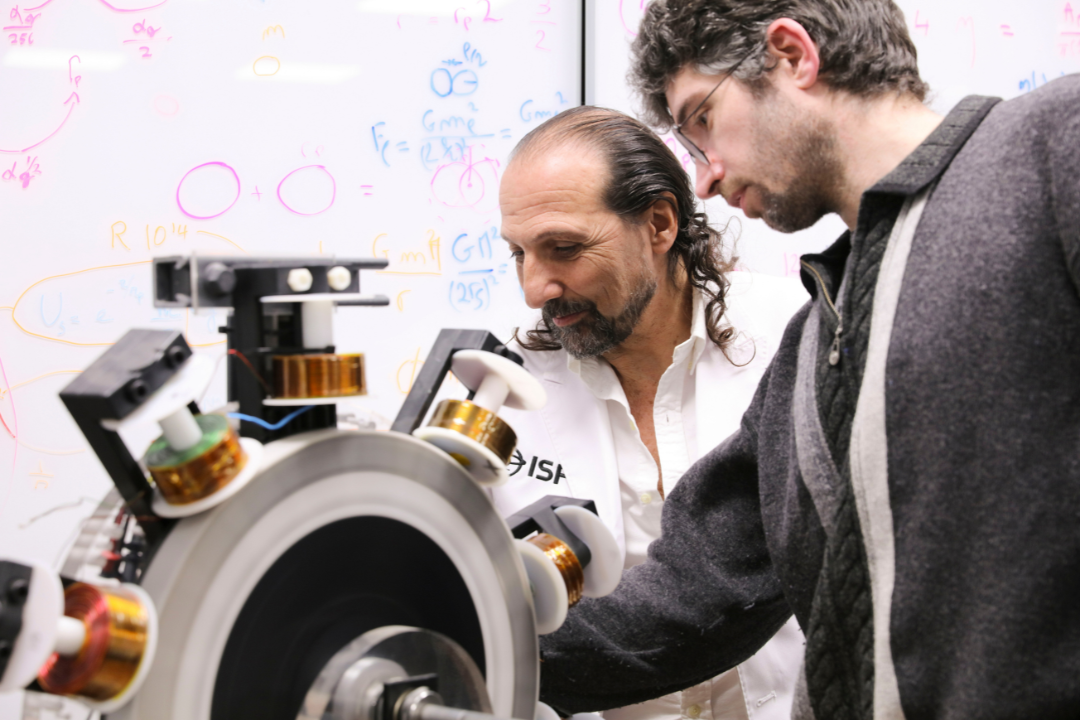
This brilliant experiment describes a mechanism analogous to the one Nassim Haramein used to design his Harmonic Flux Resonator (HFR), in which the rotation of electromagnetic fields would create a density gradient that allows interaction or coupling with the quantum vacuum. Based on the hypothesis that space is a superfluid, the HFR is a magneto-hydrodynamic device that has managed to generate a certain amount of coherent gradient in a localized region of space, producing gravitational effects, among other remarkable qualities.


This study, together with Haramein’s work, recalls Dr. Eugene Podkletnov’s experiments and the gravitational effects encountered using rotating superconducting discs. This empirical evidence for a device that can modify a localized gravitational field through spin, came from his team in 1992, and the results on gravitationally induced weight reduction were published in an article in Journal Physica C: Superconductivity. The effect was produced by a superconducting ceramic disk cooled below 77 degrees Kelvin, which levitated when spun at approximately 5000 rpm.


More at:
https://www.nature.com/articles/s41567-020-0944-3

https://www.sciencealert.com/an-experiment-has-just-demonstrated-how-energy-could-be-extracted-from-a-black-hole

Learn more in our free Unified Science Course

Sign Up For Daily Newsletter

Be keep up! Get the latest breaking news delivered straight to your inbox.
loader

loader

loader

By signing up, you acknowledge the data practices in our Privacy Policy. You may unsubscribe at any time.
En vous inscrivant, vous reconnaissez les pratiques en matière de données dans notre politique de confidentialité. Vous pouvez vous désinscrire à n'importe quel moment.
Al registrarse, reconoce las prácticas de datos en nuestra política de privacidad. Puedes darte de baja en cualquier momento.
Share This Article
Facebook Twitter Copy Link Print
By Dr. Inés Urdaneta
Dr. Inés Urdaneta is a multi-published research physicist in the domain of light-matter interaction at the atomic, molecular, and nano/solid-state scales. In her more than 20 years of research she participated in national and international research projects throughout France, USA, México and Venezuela, on an extensive variety of topics. At present, as part of our research staff at the International Space Federation, Inés focuses on developing physical-chemical models in the frame of the generalized holographic model (GHM) and unification theory developed by Nassim Haramein, together with quantum information processes and their connection to black holes and to proto-consciousness.
Previous Article Quantum Computing via Electroluminescence
Next Article Blue And Green Colors On Nature Are More Intense … Why?

Stay Connected

981k Like
18.7k Follow
7.7k Follow
7.3k Subscribe

Categories

  • Astronomy106
  • Biology69
  • ISF News25
  • ISF Research14
  • Other22
  • Physics169
  • Technology36

You Might also Like

Astronomy

The Rotating Universe: Radio Galaxies and the Cosmic Dipole Anomaly

22. December 2025.
Astronomy

“Black Hole Stars” Detected at Cosmic Dawn

23. October 2025.
Astronomy

New Evidence Points to a Compact Object at the Sun’s Core

5. August 2025.
Astronomy

Image Reveals Coherently Ordered Spiral Vortex Around Milky Way’s Supermassive Black Hole

24. June 2024.
The International Space Federation (ISF)The International Space Federation (ISF)

Harnessing quantum vacuum energy for sustainable solutions – a unified approach to science, technology and education.

Quick links

  • About
  • Research Papers
  • Events
  • Invest

Explore

  • ISF Research
  • Physics
  • Technology
  • Astronomy
  • Biology
  • ISF News

Sign Up for Our Newsletter

Subscribe to our newsletter to get our newest articles instantly!

loader

Follow US
© 2023 International Space Federation. All Rights Reserved. INTERNATIONAL SPACE FEDERATION is a trademark of ISFS SA. The mark is registered in the United States under Registration No. 7772313. The ®️ symbol is used exclusively in the U.S.
  • Press
  • Careers
  • Privacy policy
  • Carrieres
  • Presse
  • Prensa
Join Us!

Subscribe to our newsletter and never miss our latest news.

loader

Welcome Back!

Sign in to your account

Lost your password?