

Black holes are exotic creatures, mainly classified in two types according to their size: stellar black holes (up to tenths of solar masses) and supermassive black holes (billions of solar masses). We commonly used to believe that, independent of their size, black holes all share the same feature: they devour everything getting too close and entering their event horizon.
The Mystery of Star Formation in Galaxy Clusters
For decades, astronomers have looked for galaxy clusters containing rich nurseries of stars in their central galaxies. Instead, they found powerful, giant black holes bursting out energy through jets of high-energy particles. Extremely hot particles emanating from these black holes were found to be preventing the formation of stars. So where are all the stars coming from?
Theories Behind Star Formation Near Supermassive Black Holes
The leading theories have proposed two mechanism to elucidate this mystery. One concerns the possibility of having less effective black holes that could allow star formation, and the second one concerns the possibility that the star formation happens by “accident” in the accretion disk of the black hole.
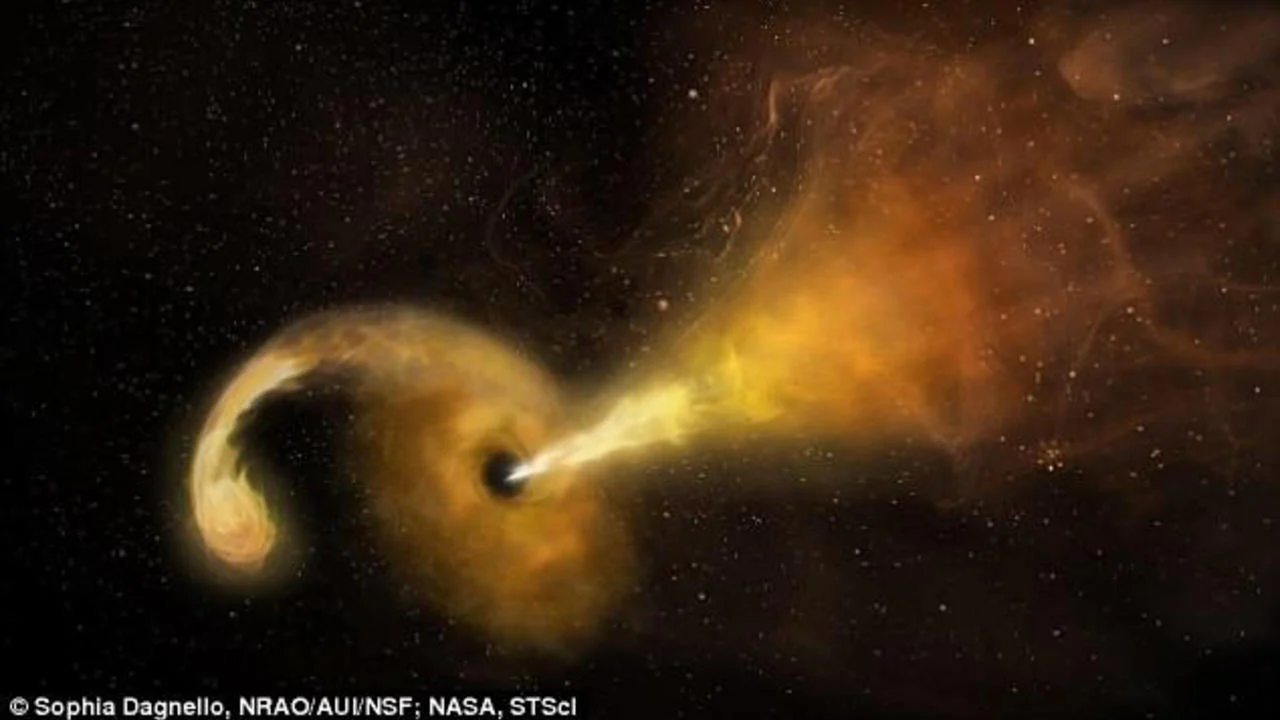
With respect to the second theory, since 2017 a team of astrophysicists have been observing supermassive black holes and the possibility that these entities could be birthing stars. By observing the collision of two galaxies some 600 million light-years away (each with a supermassive black hole at its center) through the Very Large Telescope (VLT) in Chile, they found evidence of new star birth from material being ejected from the black hole, called an outflow.
An outflow of gas could be responsible for creating new stars by swirling around the center of the black hole, in something called an accretion disc. In this region, gases are heated to incredible temperatures and then are rapidly ejected into space, so astronomers believe that some of the material might be flung out of the galaxy altogether. The newly discovered stars are much larger than our own sun: about 10 times more, and up to 40 or 50 solar masses.
This could change quite drastically our understanding of galaxy formation evolution
Maiolino on CBC News
With respect to the first possibility, scientists have compelling evidence for a galaxy cluster where stars are forming at a furious rate, apparently linked to a less effective black hole in its center. This has been very recently confirmed with new observations in this unique cluster located about 5.8 billion light years from Earth in the Phoenix Constellation, where the jets from the central black hole instead appear to be aiding in the formation of stars. The black hole is in the center of a galaxy cluster called the Phoenix Cluster, and the large galaxy hosting the black hole is surrounded by hot gas with temperatures of millions of degrees. The mass of this gas, equivalent to trillions of suns, is several times greater than the combined mass of all the galaxies in the cluster. This hot gas loses energy as it glows in X-rays, which should cause it to cool until it can form large numbers of stars.
New Insights from Recent Observations
Now, the authors of this research [1] claim that, in this particular cluster, the black hole burst is not as strong as in all other observed galaxy clusters, where the bursts of energy driven by such a black hole keeps most of the hot gas from cooling, preventing widespread star birth.
Evidence for rapid star formation in the Phoenix Cluster was previously reported in 2012 by a team led by McDonald. But deeper observations were required to learn details about the central black hole’s role in the rebirth of stars in the central galaxy, and how that might change in the future. By combining long observations in X-ray, optical, and radio light, the researchers gained a ten-fold improvement in the data quality compared to previous observations. The new Chandra data reveals that hot gas is cooling nearly at the rate expected in the absence of energy injected by a black hole. The new Hubble data shows that about 10 billion solar masses of cool gas are located along filaments leading towards the black hole, and young stars are forming from this cool gas at a rate of about 500 solar masses per year. By comparison, stars are forming in the Milky Way galaxy at a rate of about one solar mass per year.
We are witnessing a huge step forward in our understanding of the evolution of stars, galaxies, and the universe!
Unified Science in Perspective
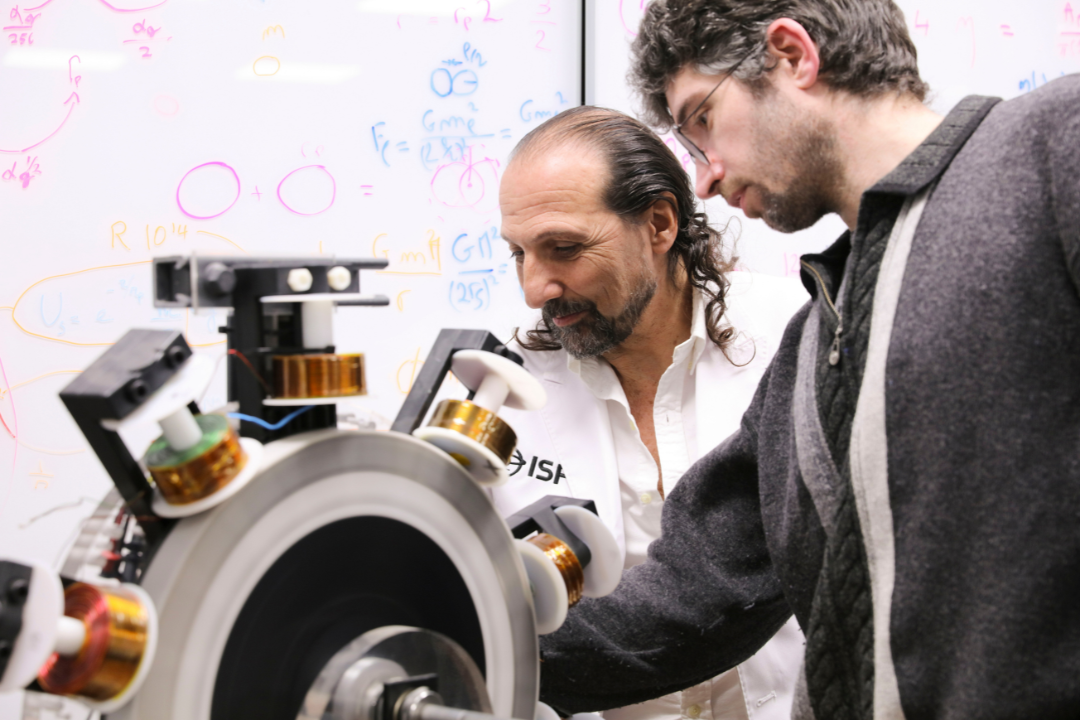
Nassim Haramein’s Generalized Holographic Theory has been predicting that matter production and star formation result from spin dynamics in the vacuum structure near the horizons of black holes. The spin dynamics result from the inclusion of torque and Coriolis forces in Einstein’s field equations and the Kerr-Newman solution—termed the Haramein-Rauscher solution—which describes the dynamical rotational structures of galaxies, novae, supernovae, and other astrophysical structures as driven by a spacetime torque, which is also responsible for the observed formation of spiral galaxies. The model is consistent with galactic structures having a super-massive black hole at their centers, as well as polar jets, accretion disks, spiral arms and galactic halo formations [2].
The new discoveries presented in this article support the mechanism proposed by Haramein’s holographic theory, where everything from protons, to stars, and even our universe obey the condition of a black hole [3]. The leading understanding on black holes is evolving and getting closer to Nassim Haramein’s perspective!
References
[1] M. McDonald et al (2019) Anatomy of a Cooling Flow: The Feedback Response to Pure Cooling in the Core of the Phoenix Cluster, ApJ 885 63 DOI 10.3847/1538-4357/ab464c
[2] Haramein, N., and Rauscher, E. A. (2005). The orgin of spin: A consideration of torque and coriolis forces in Einstein’s field equations and grand unification theory. Beyond The Standard Model: Searching for Unity in Physics, 1, 153-168
[3] Haramein, N., Rauscher, E.A., and Hyson, M. (2008). Scale unification: a universal scaling law. Proceedings of the Unified Theories Conference. ISBN 9780967868776