
By using this site, you agree to the Privacy Policy.
Accept
The International Space Federation (ISF)The International Space Federation (ISF)The International Space Federation (ISF)
  • Science News
    • All Articles
    • Physics
    • Astronomy
    • Biology
    • Technology
    • Other
  • Research
    • Research Papers
    • Physicists Testimonials
  • Technology
  • About
    • About us
  • ISF News
  • Events
    • Events
  • Get Involved
    • Invest
    • Donate – Zero Point Foundation
  • Careers
  • Contact Us
Reading: Fractal Pattern in a Quantum Material Confirmed for the First Time!
Share
The International Space Federation (ISF)The International Space Federation (ISF)
Search
  • Science News
    • Physics
    • Astronomy
    • Biology
    • Technology
  • Research Papers
    • Physicists Testimonials
  • About
    • ISF News
  • Events
  • Get involved
    • Invest
  • Translations
    online pharmacy https://worldneurologyonline.com/ no prescription pharmacy
    • Français
Follow US
© 2022 International Space Federation. All Rights Reserved.
The International Space Federation (ISF) / Explore / Physics / Fractal Pattern in a Quantum Material Confirmed for the First Time!
Physics

Fractal Pattern in a Quantum Material Confirmed for the First Time!

The word fractal has become increasingly popular, although the concept started more than two centuries ago in the 17th century with prominent and prolific mathematician and philosopher Gottfried Wilhelm Leibnitz.

Dr. Inés Urdaneta
Last updated: 2025/02/17 at 1:25 AM
Dr. Inés Urdaneta
Share
5 Min Read
SHARE

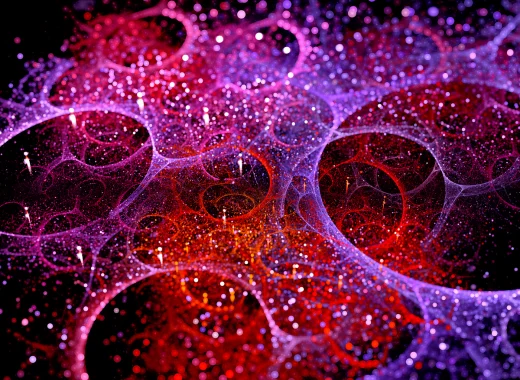
The word fractal has become increasingly popular, although the concept started more than two centuries ago in the 17th century with prominent and prolific mathematician and philosopher Gottfried Wilhelm Leibnitz. Leibnitz is believed to have addressed for the first time the notion of recursive self-similarity, and it wasn’t until 1960 that the concept was formally stabilized both theoretically and practically, through the mathematical development and computerized visualizations by Benoit Mandelbrot, who settled on the name “fractal”.

Fractals are defined mainly by three characteristics:

  1. Self-similarity: identical or very similar shapes and forms at all scales.
  2. Iteration: a recursive relationship limited only by computer capacity. With sufficiently high performance, the iterations could be infinite. This allows for very detailed shapes at every scale, that modify with respect to the first iteration, manifesting the original shape at some levels of iteration. Because of this, fractals may have emergent properties, which make them a suitable tool for complex systems.
  3. Fractal dimension, or fractional dimensions: describes the counter-intuitive notion that a measured length changes with the length of the measuring stick used; it quantifies how the number of scaled measuring sticks required to measure, for example, a coastline, changes with the scale applied to the stick.


The fractal dimension of a curve can be explained intuitively thinking of a fractal line as an object too detailed to be one-dimensional, but too simple to be two-dimensional. [1]

Fractals in the Quantum Realm: A New Discovery

Although fractals now-a-days are commonly used for the macroscopic regime such as the branches of a tree, a broccoli, blood vessels and many others, for the first time physicists at MIT have discovered fractal-like patterns in a quantum material. The material is neodymium nickel oxide or NdNiO3, a rare earth nickelate that conduces electricity or acts as an insulator, depending on its temperature. It also presents inhomogeneous magnetism: domains or regions with a specific magnetic orientation that vary in size and shape throughout the material. The material exhibits this peculiar electronic and magnetic behavior as a result of quantum, atomic-scale effects, and for this reason it is called a quantum material.

The researchers had to design a very special X-ray-focusing lens in order to map the size, shape, and orientation of magnetic domains point by point at different temperatures, confirming that the material formed magnetic domains below a certain critical temperature. Above this temperature, the domains disappeared erasing the magnetic order. Nevertheless, if they cooled the sample back to below the critical temperature, the magnetic domains reappeared almost in the same place as before! This means that the system has memory, which was very unexpected. One could have a system robust against external perturbations, even if subjected to heat, such that the information is not lost.

Secondly, after mapping the material’s magnetic domains and measuring the size of each domain, the researchers counted the number of domains of a given size and plotted their number as a function of size. The resulting distribution showed the same pattern again and again, no matter what range of domain size they focused on. They found that these magnetic patterns have a fractal nature!

___________________________________

“It was completely unexpected — it was serendipity.”
– Riccardo Comin, Assistant Professor of Physics at MIT.

Implications of Fractality in Quantum Materials

Because the material acts as an insulator or conductor depending on the temperature, scientists are exploring neodymium nickel oxide for neuromorphic devices — devices that mimic biological neurons. Here, temperature would play the role of voltage in the biological system, which is active or inactive depending on the voltage that it receives. Another potential application is resilient, magnetic data storage devices.

The results have been published recently in the journal Nature Communications.


[1] David Harte, Multifractals. Chapman & Hall. pp. 3–4. ISBN 978-1-58488-154-4.

Sign Up For Daily Newsletter

Be keep up! Get the latest breaking news delivered straight to your inbox.
loader

loader

loader

By signing up, you acknowledge the data practices in our Privacy Policy. You may unsubscribe at any time.
En vous inscrivant, vous reconnaissez les pratiques en matière de données dans notre politique de confidentialité. Vous pouvez vous désinscrire à n'importe quel moment.
Al registrarse, reconoce las prácticas de datos en nuestra política de privacidad. Puedes darte de baja en cualquier momento.
Share This Article
Facebook Twitter Copy Link Print
By Dr. Inés Urdaneta
Dr. Inés Urdaneta is a multi-published research physicist in the domain of light-matter interaction at the atomic, molecular, and nano/solid-state scales. In her more than 20 years of research she participated in national and international research projects throughout France, USA, México and Venezuela, on an extensive variety of topics. At present, as part of our research staff at the International Space Federation, Inés focuses on developing physical-chemical models in the frame of the generalized holographic model (GHM) and unification theory developed by Nassim Haramein, together with quantum information processes and their connection to black holes and to proto-consciousness.
Previous Article Sound has Mass and thus, Gravity?
Next Article Artificial Intelligence Meets Quantum Physics

Stay Connected

981k Like
18.7k Follow
7.7k Follow
7.3k Subscribe

Categories

  • Astronomy106
  • Biology69
  • ISF News25
  • ISF Research14
  • Other22
  • Physics168
  • Technology36

You Might also Like

Physics

Gravitational Waves Leave Their Mark on Atomic Light: A New Window into Vacuum Field Physics

22. April 2026.
BiologyPhysics

Do Cells Use a Quantum Compass to Heal Wounds?

2. December 2025.
Physics

Space-Memory Experiments: Quantum Memory Matrix Results Explained

3. October 2025.
Physics

From Bit to Quanta: New Theory Links Entanglement to Particle Creation

17. September 2025.
The International Space Federation (ISF)The International Space Federation (ISF)

Harnessing quantum vacuum energy for sustainable solutions – a unified approach to science, technology and education.

Quick links

  • About
  • Research Papers
  • Events
  • Invest

Explore

  • ISF Research
  • Physics
  • Technology
  • Astronomy
  • Biology
  • ISF News

Sign Up for Our Newsletter

Subscribe to our newsletter to get our newest articles instantly!

loader

  • Français
Follow US
© 2023 International Space Federation. All Rights Reserved. INTERNATIONAL SPACE FEDERATION is a trademark of ISFS SA. The mark is registered in the United States under Registration No. 7772313. The ®️ symbol is used exclusively in the U.S.
  • Press
  • Careers
  • Privacy policy
  • Carrieres
  • Presse
  • Prensa
Join Us!

Subscribe to our newsletter and never miss our latest news.

loader

Welcome Back!

Sign in to your account

Lost your password?