

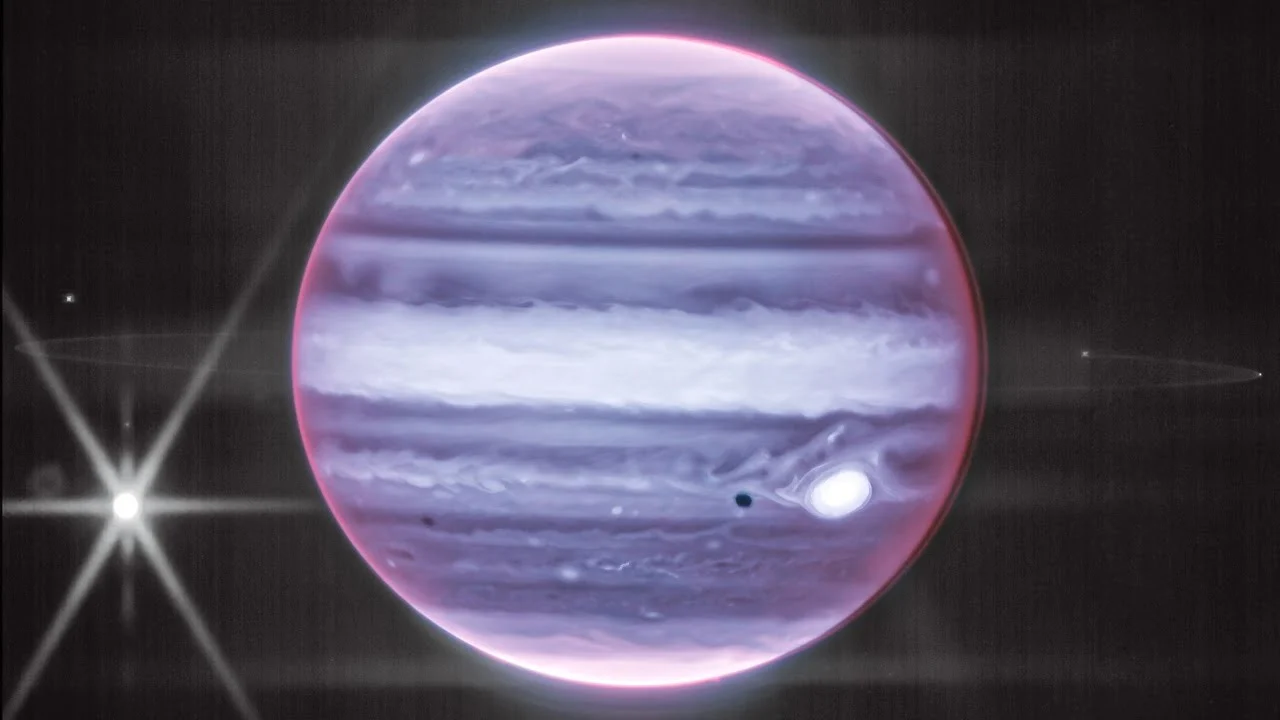
Perhaps one of the most noble pursuits that humankind engages in is observational astronomy, borne by unbounded curiosity and the pure enjoyment that comes from viewing the wonders of the cosmos, the discovery rewards the spirit and the intellect, because when we view the Universe, we are in fact coming to better understand ourselves. To further this noble and enlightening pursuit, NASA’s Goddard Space Flight Center has successfully deployed one of humanity’s most technologically advanced “eye on the universe”, the James Webb Space Telescope—a technological marvel— with the first images having been revealed on July 11th.
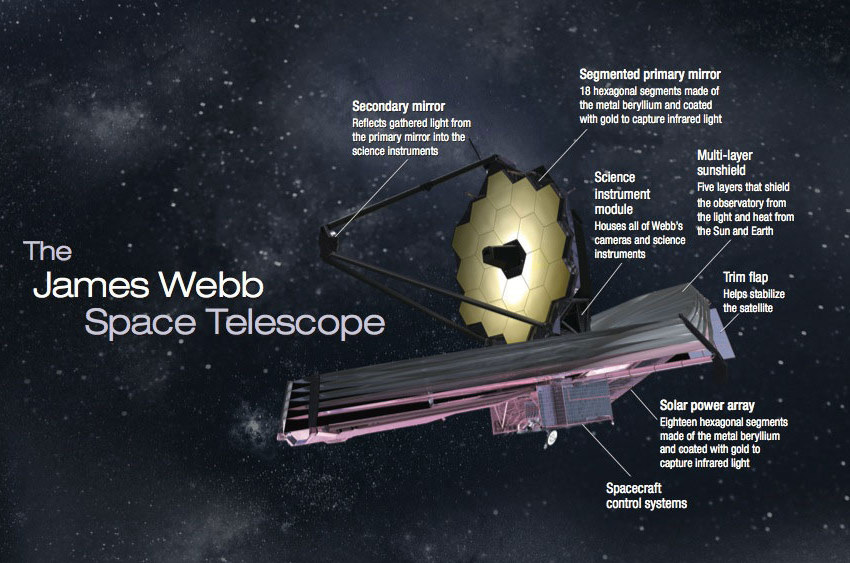
The stated mission:
The James Webb Space Telescope (sometimes called JWST or Webb) is an orbiting infrared observatory that will complement and extend the discoveries of the Hubble Space Telescope, with longer wavelength coverage and greatly improved sensitivity. The longer wavelengths enable Webb to look much closer to the beginning of time and to hunt for the unobserved formation of the first galaxies, as well as to look inside dust clouds where stars and planetary systems are forming today. NASA Goddard Space Flight Center/ About

The James Webb Space Telescope will not be in orbit around the Earth, like the Hubble Space Telescope is— it will actually orbit the Sun, 1.5 million kilometers (1 million miles) away from the Earth at what is called the second Lagrange point or L2. What is special about this orbit is that it lets the telescope stay in line with the Earth as it moves around the Sun. This allows the satellite’s large sunshield to protect the telescope from the light and heat of the Sun and Earth (and Moon).

The Webb telescope will orbit far from Earth and shielded from the Sun because the telescope will be capturing many images in the infrared EM spectrum— which enables viewing high-dust regions that obscure smaller wavelength light, like rocky proto-planetary discs— the telescope must operate at vacuum-temperature.
In addition to its many remarkable technological accomplishments, the JWST mission will also be a true democratization of science in which the worldwide astronomical community can propose projects and make observations with the Webb telescope, and all data / images are publicly available to all. Projects must be within the scope of the primary mission objectives, which include:
- Search for the first galaxies or luminous objects formed after the Big Bang
- Determine how galaxies evolved from their formation until now
- Observe the formation of stars from the first stages to the formation of planetary systems
- Measure the physical and chemical properties of planetary systems, including our own Solar System, and investigate the potential for life in those systems
In just the first few weeks of operation, the JWST mission is already reshaping astronomy.
Exoplanets and Disks
For astrochemists and astrobiologists the Webb telescope will be a treasure-trove of data, enabling never-before-possible observations of early planet-forming discs and direct analysis of exoplanet atmospheres.

JWST will let scientists study molecules in the disks of ice and dust surrounding young stars where planets, comets, and other bodies are born. Image credit: ALMA (ESO/NAOJ/NRAO)
Perhaps one of the most exciting features of the JWST mission is that it has the possibility of verifying the habitability of Earth-like exoplanets by analyzing the molecular constitution of their atmospheres (if present).
At the top of the list for potentially habitable Earth-like exoplanets is the TRAPPIST-1 system, an incredible collection of seven rocky exoplanets 41 light years away from earth. The system is highly amenable to direct observation and has a high possibility for containing a habitable Earth-like body as the seven rocky exoplanets are distributed across the system’s habitable zone.

Step by step! ???? Welcome to Trappist-1! This is the best look we ever had (so far) at an extraordinary system thanks to the James Webb Space Telescope, which is one of our best candidates for finding life. The picture may appear pixelated and it was made to confirm that the telescope was properly aimed and calibrated. This is not the last we will see, either! If TRAPPIST-1b did pass in front of the star on July 18, some of the star’s light may have filtered through the exoplanet’s atmosphere. Astronomers might learn about TRAPPIST-1b’s atmosphere by comparing TRAPPIST-1’s spectra before, during, and after the planet’s passage. Outstanding! – Resonance Science Foundation affiliate astronomer María Carolina Bruhl.
The first data of the spectral analysis of the exoplanets will is eagerly anticipated, although interpretations of habitability will have to be nuanced— the exoplanets are right up against the main star, and because it is a low-mass dwarf prone to frequent solar flares the planetary atmospheres may be ablated, but if there are large bodies of water like oceans, there is still a good chance for aquatic life.

Galaxies
Two of the primary mission objectives are to (1) search for the first galaxies or luminous objects formed after the Big Bang, and (2) determine how galaxies evolved from their formation until now. In just the first few weeks of operation, the Webb telescope recorded the most distant, and hence earliest galaxy known:

A newfound galaxy dubbed GLASS-z13, which is so far away that we see it as it appeared 300 million years after the Big Bang, now holds the record for the earliest known galaxy. That record is not expected to last long. Image credit: Naidu et al, P. Oesch, T. Treu, GLASS-JWST, NASA/CSA/ESA/STScI
The finding comes from analysis of one of the first released images of Webb telescope— the cluster of galaxies called SMACS 0723— that contains such a large amount of matter that the dense galactic cluster bends spacetime into a veritable lens, magnifying galaxies behind it from our line-of-sight (image below). The research teams reported their results on the arXiv server [1], [2].

More updates will be posted on this report in the coming days as data is compiled.
References
[1] G. Mahler et al., “Precision modeling of JWST’s first cluster lens SMACSJ0723.3-7327.” arXiv, Jul. 19, 2022. Accessed: Aug. 01, 2022. [Online]. Available: https://arxiv.org/abs/2207.07101
[2] M. Pascale et al., “Unscrambling the lensed galaxies in JWST images behind SMACS0723.” arXiv, Jul. 23, 2022. Accessed: Aug. 01, 2022. [Online]. Available: https://arxiv.org/abs/2207.07102