

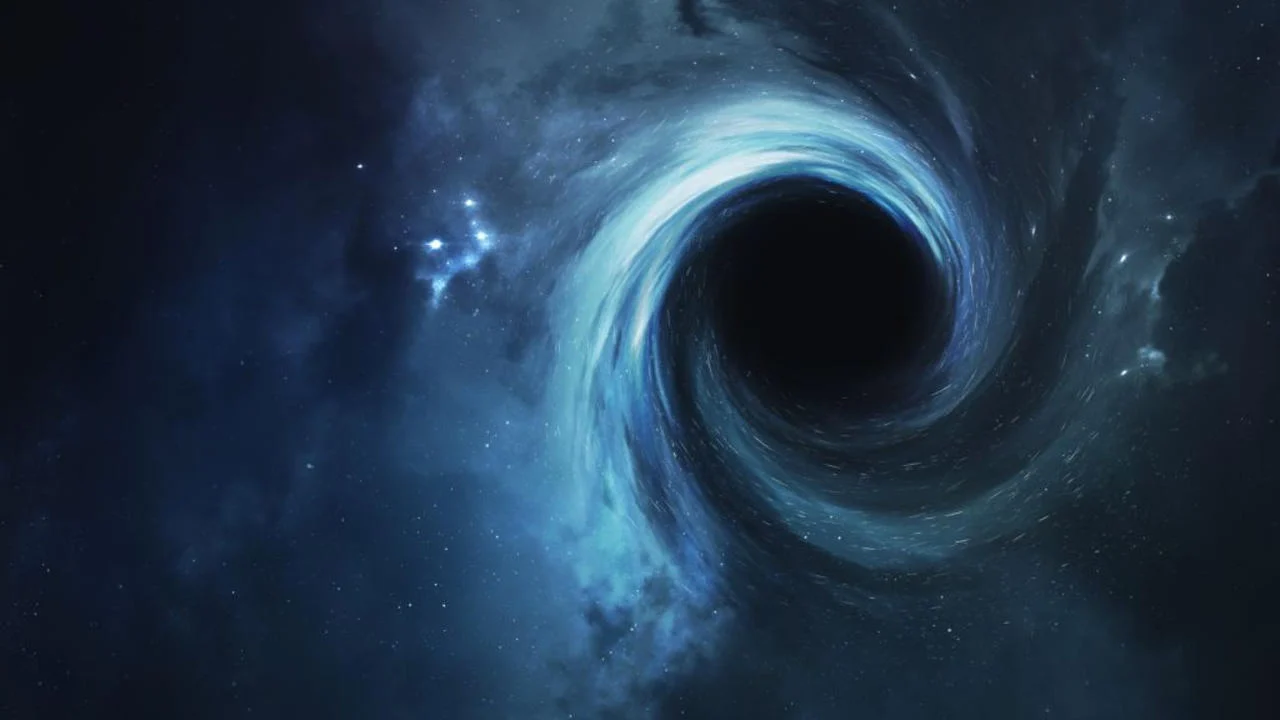
Those enigmatic black holes that lead to places unknown may not be what we thought they were – or at least that’s what some scientists think.
Since first proposed in 1784 by John Mitchell and their prediction in 1915 by Einstein’s theory of general relativity, evidence supporting the idea of black holes has continued to be found.
Described as infinitely dense points in space time – where not even light can escape – the presence of a black hole is thus inferred from the gravitational effects on the surrounding material. But what if something else – other than a black hole – could produce these same effects?
What Are GEODEs? Understanding the Dark Energy Alternative
Such a question was addressed in two recent papers by a team of scientists at the University of Hawaii. They consider the consequences of replacing all black holes with a class of objects with ‘dark energy’ interiors known as Generic Objects of Dark Energy (GEODEs).
GEODEs, as they are now referred to, were first postulated in 1966 by Russian physicist Erast Gliner who suggested such objects as viable stellar remnants – the end point of stars.
The current understanding of stellar evolution states that for stars massive enough, the stellar remnants would be black holes. However, there are alternative models in which black hole interiors are described by a ‘dark energy’ equation of state – an equation describing the state of matter in terms of its pressure, temperature and volume, for example. Gliner thus proposed that instead of the end stage of stars gravitationally collapsing into black hole singularities, they would collapse into non-singular ‘dark energy’ objects (GEODEs) that only appear to be black holes from the outside.
Fifty years later, the Hawaiian team led by Kevin Croker and Joel Weiner started to look at the Friedman equations – the equations derived in 1922 that describe the expansion of the universe where ultra-dense regions of space such as neutron stars and black holes were treated in the same way as all other regions of space. The current understanding of a black hole is that of a singularity, which is a mathematical construct, and the physicality of such is yet to be understood. What Croker and Weiner found is that in order to incorporate black holes into the framework of an expanding universe, they can’t be singularities. When treated as non-singular GEODEs, they found that if only a fraction of the oldest stars collapsed in this way their averaged contribution would naturally produce the dark energy responsible for the accelerated expansion of the universe.
“If what we thought were black holes are actually objects without singularities, then the accelerated expansion of our universe is a natural consequence of Einstein’s theory of general relativity” – Dr Kevin Croker
The assumption made by cosmologists that the Universe is insensitive to the details of the objects it contains now it seems no longer stands. Not only does this give us a new way of looking at black holes, but also how we look at the Universe and its interconnectedness.
Challenges in Distinguishing Black Holes from GEODEs
Further support of black holes being more like these GEODEs comes from the binary black hole merger mass found when assuming the colliding binary black holes were instead GEODEs. The resultant mass was greater than if the objects were black holes, and thus more in agreement with the 2016 LIGO-Virgo observations. Of course, this doesn’t confirm the existence of GEODEs just yet and, unfortunately, although observational signatures have been developed, there does not yet seem to be a way to distinguish between the different models.
As well, the GEODEs as proposed by Gliner and described by the team at the University of Hawaii are not the only description of such objects. In 2015, the Gravastar was described by physicists Pawel Mazur and Emil Mottola, and more than 80 years ago George McVittie proposed such a solution in which he describes a mass-particle in an expanding universe.
Highlights:
These ideas of objects where the interior region is made of the quantum vacuum – rather than a singularity – is very much in agreement with the unified physics perspective which sees all matter as emerging from the granular Planck scale structure of spacetime, otherwise known as the quantum vacuum. Furthermore, this quantized view of the Universe, as offered by the unified perspective in the form of the generalized holographic approach, similarly describes the expansion of the universe. Notably, the expansion of the Universe as originally proposed by George Lemaitre starts from a primeval super atom, not a singularity. Similarly, when we consider the vacuum energy of a Planck particle as it expands to the size of the Universe, we can explain the expansion of the Universe without the need for dark energy and as well resolving the vacuum catastrophe.
Article: https://bgr.com/2019/10/02/black-hole-theory-geode-study/