
By using this site, you agree to the Privacy Policy.
Accept
The International Space Federation (ISF)The International Space Federation (ISF)The International Space Federation (ISF)
  • Science News
    • All Articles
    • Physics
    • Astronomy
    • Biology
    • Technology
    • Other
  • Research
    • Research Papers
    • Physicists Testimonials
  • Technology
  • About
    • About us
  • ISF News
  • Events
    • Events
  • Get Involved
    • Invest
    • Donate – Zero Point Foundation
  • Careers
  • Contact Us
Reading: First Spatiotemporal Map of Galactic Local Region Reveals Mechanisms of Star Formation
Share
The International Space Federation (ISF)The International Space Federation (ISF)
Search
  • Science News
    • Physics
    • Astronomy
    • Biology
    • Technology
  • Research Papers
    • Physicists Testimonials
  • About
    • ISF News
  • Events
  • Get involved
    • Invest
  • Translations
    online pharmacy https://worldneurologyonline.com/ no prescription pharmacy
Follow US
© 2022 International Space Federation. All Rights Reserved.
The International Space Federation (ISF) / Explore / Astronomy / First Spatiotemporal Map of Galactic Local Region Reveals Mechanisms of Star Formation
Astronomy

First Spatiotemporal Map of Galactic Local Region Reveals Mechanisms of Star Formation

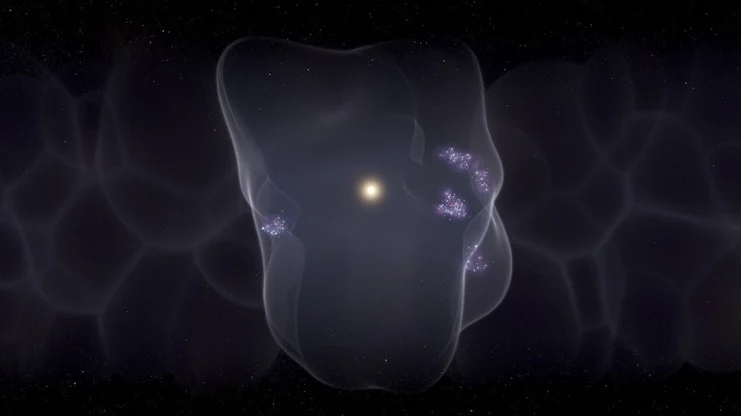
Most studies of star formation—the “birth” of new stars—have been performed using static 2-dimensional photographs of star forming regions, or nebulae. Now, a new study using 3-D space motions that map stars in 3 dimensions of space, motion, and time astronomers have been able to generate a spatiotemporal map that reveales stars in our local region of the galaxy forming along the surface of an approximately 1000 light year wide bubble [1].

Dr. William Brown
Last updated: 2025/10/14 at 11:02 AM
Dr. William Brown
Share
3 Min Read
SHARE

Most studies of star formation—the “birth” of new stars—have been performed using static 2-dimensional photographs of star forming regions, or nebulae. Now, a new study using 3-D space motions that map stars in 3 dimensions of space, motion, and time astronomers have been able to generate a spatiotemporal map that reveales stars in our local region of the galaxy forming along the surface of an approximately 1000 light year wide bubble [1]. The stars in our “Local Bubble” are all moving away from a central point that appeared to form from several supernovae about 14 million years ago, which triggered expanding shockwaves that initiated condensation of interstellar gases into the discrete surface region of the bubble. The supernovae shockwaves—carrying all the heavy elements of the supernova metallogenesis—are responsible for triggering new star formation via the condensing of interstellar gases.

Astronomers have long theorized that supernovae could trigger this condensing by sweeping up gas into dense clouds that ultimately form new stars, but according to reports from the researchers involved in the latest study, they were surprised to learn that almost every single new star near the sun is forming on the surface of this Local Bubble.

Interestingly, the Sun is located nearly exactly at the center of the Local Bubble, although it wasn’t in the current central location when the supernovae occurred, it was at a safe distance from the supernovae emissions starting 14 million years ago. This observation and others have led astronomers to theorize that this similar structuring occurs throughout the Milky Way galaxy—in which there will be large voids surrounded by dense stellar formation surfaces, similar in patterning to the large-scale cosmological structure known as the cosmic web.

Researchers involved in the study believe that our Local Bubble may be interacting with other bubbles in our galactic neighborhood— new data from the Gaia mission, Gaia DR3, will help provide 3-D space motions for 30 million stars, expanding the spatiotemporal map beyond our Local Bubble to include adjacent stellar formation areas, and may reveal how this galactic patterning affects our solar system and others.

Reference

[1] C. Zucker et al., “Star formation near the Sun is driven by expansion of the Local Bubble,” Nature, vol. 601, no. 7893, pp. 334–337, Jan. 2022, doi: 10.1038/s41586-021-04286-5.
Sign Up For Daily Newsletter

Be keep up! Get the latest breaking news delivered straight to your inbox.
loader

loader

loader

By signing up, you acknowledge the data practices in our Privacy Policy. You may unsubscribe at any time.
En vous inscrivant, vous reconnaissez les pratiques en matière de données dans notre politique de confidentialité. Vous pouvez vous désinscrire à n'importe quel moment.
Al registrarse, reconoce las prácticas de datos en nuestra política de privacidad. Puedes darte de baja en cualquier momento.
Share This Article
Facebook Twitter Copy Link Print
By Dr. William Brown
William Brown is a biophysicist, investigating the physics operational at the cellular and molecular level of the biological system. He presents lectures (Unified Science Review), talks, and Q&A forums to teach the syncretic theories of unified science. He is a part of the research team at The International Space Federation where he applies his extensive knowledge of cellular and molecular biology to an exploration of the biological system from a unified physics perspective; developing an understanding of life from the most fundamental level.
Previous Article Evidence of Black Holes Forming Galaxies is Mounting!
Next Article Measuring the Curvature of Space-time Using Time Dilation at Atomic Scale

Stay Connected

981k Like
18.7k Follow
7.7k Follow
7.3k Subscribe

Categories

  • Astronomy106
  • Biology69
  • ISF News25
  • ISF Research14
  • Other22
  • Physics168
  • Technology36

You Might also Like

Astronomy

The Rotating Universe: Radio Galaxies and the Cosmic Dipole Anomaly

22. December 2025.
Astronomy

“Black Hole Stars” Detected at Cosmic Dawn

23. October 2025.
Astronomy

New Evidence Points to a Compact Object at the Sun’s Core

5. August 2025.
Astronomy

Image Reveals Coherently Ordered Spiral Vortex Around Milky Way’s Supermassive Black Hole

24. June 2024.
The International Space Federation (ISF)The International Space Federation (ISF)

Harnessing quantum vacuum energy for sustainable solutions – a unified approach to science, technology and education.

Quick links

  • About
  • Research Papers
  • Events
  • Invest

Explore

  • ISF Research
  • Physics
  • Technology
  • Astronomy
  • Biology
  • ISF News

Sign Up for Our Newsletter

Subscribe to our newsletter to get our newest articles instantly!

loader

Follow US
© 2023 International Space Federation. All Rights Reserved. INTERNATIONAL SPACE FEDERATION is a trademark of ISFS SA. The mark is registered in the United States under Registration No. 7772313. The ®️ symbol is used exclusively in the U.S.
  • Press
  • Careers
  • Privacy policy
  • Carrieres
  • Presse
  • Prensa
Join Us!

Subscribe to our newsletter and never miss our latest news.

loader

Welcome Back!

Sign in to your account

Lost your password?