

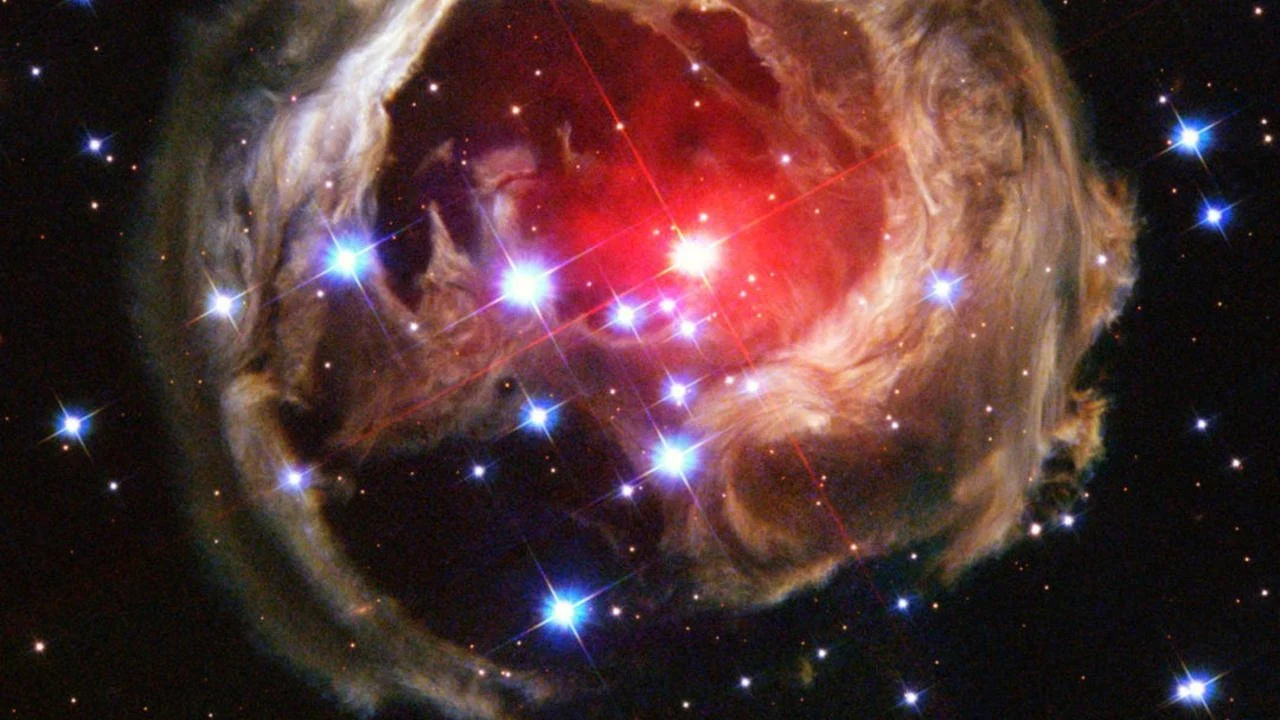
The enigmatic pulsating variable stars have just become more intriguing – as astronomers find them to be pulsating at the Golden ratio!
Any star that varies in brightness – whether on timescale of seconds or years – falls into the category of variable stars, where the variability can be due to changes in stellar luminosity, mass, size or position. While extrinsic variables are simply due to the eclipsing of the source by another source such as a star or planet, intrinsic variables change in brightness due to underlying physical mechanisms such as pulsations and/or eruptions. The pulsating variable stars shrink and swell in size, thus varying their intrinsic luminosity and in effect pulsating through continuous contraction and expansion. Cepheid variables, the most famous of the pulsating variables, are well known and much loved by astronomers for their use in the measurement of intergalactic distances. The distinct relationship between the period and the brightness, discovered by Henrietta Leavitt (1868-1921) and developed by Ejnar Hertzsprung (1873-1967), allows the intrinsic luminosity and thus distance of the star to be determined. They have thus become the favorite standard candle. RR Lyrae stars are another type of pulsating variable and can also be used as standard candles, however as their intrinsic luminosity is lower than Cepheid variables they cannot be detected at the great distances that Cepheids are famous for.
A team of astronomers, from Germany the UK and the USA, interested in exploring the pulsation periods of variable stars, in particular the RR Lyrae stars which typically have periods of 0.5 days, were finally able to with the latest generation of space telescopes.
The Kepler spacecraft, known for its successful mission to search for exoplanets, also has a side job and unbeknown to many has been tracking the brightness of 150,000 stars for the last 6 years. Of these stars are the Cepheid and RR Lyrae pulsating variable stars, whose pulsations were observed at both single frequencies and multiple frequencies. What was of particular interest was that for several of the stars and in particular the RR Lyrae metal-rich star, KIC 5520878, the pulsations primary and secondary frequencies are at the phi ratio – the Golden Ratio!
This is extremely interesting as the dynamical behavior exhibited by KIS 5520878 is similar to what is known as a strange nonchaotic attractor, of which has never been observed outside the laboratory!
A dynamical system generally consists of multiple attractors which drive the system in either a periodic or aperiodic fashion. The aperiodic dynamic, where trajectories appear to skip around randomly are known as strange attractors with a good example being the weather system, as although complex and chaotic, it will always fall within the realm of possible states. What is interesting is that the Kolmogorov-Arnold-Moser Theorem (KAM), which sets the conditions for the extent of chaos, shows that a dynamical system with frequencies in the golden ratio is maximally resistant to perturbations and exhibits distinct dynamics between order and chaos. Such a system is referred to as a strange nonchaotic attractor, making the RR Lyrae star KIC 5520878 the first strange nonchaotic attractor ever observed outside the laboratory. The exact mechanisms responsible for this intriguing phenomenon are not fully understood and are still up for discussion. Read more here.
Learned et al. (2014) had previously proposed that a sufficiently advanced extra-terrestrial civilization could use neutrino beams to tickle these pulsating stars, such as KIC 5520878, as a means to transmit information throughout the galaxy and beyond. However, although not removing the possibility he concluded that in the case of KIC 5520898 the two pulsation periods are of natural origin. Read more here.