

By means of numerical simulations and computational calculations, a team from the University of Massachusetts Dartmouth and Georgia Gwinnett College observed that rotating black holes can be traversable. The results were published in Phys. Rev. D, and the calculations were made by Caroline Mallary, student of the research team’s director, Gaurav Khanna.
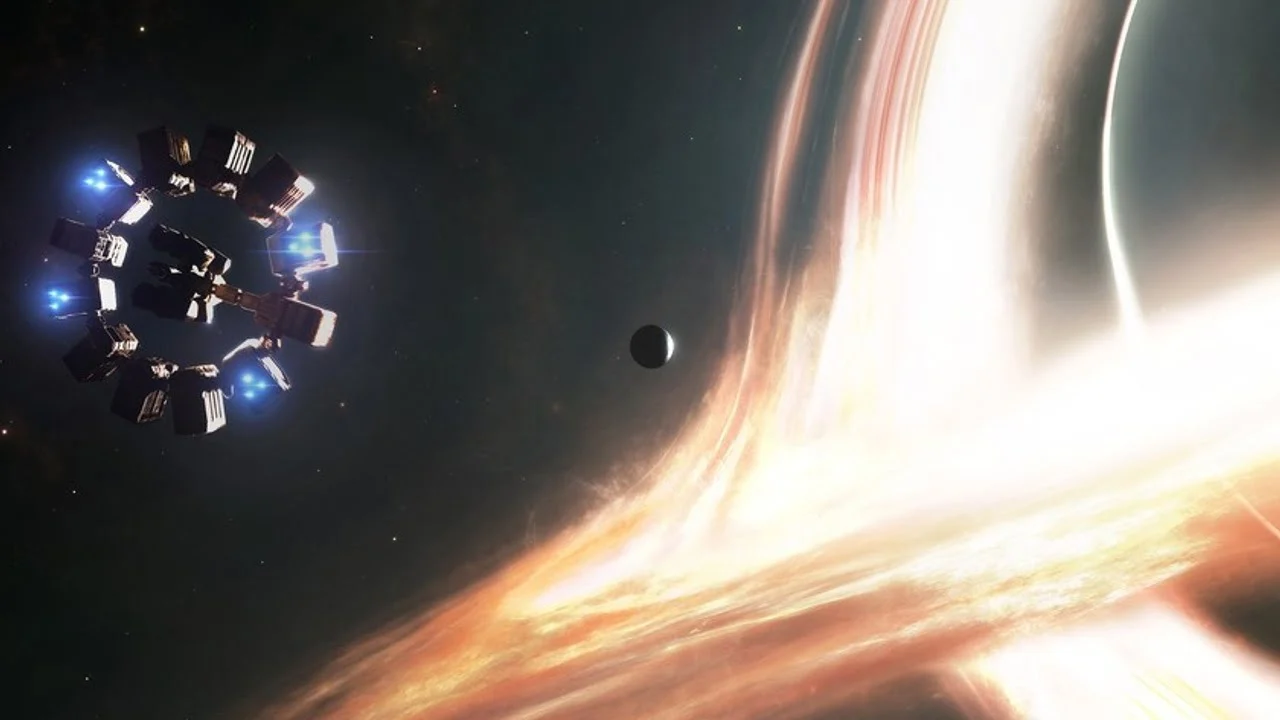
Mallary wanted to test whether Cooper (played by Matthew McConaughey) in Christopher Nolan’s movie Interstellar, could survive the plummet into Gargantua – a fictional, rotating, supermassive black hole about 100 million times the mass of our sun. The physical properties of this black hole were taken from the book written by Nobel laureate Kip Thorne, on which the film was based.

These mysterious creatures called black holes, are regions in space where there is an enormous accumulation of energy/matter, concentrated in such a small volume that the energy/mass density is almost infinite -known as a singularity- and gravity therefore becomes extremely large in that region, to such an extent that nothing, not even light, could escape. This enormous density and extremely high temperature could cause an opening or hole in the fabric of spacetime, which could serve as a bridge or portal for space travel.
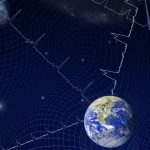
Black holes would be a kind of shortcut that would allow us to cross enormous distances in space, in very short periods of time, thus overcoming the limits imposed by the speed of light. Not because we have exceeded the speed of light, but because we have considerably shortened the trajectory. In such a case, at least hypothetically, it is believed that a spacecraft could enter through a black hole and exit at the other end through a white hole, which are regions of space where nothing, not even light, could enter, as shown in the image below.

However, until now it was not believed that black holes could be physically traversable; if a spacecraft were to enter this region of extremely high temperature and density, it would begin to undergo a series of very unpleasant stretches and compressions, which would increase before the complete evaporation of the object.
The key to achieving success in such an endeavor was that, in the case of rotating black holes, there are additional factors that come into play and that completely change the outcome of the numerical simulations, as Mallary’s work demonstrates. Her study captures the most relevant physical effects that a spacecraft, or any other large object, would suffer when falling into a rotating black hole, such as Sagittarius A*, the supermassive hole at the center of our Milky Way galaxy. The paper examines the “tidal” forces experienced by Cooper’s spacecraft due to the Cauchy singularity, which is the inner horizon of the black hole.
 Gran Firmamento, by Jorgelina Alvarez, from the Antartic.
Among the discoveries Mallory found, there was a previously unnoticed feature that emerged: the effects of the singularity, in the context of a rotating black hole, result in cycles of stretching and compression in the spacecraft that are accelerating at such a rate that it does not have a “sustained” effect over time, leaving the object unharmed. And the larger the black hole, the smaller the strength of that effect. In the case of Gargantua, the effect is so small, that any ship and the travelers on board would not detect it; this would allow a very smooth passage.
The effects were calculated for different materials, for example, steel and glass. For the case of steel, the figure below shows the physical stress on the steel shell of the spacecraft as it falls into the rotating black hole.

Image taken from Khanna/UMassD.
The inset shows a detailed zoom for very late times. As remarked by Khanna, the important feature is that the strain increases rapidly near the black hole but does not grow indefinitely.
The crucial point is that these effects do not increase without bound; in fact, they remain finite, even though the stresses on the spacecraft tend to grow indefinitely as it approaches the black hole. Khanna/UMassD
Mention should be made of certain approximations that allowed important simplifications in the calculation; for example, the black hole was assumed to be isolated, and free of surrounding disturbances like a star. Therefore, numerical simulations would have to be performed taking into account the real neighborhoods of the black hole, since most of them are surrounded by cosmic material: dust, gases, radiation …
It should also be noted that in this work no quantum effects of any kind were considered, the treatment was purely with classical general relativity, even though quantum effects are to be expected once the Cauchy horizon is crossed.
Although these are numerical simulations, we are very optimistic because these results show that black holes behave very differently from stationary ones, allowing us to make predictions that are essential to perform such a feat in real life.
Highlights:
The first finding of this work is that the singularity inside a rotating black hole is technically “weak” and therefore does not cause damage to interacting objects.
From the generalized holographic theory of Nassim Haramein, stellar evolution changes radically, and black holes would not be the final stage of a star, but on the contrary, they would be the initial stage, so that when a star collapses, it leaves naked the singularity at its center. And the origin of a black hole is the spin intrinsic to the dynamics of space; like water going down a drain, the water would be space-time, the drain is the singularity, and the vortex that goes into the drain is what we call a black hole. Therefore, all black holes rotate. All of them, without exception.
For more than 25 years Nassim Haramein has claimed that, if everything in the universe rotates, it is because the rotation comes from space itself. Like when we add milk to a black coffee, and stir it with a spoon, we would not think that the milk is rotating on its own, and it is thanks to the milk that we can see the spiral pattern and the rotation of the system. The milk would be, for example, a galaxy, and the coffee, the space where the galaxy is immersed. From the generalized holographic model, the spin would be intrinsic to the vacuum dynamics, resulting from the inclusion of the torsion and Coriolis forces in the Einstein field equations and the Kerr-Newman solution, called the Haramein-Rauscher solution. The density gradient, from the quantum vacuum to the macroscopic vacuum, obey these dynamics; the dynamical rotational structures of galaxies, novae, supernovae and other astrophysical structures would be driven by the space-time torsion also responsible for the observed formation of spiral galaxies.
This same dynamics would govern black holes, which would have a topology very different from that currently described by Einstein’s field equations. The Haramein-Rauscher metric produces a double toroid topology, separated at the equator, which is where the matter that “escapes” or is produced in the black hole would be concentrated. And given that in the center of each galaxy we have observed the existence of black holes, sometimes older than the age of the galaxy, that would suggest that galaxies are being formed by black holes, and hence the galaxies have the shape they have, apparently horizontal, because the matter is accumulating at the equator of this dynamic.
Therefore, black holes are very different creatures from what we have been used to think of. As explained in this RSF article, observing or detecting the rotation of a black hole is very difficult.
More at: