
By using this site, you agree to the Privacy Policy.
Accept
The International Space Federation (ISF)The International Space Federation (ISF)The International Space Federation (ISF)
  • Science News
    • All Articles
    • Physics
    • Astronomy
    • Biology
    • Technology
    • Other
  • Research
    • Research Papers
    • Physicists Testimonials
  • Technology
  • About
    • About us
  • ISF News
  • Events
    • Events
  • Get Involved
    • Invest
    • Donate – Zero Point Foundation
  • Careers
  • Contact Us
Reading: Saturn’s Rings Reveal Sought After Spin Rate
Share
The International Space Federation (ISF)The International Space Federation (ISF)
Search
  • Science News
    • Physics
    • Astronomy
    • Biology
    • Technology
  • Research Papers
    • Physicists Testimonials
  • About
    • ISF News
  • Events
  • Get involved
    • Invest
  • Translations
    online pharmacy https://worldneurologyonline.com/ no prescription pharmacy
Follow US
© 2022 International Space Federation. All Rights Reserved.
The International Space Federation (ISF) / Explore / Astronomy / Saturn’s Rings Reveal Sought After Spin Rate
Astronomy

Saturn’s Rings Reveal Sought After Spin Rate

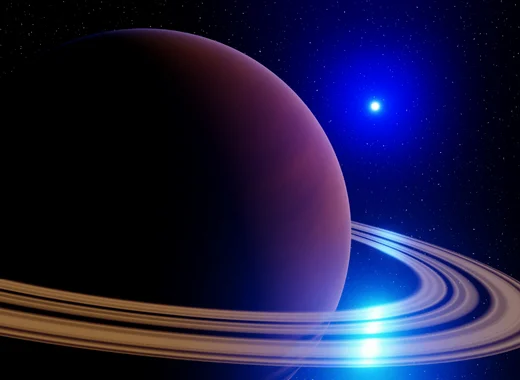
The rotation speed – spin rate – of Saturn was previously found through observations of its magnetic field. Now, scientists have determined the spin rate through ripples in its rings!

RSF Research
Last updated: 2024/04/22 at 2:28 PM
RSF Research
Share
2 Min Read
SHARE

The rotation speed – spin rate – of Saturn was previously found through observations of its magnetic field. Now, scientists have determined the spin rate through ripples in its rings!

NASA’s twin voyager probes, launched over 40 years ago, observed the swirling magnetic field of Saturn, from which it was able to deduce a rotation period for the magnetic field and conclude a spin rate of 10 hours and 40 minutes. During this mission, in the 1980’s, the ring system was observed in great detail revealing the gravitational effects of Saturn’s moons on the rock and ice particles in the rings. When the particles and moons orbit at simple ratios of each other, the particles are periodically kicked by the moons. These kicks, known as orbital resonance, can launch waves that propagate away from the planet – with some anomalous “backwards” waves.

Detailed observations of these waves have been made, since 2000, with NASA’s Cassini spacecraft and the Cassini Visible and Infrared Mapping Spectrometer (VIMS) and now a team of scientists led by Christopher Mankovich have compared this data with the ripples generated from model simulations of Saturn’s internal structure. The results have revealed a more precise spin rate for the planet – 10 hours and 35 minutes – and as well have revealed a greater understanding of Saturn’s internal structure.

“It turns out that Saturn’s rings are an extraordinarily sensitive way of detecting disturbances inside the planet,” says David Stevenson of the California Institute of Technology in Pasadena, California.

The correlation found between the internal dynamics and the exterior rings can be extended for all gas giants and planetary bodies in general. This has huge implications for unified physics, as with such a fundamental understanding confirmed with observations, the model can be extended to planets, stars, galaxies and all rotating systems across all scales.

Article: https://www.newscientist.com/article/2170634-ripples-in-saturns-rings-unravel-mystery-of-how-fast-it-spins/

Paper: https://arxiv.org/abs/1805.10286
Learn more in our free Unified Science Course

Sign Up For Daily Newsletter

Be keep up! Get the latest breaking news delivered straight to your inbox.
loader

loader

loader

By signing up, you acknowledge the data practices in our Privacy Policy. You may unsubscribe at any time.
En vous inscrivant, vous reconnaissez les pratiques en matière de données dans notre politique de confidentialité. Vous pouvez vous désinscrire à n'importe quel moment.
Al registrarse, reconoce las prácticas de datos en nuestra política de privacidad. Puedes darte de baja en cualquier momento.
Share This Article
Facebook Twitter Copy Link Print
Previous Article Habitable Water World Exoplanets
Next Article Speculative Wormhole Echoes Could Revolutionize Astrophysics

Stay Connected

981k Like
18.7k Follow
7.7k Follow
7.3k Subscribe

Categories

  • Astronomy106
  • Biology69
  • ISF News25
  • ISF Research14
  • Other22
  • Physics168
  • Technology36

You Might also Like

Astronomy

The Rotating Universe: Radio Galaxies and the Cosmic Dipole Anomaly

22. December 2025.
Astronomy

“Black Hole Stars” Detected at Cosmic Dawn

23. October 2025.
Astronomy

New Evidence Points to a Compact Object at the Sun’s Core

5. August 2025.
Astronomy

Image Reveals Coherently Ordered Spiral Vortex Around Milky Way’s Supermassive Black Hole

24. June 2024.
The International Space Federation (ISF)The International Space Federation (ISF)

Harnessing quantum vacuum energy for sustainable solutions – a unified approach to science, technology and education.

Quick links

  • About
  • Research Papers
  • Events
  • Invest

Explore

  • ISF Research
  • Physics
  • Technology
  • Astronomy
  • Biology
  • ISF News

Sign Up for Our Newsletter

Subscribe to our newsletter to get our newest articles instantly!

loader

Follow US
© 2023 International Space Federation. All Rights Reserved. INTERNATIONAL SPACE FEDERATION is a trademark of ISFS SA. The mark is registered in the United States under Registration No. 7772313. The ®️ symbol is used exclusively in the U.S.
  • Press
  • Careers
  • Privacy policy
  • Carrieres
  • Presse
  • Prensa
Join Us!

Subscribe to our newsletter and never miss our latest news.

loader

Welcome Back!

Sign in to your account

Lost your password?