
By using this site, you agree to the Privacy Policy.
Accept
The International Space Federation (ISF)The International Space Federation (ISF)The International Space Federation (ISF)
  • Science News
    • All Articles
    • Physics
    • Astronomy
    • Biology
    • Technology
    • Other
  • Research
    • Research Papers
    • Physicists Testimonials
  • Technology
  • About
    • About us
  • ISF News
  • Events
    • Events
  • Get Involved
    • Invest
    • Donate – Zero Point Foundation
  • Careers
  • Contact Us
Reading: Speculative Wormhole Echoes Could Revolutionize Astrophysics
Share
The International Space Federation (ISF)The International Space Federation (ISF)
Search
  • Science News
    • Physics
    • Astronomy
    • Biology
    • Technology
  • Research Papers
    • Physicists Testimonials
  • About
    • ISF News
  • Events
  • Get involved
    • Invest
  • Translations
    online pharmacy https://worldneurologyonline.com/ no prescription pharmacy
Follow US
© 2022 International Space Federation. All Rights Reserved.
The International Space Federation (ISF) / Explore / Astronomy / Speculative Wormhole Echoes Could Revolutionize Astrophysics
Astronomy

Speculative Wormhole Echoes Could Revolutionize Astrophysics

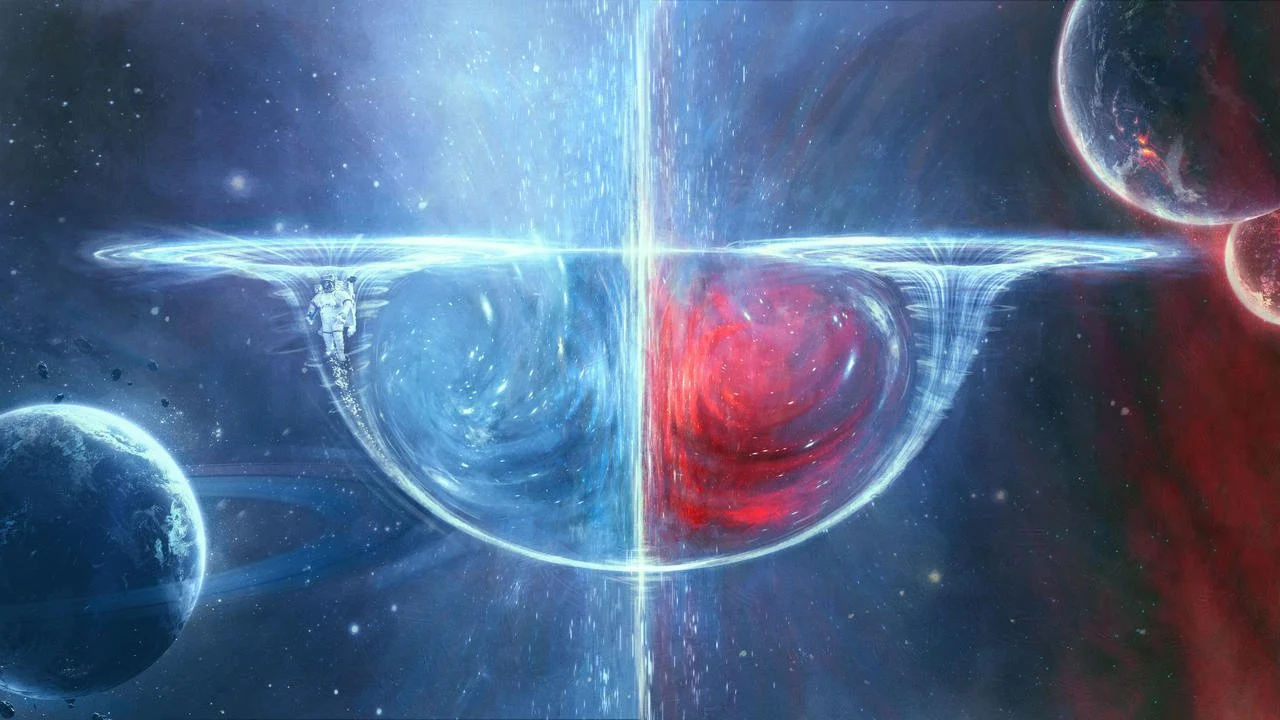
The scientific collaborations LIGO and Virgo have detected gravitational waves from the fusion of two black holes, inaugurating a new era in the study of the cosmos. But what if those ripples of space-time were not produced by black holes, but by other exotic objects? A team of European physicists suggest an alternative—wormholes that can be traversed to appear in another universe.

RSF Research
Last updated: 2024/08/27 at 3:26 PM
RSF Research
Share
5 Min Read
SHARE

The scientific collaborations LIGO and Virgo have detected gravitational waves from the fusion of two black holes, inaugurating a new era in the study of the cosmos. But what if those ripples of space-time were not produced by black holes, but by other exotic objects? A team of European physicists suggest an alternative—wormholes that can be traversed to appear in another universe.

Scientists have deduced the existence of black holes from a multitude of experiments, theoretical models and indirect observations such as the recent LIGO detections, which are believed to originate from the collision of two of these dark gravitational monsters.

Challenges Posed by Event Horizons and Quantum Mechanics

But there is a problem with black holes—they present an edge, called an event horizon, from which nothing can escape. This is in conflict with quantum mechanics, whose postulates ensure that information is always preserved, not lost.

One of the theoretical ways to deal with this conflict is to explore the possibility that the alleged black holes we ‘observe’ in nature are no such thing, but rather some type of exotic compact objects (ECOs), such as wormholes, which do not have an event horizon.

“The final part of the gravitational signal detected by these two detectors – what is known as ringdown – corresponds to the last stage of the collision of two black holes, and has the property of completely extinguishing after a short period of time due to the presence of the event horizon,” explain the Spanish researchers Pablo Bueno and Pablo A. Cano from KU Leuven University (Belgium).

“However, if there were no horizon, those oscillations would not disappear completely; instead, after a certain time, they would produce a series of ‘echoes,’ similar to what happens with sound in a well. Interestingly, if instead of black holes, we had an ECO, the ringdown could be similar, so we need to determine the presence or absence of the echoes to distinguish the two types of objects.”

This possibility has been explored theoretically by several groups and tentative experimental analyses using the original LIGO data have been already performed, but the verdict is inconclusive.

Understanding Wormhole Echoes in Gravitational Wave Signals

The team of the KU Leuven University, in which Professor Thomas Hertog also participated, has presented a model that predicts how gravitational waves caused by the collision of two rotating wormholes would be detected.

The gravitational wave signals observed so far are completely extinguished after a few moments as a consequence of the presence of the event horizon. But if this did not exist, these oscillations would not disappear altogether; rather, after some time, there would be echoes in the signal, which may have gone unnoticed until now due to a lack of models or theoretical references with which to compare.

“Wormholes do not have an event horizon, but act as a space-time shortcut that can be traversed, a kind of very long throat that takes us to another universe,” Bueno explains, “and the fact that they also have rotation changes the gravitational waves they produce.”

According to the study, published by Physical Review D, the graphs obtained with the new model do not differ much from those recorded so far, except for the echoes, which act as a clear differentiating element.

“The confirmation of echoes in the LIGO or Virgo signals would be a practically irrefutable proof that astrophysical black holes don’t exist,” Bueno says, adding, “Time will tell if these echoes exist or not. If the result were positive, it would be one of the greatest discoveries in the history of physics.”

Read more at: Phys.org: wormhole echoes 

More information: Pablo Bueno et al. Echoes of Kerr-like wormholes, Physical Review D (2018). DOI: 10.1103/PhysRevD.97.024040

Orignial Article Source from: Plataforma SINC: Ecos de agujeros de gusano que pueden revolucionar la astrofísica.

Related RSF posts:
Detection of echoes of gravitational waves support Planck-scale structure of spacetime predicted by quantum gravity

Learn more in our free Unified Science Course

Sign Up For Daily Newsletter

Be keep up! Get the latest breaking news delivered straight to your inbox.
loader

loader

loader

By signing up, you acknowledge the data practices in our Privacy Policy. You may unsubscribe at any time.
En vous inscrivant, vous reconnaissez les pratiques en matière de données dans notre politique de confidentialité. Vous pouvez vous désinscrire à n'importe quel moment.
Al registrarse, reconoce las prácticas de datos en nuestra política de privacidad. Puedes darte de baja en cualquier momento.
Share This Article
Facebook Twitter Copy Link Print
Previous Article Saturn’s Rings Reveal Sought After Spin Rate
Next Article The Search For Supernovae With The Re-Purposed Kepler – K2

Stay Connected

981k Like
18.7k Follow
7.7k Follow
7.3k Subscribe

Categories

  • Astronomy106
  • Biology69
  • ISF News25
  • ISF Research14
  • Other22
  • Physics168
  • Technology36

You Might also Like

Astronomy

The Rotating Universe: Radio Galaxies and the Cosmic Dipole Anomaly

22. December 2025.
Astronomy

“Black Hole Stars” Detected at Cosmic Dawn

23. October 2025.
Astronomy

New Evidence Points to a Compact Object at the Sun’s Core

5. August 2025.
Astronomy

Image Reveals Coherently Ordered Spiral Vortex Around Milky Way’s Supermassive Black Hole

24. June 2024.
The International Space Federation (ISF)The International Space Federation (ISF)

Harnessing quantum vacuum energy for sustainable solutions – a unified approach to science, technology and education.

Quick links

  • About
  • Research Papers
  • Events
  • Invest

Explore

  • ISF Research
  • Physics
  • Technology
  • Astronomy
  • Biology
  • ISF News

Sign Up for Our Newsletter

Subscribe to our newsletter to get our newest articles instantly!

loader

Follow US
© 2023 International Space Federation. All Rights Reserved. INTERNATIONAL SPACE FEDERATION is a trademark of ISFS SA. The mark is registered in the United States under Registration No. 7772313. The ®️ symbol is used exclusively in the U.S.
  • Press
  • Careers
  • Privacy policy
  • Carrieres
  • Presse
  • Prensa
Join Us!

Subscribe to our newsletter and never miss our latest news.

loader

Welcome Back!

Sign in to your account

Lost your password?