
By using this site, you agree to the Privacy Policy.
Accept
The International Space Federation (ISF)The International Space Federation (ISF)The International Space Federation (ISF)
  • Science News
    • All Articles
    • Physics
    • Astronomy
    • Biology
    • Technology
    • Other
  • Research
    • Research Papers
    • Physicists Testimonials
  • Technology
  • About
    • About us
  • ISF News
  • Events
    • Events
  • Get Involved
    • Invest
    • Donate – Zero Point Foundation
  • Careers
  • Contact Us
Reading: The Big Bang: A Big Bounce?
Share
The International Space Federation (ISF)The International Space Federation (ISF)
Search
  • Science News
    • Physics
    • Astronomy
    • Biology
    • Technology
  • Research Papers
    • Physicists Testimonials
  • About
    • ISF News
  • Events
  • Get involved
    • Invest
  • Translations
    online pharmacy https://worldneurologyonline.com/ no prescription pharmacy
Follow US
© 2022 International Space Federation. All Rights Reserved.
The International Space Federation (ISF) / Explore / Astronomy / The Big Bang: A Big Bounce?
Astronomy

The Big Bang: A Big Bounce?

The most spread worldview on the origin of our Universe, is that of the big explosion, commonly known as the Big Bang (BB). We have asked ourselves what happens right after, at the first instants of the universe… the most accepted view among cosmologists is that of an exponential expansion, called the inflation theory.

Dr. Inés Urdaneta
Last updated: 2024/08/27 at 5:26 PM
Dr. Inés Urdaneta
Share
5 Min Read
SHARE

The most spread worldview on the origin of our Universe, is that of the big explosion, commonly known as the Big Bang (BB). We have asked ourselves what happens right after, at the first instants of the universe… the most accepted view among cosmologists is that of an exponential expansion, called the inflation theory.

The Role of Cosmic Inflation in the Early Universe

The BB theory results from doing a backward-in-time evolution to the universes’ expansion. If it is expanding as time moves forward, this implies the universe was smaller, denser and hotter in the distant past. The BB theory predicts that the early universe was much denser and extremely hot, about 273 million degrees above absolute zero, too hot for atoms to exist, only free electrons and hydrogen nuclei – protons and neutrons- where present.  After cooling during the expansion, these nuclei and electrons combined to compose the first light atom, the Hydrogen (H). It is now known that hydrogen atoms fill all over the space.

Cosmic Microwave Background: A Glimpse into the Early Universe

One of the signatures expected from this BB event that occurred about 13.7 billion years ago, is the radiation linked to the remaining of heat from that period, the so called “cosmic microwave background (CMB)”, emitted only a few hundred thousand years after the Big Bang, much before cosmological structures such as stars or galaxies ever existed. The properties of the CMB radiation, allows us to have a look into the conditions in the early universe, on very large scales in space-time. BB theory predicts the spectrum of the CMB radiation to have a blackbody form, which was indeed measured with accuracy by the FIRAS experiment.

Cosmic microwave background (CMB) image from ESA.

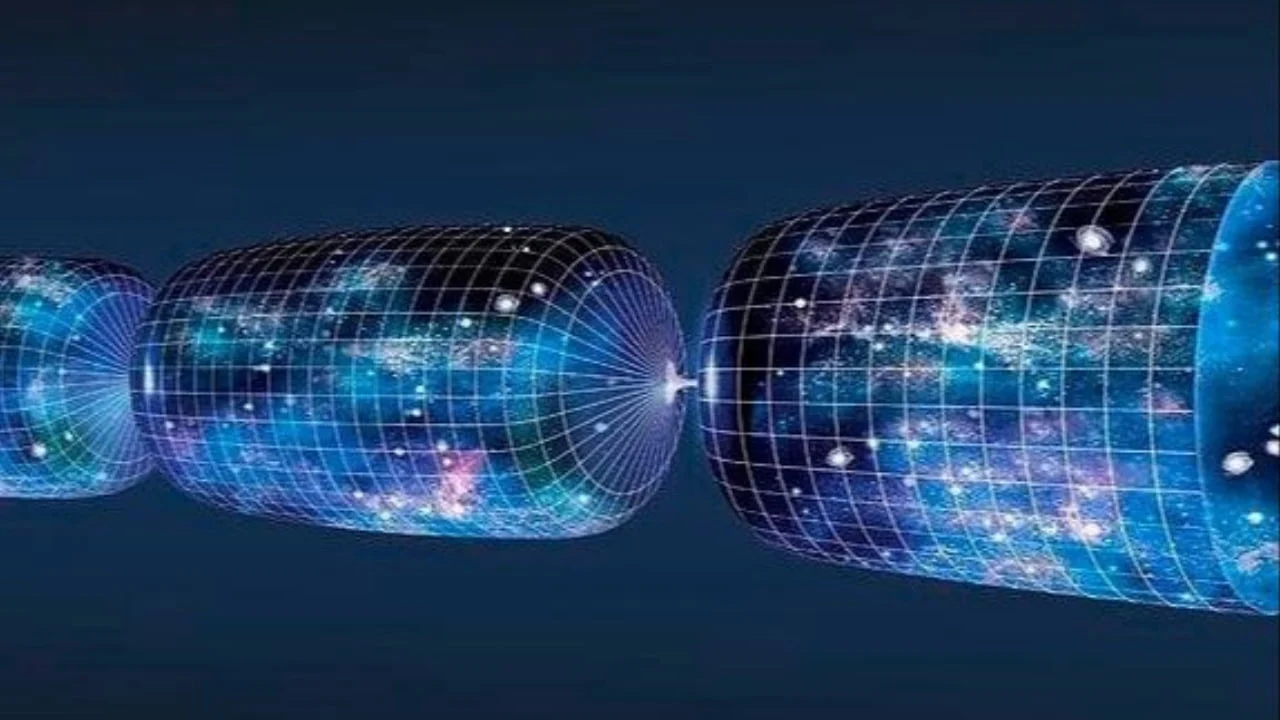
For the theory of inflation to be fully confirmed, the scientists expect the remaining of the ripples or gravitational waves occurring at the time of the BB event, to induce subtle swirls in the polarization of the CMB. But even with the most sophisticated experiments and devices, this has not been measured. It could be that these swirls are just to faint to be detected, so the model is not entirely discarded, but the absence of this confirmation can open the route to many other competing theories, such as the oscillating universe theory, where the BB was actually a bounce occurring after a long contracting period.

Cosmologist Loeb and collaborators at Harvard have predicted an oscillatory pattern in the distribution of matter throughout the cosmos that, if detected, could distinguish between inflation and this oscillatory scenario. What happened right after the BB could gives us some hints on what happened before de BB, helping us elucidate the origin of the BB, which is a mystery by itself.

Highlights:

As Nassim Haramein explains, in principle there would be no reason why creation would not be cyclical instead of one event that eventually peters out. Furthermore, the mechanism most likely has to do with black hole information exchange across Event Horizons, since the universe obeys the condition of a black hole.  From our model there are well defined Cycles and geometric nature to spacetime both at the universal scales and the quantum scale.

Additionally, following the model proposed by the Generalized Holographic Model, the mechanism resembles more information escaping from a black hole, like a proton arriving in a larger universe that has lower pressure gradients, an so inflating very rapidly to eventually reach stability. The remnant relationship that we see on the CMB maybe the entanglement information from that mother universe from which the proton escaped. This connects the Big Bounce theory to recently awarded Nobel in Physics, Roger Penrose’s CCC theory (conformal cyclic cosmology), which we will address in a following article. 

Learn more in our free Unified Science Course

Sign Up For Daily Newsletter

Be keep up! Get the latest breaking news delivered straight to your inbox.
loader

loader

loader

By signing up, you acknowledge the data practices in our Privacy Policy. You may unsubscribe at any time.
En vous inscrivant, vous reconnaissez les pratiques en matière de données dans notre politique de confidentialité. Vous pouvez vous désinscrire à n'importe quel moment.
Al registrarse, reconoce las prácticas de datos en nuestra política de privacidad. Puedes darte de baja en cualquier momento.
Share This Article
Facebook Twitter Copy Link Print
By Dr. Inés Urdaneta
Dr. Inés Urdaneta is a multi-published research physicist in the domain of light-matter interaction at the atomic, molecular, and nano/solid-state scales. In her more than 20 years of research she participated in national and international research projects throughout France, USA, México and Venezuela, on an extensive variety of topics. At present, as part of our research staff at the International Space Federation, Inés focuses on developing physical-chemical models in the frame of the generalized holographic model (GHM) and unification theory developed by Nassim Haramein, together with quantum information processes and their connection to black holes and to proto-consciousness.
Previous Article 2020 Physics Nobel Prize to Black Holes!
Next Article Graphene Proves That Brownian Motion Can Be A Source of Energy!

Stay Connected

981k Like
18.7k Follow
7.7k Follow
7.3k Subscribe

Categories

  • Astronomy106
  • Biology69
  • ISF News25
  • ISF Research14
  • Other22
  • Physics168
  • Technology36

You Might also Like

Astronomy

The Rotating Universe: Radio Galaxies and the Cosmic Dipole Anomaly

22. December 2025.
Astronomy

“Black Hole Stars” Detected at Cosmic Dawn

23. October 2025.
Astronomy

New Evidence Points to a Compact Object at the Sun’s Core

5. August 2025.
Astronomy

Image Reveals Coherently Ordered Spiral Vortex Around Milky Way’s Supermassive Black Hole

24. June 2024.
The International Space Federation (ISF)The International Space Federation (ISF)

Harnessing quantum vacuum energy for sustainable solutions – a unified approach to science, technology and education.

Quick links

  • About
  • Research Papers
  • Events
  • Invest

Explore

  • ISF Research
  • Physics
  • Technology
  • Astronomy
  • Biology
  • ISF News

Sign Up for Our Newsletter

Subscribe to our newsletter to get our newest articles instantly!

loader

Follow US
© 2023 International Space Federation. All Rights Reserved. INTERNATIONAL SPACE FEDERATION is a trademark of ISFS SA. The mark is registered in the United States under Registration No. 7772313. The ®️ symbol is used exclusively in the U.S.
  • Press
  • Careers
  • Privacy policy
  • Carrieres
  • Presse
  • Prensa
Join Us!

Subscribe to our newsletter and never miss our latest news.

loader

Welcome Back!

Sign in to your account

Lost your password?