

Graphene, one of the most important nanomaterials developed so far, continues to surprise the scientific community. This time, thanks to the extraordinary phenomena found by a group of physicists from the University of Arkansas. We are talking specifically about the capacity to use the thermal motion of atoms in graphene as a source of energy!
In this recent work, published in Physical Review E under the title Fluctuation-induced current from freestanding graphene, the team of researchers have successfully developed a circuit capable of capturing graphene’s thermal motion and converting it into an electrical current.
As it is said in this article: “The idea of harvesting energy from graphene is controversial because it refutes physicist Richard Feynman’s well-known assertion that the thermal motion of atoms, known as Brownian motion, cannot do work. Thibado’s team found that at room temperature the thermal motion of graphene does in fact induce an alternating current (AC) in a circuit, an achievement thought to be impossible.”

How the Circuit Captures Energy from Graphene
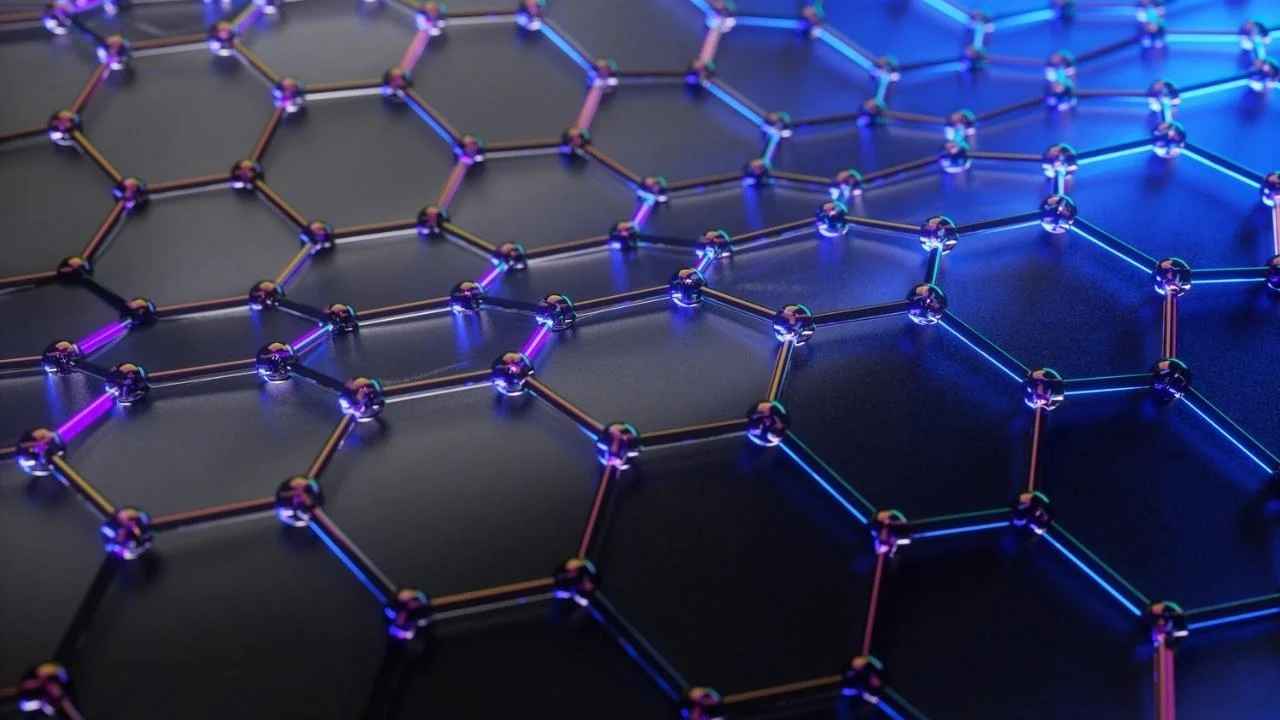
Graphene is a single layer of carbon atoms, as seen in the Figure above. This layer bends and ripples at room temperature; there is no need to induce this movement, which own its own, can provide energy if properly harvested from it. Therefore, in other words, it is a free energy device!
That is what Thibado’s group achieved by building their circuit with two diodes for converting AC into a direct current (DC). Placing the diodes in opposition allows the current to flow both ways, providing separate paths through the circuit and producing a pulsing DC current that performs work on a load resistor. Additionally, their design increased the amount of power delivered. This means that it gives more energy than is injected into it … or, in other words, it exhibits an over-unity mechanism!
As Professor Paul Thibado, leader of this research, said “… the on-off, switch-like behavior of the diodes amplifies the power delivered, rather than reducing it, as previously thought. The rate of change in resistance provided by the diodes adds an extra factor to the power.”
In this article it is said that team used a relatively new field of physics to prove the diodes increased the circuit’s power. “In proving this power enhancement, we drew from the emergent field of stochastic thermodynamics and extended the nearly century-old, celebrated theory of Nyquist”.
Technological Implications: Graphene-Based Energy Harvesting for Electronics
The low frequency current induced in the circuit by the relatively slow motion of graphene, is important from a technological perspective because electronics function more efficiently at lower frequencies. For this reason, Thibado suggests that an energy harvesting circuit based on graphene could be introduced into a chip to provide clean, limitless, low-voltage power for small devices or sensors.
If the DC current can be stored in a capacitor, it could serve as a low power battery replacement.
It is important to notice that since the system (graphene and circuit) are at the same temperature, heat does not flow between the two, so there is no violation of the second law of thermodynamics.
The fact that this effect has been harvested in Graphene, confirms the exceptional characteristics that this material has, which are to be explored further.
Highlights:
This experimental result is very important in the frame of the Generalized holographic model, based on Bekenstein-Hawking, Susskind and ‘t Hooft development of the holographic principle, were Nassim Haramein et al. consider a statistical entropy and thermodynamics approach of a surface-to-volume generalized holographic ratio, to solve from first principle calculations the proton puzzle1, the vacuum catastrophe2, and finding the electron mass3 as well.
As Nassim Haramein says about Thibado’s work “This work clearly shows that stochastic thermodynamics actually carry information or has order! This is remarkable and it supports the holographic mass solution which is statistical thermodynamics inducing the coherent energy behavior that we call mass/energy.”
This is related as well to the theory of stochastic electrodynamics. A good reference can be found in the papers from the excellent physicist Bernard Haisch (https://www.calphysics.org/research.html), in particular, his work on Zero Point Energy.
References:
1Quantum Gravity and the Holographic Mass, Haramein, N. (2012). Quantum Gravity and the Holographic Mass, Physical Review & Research International, ISSN: 2231-1815, Page 270-292
2The Electron and the Holographic Mass Solution, Val baker, A.K.F, Haramein, N. and Alirol, O. (2019). The Electron and the Holographic Mass Solution, Physics Essays, Vol 32, Pages 255-262
3Resolving the Vacuum Catastrophe: A Generalized Holographic Approach, Haramein, N & Val Baker, A. K. F. (2019). Resolving the Vacuum Catastrophe: A Generalized Holographic Approach, Journal of High Energy Physics, Gravitation and Cosmology, Vol.05 No.02(2019), Article ID:91083, 13 pages