

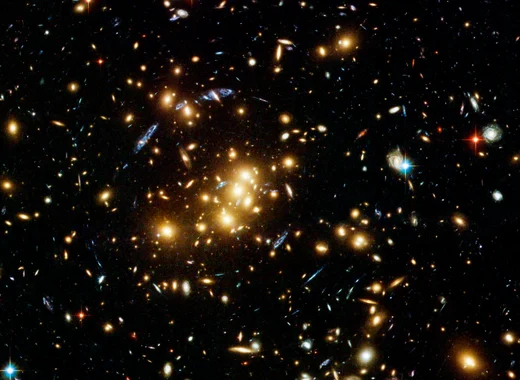
Just a couple of years ago, astronomers and astrophysicists were baffled by the observation of a synchronized behavior in galaxies, which can not be explained by their individual gravitational fields. Such was the case of a study lead by Joon Hyeop Lee, an astronomer at the Korea Astronomy and Space Science Institute, and published in The Astrophysical Journal in October 2018, reporting hundreds of galaxies rotating in sync with the motions of galaxies that were tens of millions of light years away.
Given the fact that from our known theories, in principle it would be impossible that galaxies separated by megaparsecs (millions of light years) could directly interact with each other, their interaction happens across distances that are too large to be explained by their gravitational force. It is then speculated that some unacknowledged force must be acting.
This discovery came after the 2014 study published in the journal Astronomy & Astrophysics, led by Damien Hutsemékers, an astronomer at the University of Liège in Belgium, where the team observed a similar synchronicity using the Very Large Telescope (VLT) in Chile. By watching the universe when it was only a few billion years old, the observations recorded the polarization of light from nearly 100 quasars. The team used this data to reconstruct the geometry and alignment of the black holes at their cores, and the results showed that the rotation axes of 19 quasars were parallel even though they were separated by several billion light years. The existence of correlations in quasar axes over such extreme distances constitutes a serious challenge to our cosmological principle of the universe as basically uniform and homogenous at extremely large scales.
And the evidence of this connection at cosmological scales increases with the recent study published in January 2021, addressing the so-called plane-of-satellites problem. It refers to the fact that several dwarf galaxies around the Milky Way and Andromeda co-orbit in thin, planar structures, identifying a similar case around the nearby elliptical galaxy Centaurus A (Cen A). This observation poses a real challenge for the standard Λ cold dark matter (ΛCDM) cosmological model.
As explained in the abstract of their paper, “We study the satellite system of Cen A, adding twelve new galaxies with line-of-sight velocities from VLT/MUSE observations. We find that 21 out of 28 dwarf galaxies with measured velocities share a coherent motion. Similarly, flattened and coherently moving structures are found only in 0.2% of Cen A analogs in the Illustris-TNG100 cosmological simulation, independently of whether we use its dark-matter-only or hydrodynamical run. These analogs are not co-orbiting, and they arise only by chance projection, thus they are short-lived structures in such simulations. Our findings indicate that the observed co-rotating planes of satellites are a persistent challenge for ΛCDM, which is largely independent from baryon physics.”
The standard cosmological model predicts that satellite galaxies should be randomly distributed on the hosts and should also move randomly. The observations of satellite galaxies around Centaurus A, synced kinematically into a disk-like alignment, suggests that something is wrong with the standard cosmological simulations. An idea to improvement these simulations is to include dark matter, since it is speculated that the “cosmic web,” an enormous structure supposedly made of filaments of dark matter that links galaxies across the universe, could be guiding the orbits of satellite galaxies.
Highlights:
The observations presented in this article pose a real challenge for our current cosmological models. It is becoming evident that there is something missing or wrong in our description of the universe evolution, mechanics, and dynamics.
These same observations, which rule out our current models, go in the direction of validating Nassim Haramein’s unified model, in which the alignment of galaxies and rotation axes are a direct consequence of the structure and dynamics of space-time, described from a different formalism to the conventional model. According to Nassim Haramein’s hydrodynamic model, there are regions of space that act as a superfluid, and in which quantum entanglement connects and communicates vast expanses of space. This allows, for instance, a fractal concatenation of the reference frames of each scale (from the Planck scale to the universal scale), such that the system behaves as a connected whole. The paper entitled Scale invariant unification of forces, fields and particles in a Quantum Vacuum plasma, to be published soon, explains the complete theory (see the abstract here).
In regards to the inclusion of Dark matter filaments, as “links” connecting the dynamics of galaxies, we would like to address the very recent work reporting signs of a faint gravitational tide, known as the “external field effect” or EFE, which can be observed statistically in the orbital speeds of stars in more than 150 galaxies. The effect cannot be explained by dark matter theories, though it’s predicted by what’s known as the modified Newtonian dynamics theory, also known as MOND. This study suggest that dark matter maybe could be explained by a different law of gravity!
In this sense, the generalized holographic solution provides the missing piece of the puzzle for quantum gravity, as it has been proven by the published papers Quantum gravity and the holographic mass, Resolving the vacuum catastrophe: a Generalized Holographic Approach, and The Electron and the Holographic mass solution. The vacuum catastrophe paper explains how and why dark energy and dark mass are two different aspects of the vacuum energy density. Therefore, once the vacuum energy density is properly accounted for, there is no need for dark mass and dark energy!