

For some time now we have been following the Event Horizon Telescope initiative (EHT) aiming at the obtention of the first image of the EH of a Black Hole for Sagittarius A (Sag. A*), located at the center of our own galaxy, the milky way. Given the fact that Sag. A* nuclei is much less active that Messier 87 (M87*), the image reported first is that of M87*. Even though M87* is 2000 times farther away, it is 2000 times more massive. This compensates exactly the distance, with a higher nuclei activity allowing a better resolution and faster data analysis than Sag. A*.
So finally, the day has come! The moment couldn’t be more exciting. First EHT results for the shadow of the black hole, which is 55 million light years away from Earth, with a mass 6.5 billion times the mass of our Sun and located at the center of M87*, have been announced worldwide today, April 10th 2019, at the same time by different press conferences around the globe.
I attended with deep expectation the moment when a group of five Mexican scientists announced the results in Mexico City, during the Conacyt (Consejo Nacional de Investigaciones Científicas y Tecnológicas) press conference. In this announcement the panelists explained the relevance of the event and the images shared to the public, giving more details about the international collaboration, the measurement, the calculations and, finally, the involvement of Mexico through the scientists, the equipment and the technology developed in the process.

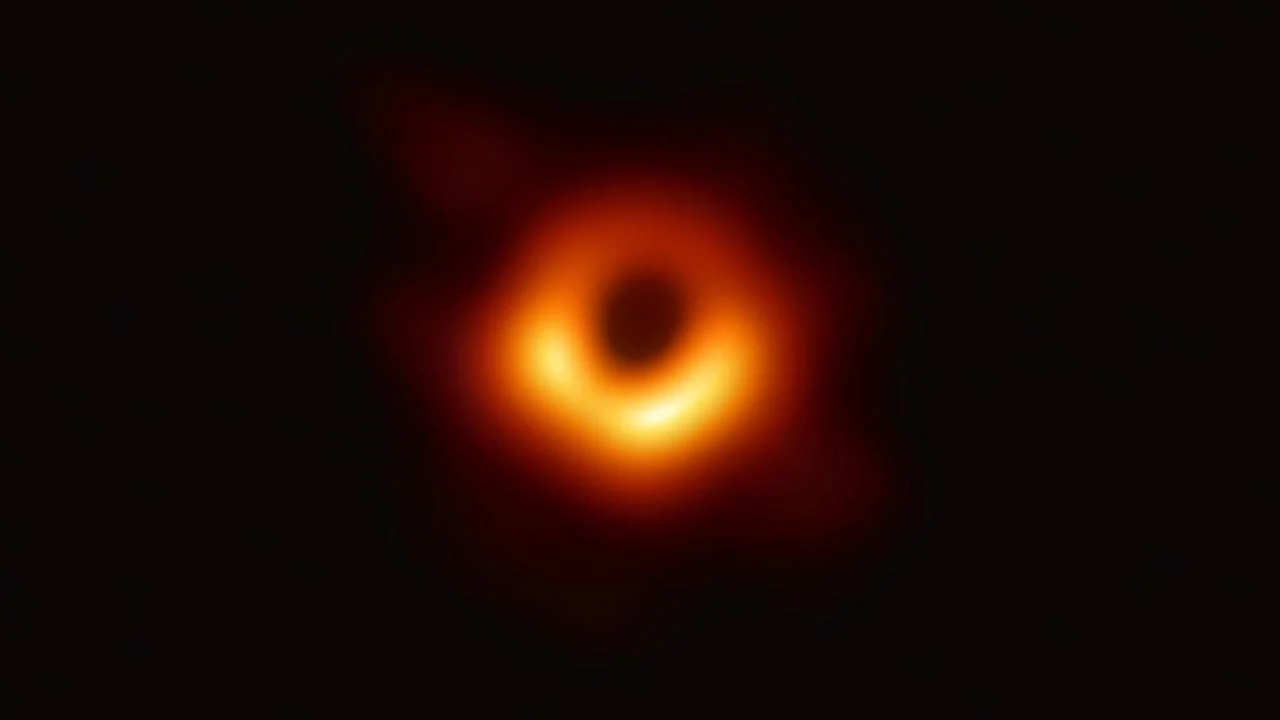
The main result, shown in Figure 1, is breathtaking. The first image of the shadow of a black hole, is finally here.


M87* is a massive galaxy (left Figure 2) located in the Virgo Cumuli of galaxies (right Figure 2). In order to understand the meaning of the image presented in Figure 1, Figure 3 can help us out. The data involved in Figure 1 collects many of the phenomena shown in Figure 3, but due to the resolution of the equipment and measurements, it doesn’t appear exactly as depicted.

Due to the gravitational curvature and light captured by the Event horizon of the black hole predicted by Einstein general relativity theory, the black hole was expected to create a dark region similar to a shadow. This was confirmed by the EHT results; the shadow being the obscure region in the center of the ring in Figure 1. The image gives a direct evidence of the BH event horizon, which can be measured in order to confirm the mass of the black hole.
A Collective International Endeavor
This unprecedented initiative has networked eight Telescopes (see Figure 4) placed in different locations and synchronized by long distance interferometry with atomic precision using hydrogen masars, in order to collect data during the Earth rotation as if it were one single telescope able of measuring 1.3 millimeter wavelengths (thermic radiation) emanating from M87* center with the highest time accuracy and with 20 microseconds of arc resolution, during four days. These were April 5, 6 and April 10 to 11, in 2017. Each telescope collected near 350 terabytes per day, which were saved in high performance helium hard disks. Data was transported by airplane to the supercomputers in Max Planck institute and MIT observatory, where they were combined to be carefully converted into a single image, using software developed for such an endeavor. Data took over two years to be fully analyzed to construct the first image reported, and at least 200 people participated in the research team.

All telescopes were chosen for working at the millimeter region, mainly for three reasons: 1) the higher energy production of the black hole happens at that bandwidth, 2) cosmic dust being smaller that the millimeter size wouldn’t interference with the measurements; we can reach very long distances with clear transparency, and 3) the atmosphere has a stronger impact on the optical bandwidth, so the signal would have too much interference when reaching the Earth.
Mexico and the EHT
The larger plate of the EHT network belongs to the Telescope Alfonso Serrano (GMT in Figure 5), located at a height of 4600 meters, in the Sierra Negra Mexican region. The size of the plate allowed a better resolution, enhanced by the lack of luminal noise at such height. A colder climate is also better suited for the type of experiment required.

The technologies, computational developments and algorithms are side products worth mentioning. Dr. Loinard pointed out as an example the thesis project by his student Dr. Katie Bouman. The algorithms created for the EHT data analysis were used for a very different objective: filming potato chips placed on a table. The sound waves surrounding them, displaced the chips with variations that could be measured by the technologies/algorithms with such resolution that the conversation being held in the vicinity of the chips could be recreated. This is an application secret services around the globe would dream of! Another huge application of the ETH research consists of camera detecting millimeter wavelength signals; this would allow detection to go through many materials. Imagine using your phone to detect a failure in your oven or printer, without having to disassemble it… now that is an invention we would aim for, and it will likely be available very soon.
Curiously, 100 years ago, the first confirmation of Einstein relativity theory occurred, when observing the total solar eclipse in 1919 during two expeditions, one to Sobral, Brazil, and the second one to Prince Island, African coast. Today, 100 years later, the theory is being validated through these results.
As a final comment, it has been remarkable being able to witness this conference in Mexico City. As archeological sites, temples and texts have shown, Mexico and Mesoamerican cultures are very active in astronomy since pre-Hispanic times, and it is inspiring to acknowledge the evolution this science has had in such millenary cultures. This topic would deserve and require a whole new article on its own.
Unified Science in Perspective
The main observation emerging from these results is the fact that black holes are now confirmed. They do exist! Models disregarding their existence could be ruled out. Additionally, a stronger validation of Einstein relativity theory is also achieved. But we would need better resolution in order to verify predicted model beyond all doubt. For example, to confirm the exact circular shape of the ring predicted by the theory.
*All Figures where provided at the press conference held by Conacyt.
More at:
- A virtual telescope the size of the Earth (https://resonance.is/a-virtual-telescope-the-size-of-the-earth/)
- First virtual reality simulation of a supermassive black hole (https://resonance.is/first-virtual-reality-simulation-of-a-supermassive-black-hole/)