

Scientists have made a significant advancement in understanding one of the most fundamental aspects of our physical world – how light interacts with matter at the quantum level. In a new study published in Physical Review Letters [1], researchers have developed a comprehensive mathematical framework that provides an exact description of how single particles of light (photons) interact with matter in complex optical environments. This breakthrough has far-reaching implications for technologies ranging from quantum computers to ultra-efficient solar cells, and even our understanding of natural processes like photosynthesis.
The Quantum Nature of Light and Matter
When light interacts with matter at the microscopic scale, the rules of quantum mechanics take over, leading to strange and counterintuitive behaviors that have puzzled scientists for decades. Understanding these interactions is crucial for developing new technologies like quantum computers, ultra-secure communication systems, and highly efficient solar cells. However, accurately describing these interactions mathematically has proven extremely challenging, especially in complex optical systems like nanoscale devices and optical cavities.
At its most fundamental level, the interaction between light and matter involves the exchange of energy and momentum between electromagnetic fields and charged particles. When a photon – the elementary particle of light – encounters matter, it can be absorbed, scattered, or trigger the emission of another photon. These interactions are governed by quantum electrodynamics (QED).
Understanding the “shape” of a single photon adds another layer of complexity to this interaction. While we often think of photons as point-like particles, they actually possess a three-dimensional electromagnetic field distribution that can be measured and manipulated. This field distribution, or “photon wavefunction,” determines how the photon interacts with matter at different points in space and time. Using sophisticated quantum tomography techniques, scientists can reconstruct this shape by measuring the photon’s interaction with carefully prepared atomic systems and specialized detectors.
The Challenge of Light-Matter Interactions
When light interacts with matter – whether it’s sunlight hitting a solar panel or laser light manipulating quantum bits – the process is far more complex than our everyday experience suggests. At the quantum level, these interactions involve an intricate dance between light particles and the atoms or molecules they encounter. In quantum mechanical terms, light exists as both a wave and a particle, described by Maxwell’s equations in its wave form and by discrete photons in its particle form. When light interacts with matter, it couples to the quantum states of atoms and molecules, which have discrete energy levels determined by the arrangement of their electrons.
The quantum mechanical principle of superposition means that when a photon interacts with matter, the system enters a state where multiple quantum pathways exist simultaneously. This quantum mechanical dance involves virtual photons – temporary and extremely fast disturbances in the electromagnetic field that mediate the interaction between real photons and matter. Traditional approaches to modeling these interactions often rely on the Jaynes-Cummings model, which describes a simplified version of how a two-level quantum system interacts with a single mode of the electromagnetic field. However, real optical environments support an infinite number of electromagnetic modes, making exact calculations traditionally impossible without approximations.
The New Approach: Pseudomode Transformation
This research led by scientists working in quantum optics, introduces an innovative mathematical approach that transforms our ability to describe and predict these quantum interactions. At its heart, it involves a clever mathematical trick: converting the infinite number of possible ways light can behave into a discrete set of what the researchers call “pseudomodes” – mathematical constructs that capture all the essential physics while making the calculations manageable without the need for traditional approximations.
To understand the significance, imagine trying to describe all the possible ways ripples can move across a pond. Previously, scientists had to consider an infinite number of possible ripple patterns, making exact calculations nearly impossible. The new approach is like finding a way to describe all possible ripple patterns using just a finite set of fundamental patterns that, when combined, can reproduce any possible ripple state. This makes previously intractable calculations not only possible but practical.
These pseudomodes are not physical modes of the electromagnetic field, but rather mathematical constructs that encode all the relevant information about how the field interacts with matter. Each pseudomode represents a collection of real electromagnetic modes that interact with matter in a similar way. By transforming the problem into the pseudomode basis, researchers can exactly solve the quantum dynamics without making approximations.
The breakthrough here lies in the completeness and exactness of the description. Previous approaches have always required some form of simplification or approximation, potentially missing important quantum effects. This new framework captures everything – from the initial interaction between light and matter to how the light propagates away into space.
The implications of this breakthrough are far-reaching. In the world of quantum computing, for example, the ability to precisely control and understand light-matter interactions is essential for creating quantum bits (qubits) – the basic building blocks of quantum computers. The new framework provides engineers and scientists with a more accurate and practical tool for designing and optimizing quantum devices.
Experimental Validation: The Silicon Microsphere
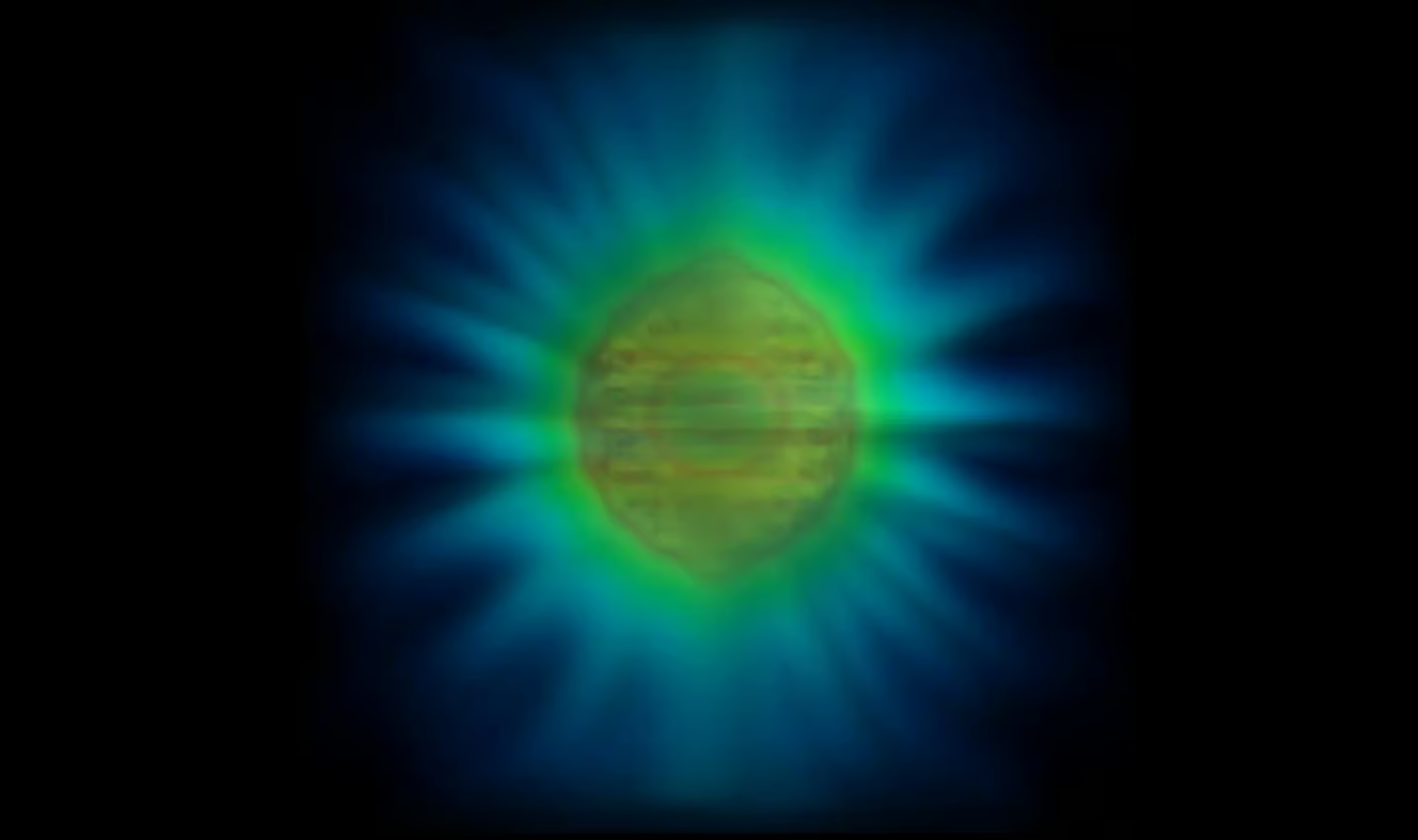
To demonstrate their framework, the researchers applied it to a specific example: a quantum emitter (like a single atom or quantum dot) interacting with a spherical silicon resonator: a silicon microsphere – a tiny ball of silicon about one-hundredth the width of a human hair. When light interacts with this microsphere, it can become trapped in whispering gallery modes – special electromagnetic modes that circle the sphere’s surface through total internal reflection. These modes couple to quantum emitters near the sphere’s surface in complex ways that depend on the geometry and material properties of the system.
This seemingly simple system exhibits rich quantum behavior, including the exchange of energy between the emitter and the resonator in a phenomenon known as Rabi oscillations. The new framework perfectly captured these complex dynamics, including subtle effects that previous approaches missed.
The pseudomode transformation reveals how these whispering gallery modes combine with radiation modes to produce the observed quantum dynamics. This includes subtle effects like frequency shifts, modified emission rates, and quantum entanglement between the emitter and field – all of which are crucial for applications in quantum technology.
Advanced Quantum Effects
The framework captures advanced quantum effects like strong coupling, where the interaction between light and matter becomes so strong that they can no longer be treated separately. In this regime, hybrid light-matter states called polaritons form, which have properties of both light and matter. Understanding these hybrid states is crucial for developing quantum memories and other quantum devices.
One of the most remarkable aspects of the new approach is its ability to capture what scientists call “non-Markovian” effects – subtle quantum phenomena where the past history of a system influences its future behavior in complex ways. Previous mathematical frameworks often had to ignore or approximate these effects, leading to less accurate predictions. The new method accounts for these effects exactly, opening up new possibilities for harnessing quantum phenomena in technology.
The Technical Innovation
For those interested in the more technical aspects, the key innovation lies in how the researchers transformed the continuous spectrum of electromagnetic modes into a discrete set of pseudomodes. This transformation preserves all the quantum mechanical properties of the system while making it mathematically tractable.
Unlike previous approaches that often lost information about quantum correlations or required artificial boundaries between “system” and “environment,” this new framework maintains a complete description of all quantum effects while remaining computationally manageable.
The framework’s ability to describe both the behavior of light near the optical device (the “near field”) and far away from it (the “far field”) is particularly noteworthy. This comprehensive description is crucial for understanding how quantum devices will actually perform in real-world applications, where both near and far-field effects play important roles.
Perhaps most excitingly, the research provides, for the first time, an exact picture of how a single photon is emitted by a quantum emitter into its environment. This fundamental process, while central to quantum optics, had never been described with such precision before. The researchers even created animations showing this emission process in both short and long time limits, providing new insights into this fundamental quantum phenomenon.

Real-World Applications
This theoretical breakthrough has significant practical implications across multiple fields among which we find:
Quantum Computing: More precise control of light-matter interactions could lead to better quantum bits (qubits) for quantum computers, potentially accelerating the development of practical quantum computing systems.
Nanophotonic Devices: Improved understanding of how light behaves in nanoscale devices could lead to more efficient optical communications technology and better photonic circuits.
Solar Energy: Better models of light-matter interaction could help in designing more efficient solar cells and other light-harvesting devices.
Biological Systems: The framework could help us better understand natural light-harvesting systems like photosynthesis, potentially leading to bio-inspired technological innovations.
Looking to the Future
This breakthrough represents more than just a mathematical advancement – it provides a new lens through which we can understand and manipulate the fundamental interactions between light and matter.
The researchers suggest their framework could be particularly valuable for developing new types of quantum devices that rely on precise control of light-matter interactions. It could also help in understanding and optimizing the behavior of existing devices, from simple optical fibers to complex quantum computers.
This development represents a significant step forward in our ability to understand and control light-matter interactions at the quantum level. While the underlying mathematics may be complex, the implications are clear: we now have a better tool for designing and optimizing quantum devices, understanding natural light-harvesting systems, and pushing the boundaries of what’s possible in quantum technology.
As we continue to develop technologies that rely on precise control of light and matter, having exact mathematical tools to describe these interactions becomes increasingly important. This breakthrough provides exactly that – a foundation upon which future innovations in quantum technology can be built.
Unified Science in Perspective: The Role of the Electromagnetic Vacuum
A crucial aspect often overlooked in simplified models is the role of the electromagnetic vacuum – the quantum ground state of the electromagnetic field. In this seemly “empty” state, quantum fluctuations create and annihilate virtual photons continuously, affecting how real photons interact with matter. These vacuum fluctuations not only lead to effects like the Lamb shift and spontaneous emission, which the new pseudomode framework can describe precisely, they are at the very origin of mass and forces [2] as shown by Haramein et al. in their latest paper (2023) “The Origin of Mass and the Nature of Gravity.”
This complementary theoretical framework suggests that the vacuum structure itself—the same quantum vacuum that affects light-matter interactions—plays a fundamental role in generating both mass and gravitational effects through quantum vacuum fluctuations. Haramein’s work proposes that microscopic black hole-like structures exist at the Planck scale throughout space, forming a quantum vacuum architecture that gives rise to mass, confining forces inside the proton, and gravity, in terms of a pressure gradient. Such geometric structure of spacetime directly influences how light and matter interact at the quantum level. When combined with the pseudomode transformation framework, this provides a more complete picture of how quantum fields, gravity, and matter are fundamentally interconnected.
The quantum vacuum fluctuations that mediate light-matter interactions in our framework may be manifestations of these deeper vacuum structures. The pseudomode transformation could potentially be extended to incorporate these gravitational effects, particularly in systems where light-matter interactions occur in strong gravitational fields or at scales where quantum gravitational effects become significant.
Implications for a Unified Field Theory
This connection between light-matter interactions and quantum gravity opens new avenues for testing unified field theories. The precise mathematical framework developed for light-matter interactions could potentially be adapted to study how the quantum vacuum’s structure influences both electromagnetic and gravitational phenomena. This becomes particularly relevant when considering:
1. The role of vacuum energy density in both light-matter interactions and gravitational effects.
2. The possibility that photon-matter coupling might be influenced by local spacetime geometry.
3. The potential connection between electromagnetic vacuum fluctuations and the microscopic structure of spacetime.
These considerations suggest that our understanding of light-matter interactions might provide a window into the fundamental nature of space, time, and gravity itself. The mathematical precision of the pseudomode transformation framework could potentially be extended to describe how the quantum vacuum’s structure, as proposed by Haramein et al., influences both electromagnetic and gravitational phenomena at the quantum scale.
For more on the electromagnetic quantum vacuum fluctuations, please read Nassim Haramein’s article: What is Zero Point Energy?
References
[1] Ben Yuen et al, Exact Quantum Electrodynamics of Radiative Photonic Environments, Physical Review Letters (2024). https://doi.org/10.1103/PhysRevLett.133.203604
[2] Nassim Haramein, Cyprien Guermonprez, & Olivier Alirol. (2023). The Origin of Mass and the Nature of Gravity. DOI: 10.5281/zenodo.8381114.