


In our daily lives, we’re surrounded by waves. From the sound waves that carry our voices to the electromagnetic waves that power our wireless devices, waves are fundamental to how we interact with and understand our world. Scientists and engineers have long used waves to explore and measure everything from the depths of the ocean to the composition of distant stars. Now, a groundbreaking study has revealed a new way to understand how these waves carry information about the objects they encounter.
A team of physicists has discovered that electromagnetic waves scattered by an object contain detailed, locally defined information about that object’s properties. This information, quantified by a concept called Fisher information, flows through space in a way that’s analogous to how energy flows in electromagnetic fields. Just as the famous Poynting vector describes energy flow in electromagnetism, the team has introduced a new “Fisher information flux” that tracks the flow of information in wave fields.
This revolutionary research published in Nature physics [1], opens up new possibilities for understanding and manipulating electromagnetic waves in various applications, from medical imaging to telecommunications. The implications of this discovery are far-reaching and could potentially revolutionize our approach to wave-based technologies.
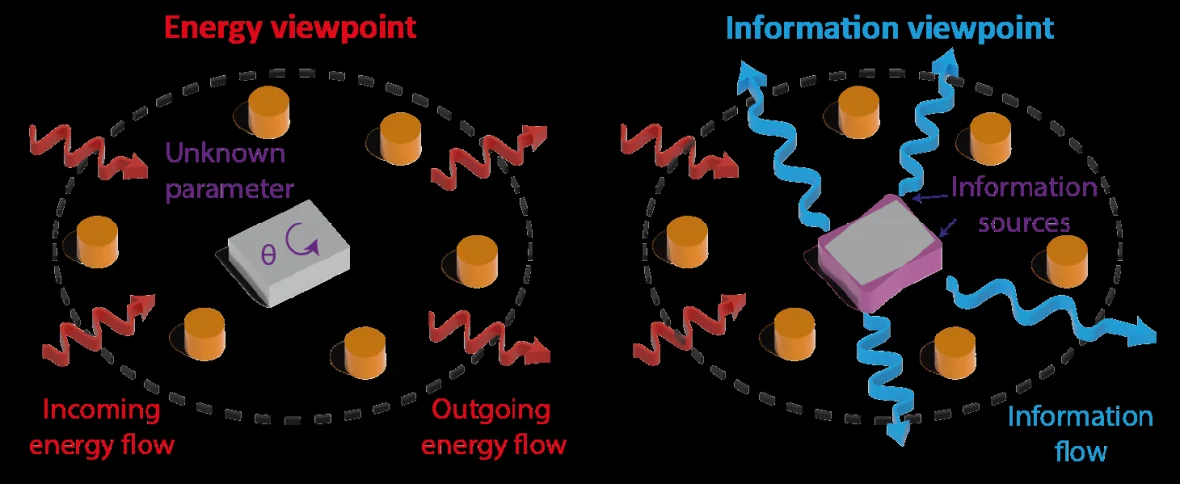
This new understanding of information flow is based on three key characteristics:
- Local definition: The Fisher information content can be assigned to specific points in space, much like energy density in electromagnetic fields. This localization allows for precise mapping of information distribution within a wave field.
- Conservation: The flow of Fisher information follows a continuity equation, similar to how energy is conserved in electromagnetic waves.
- Measurability: The researchers have demonstrated that this information flow can be experimentally observed and quantified using microwave experiments. This practical aspect of the discovery paves the way for real-world applications and further empirical studies
The concept of Fisher information isn’t new – it’s been used in statistics and data analysis for decades. In simple terms, Fisher information quantifies how much a signal tells us about a particular parameter we’re trying to measure. What’s revolutionary about this new work is the realization that Fisher information has a physical presence in wave fields, with its own density and flow patterns.
Previous studies have looked at how to maximize the Fisher information collected by detectors or how to shape input waves to get the most information out of a system. However, until now, little was known about how information is created when waves interact with an object and how that information propagates through complex environments. This new research opens up the “black box” of information flow between a target object and our detectors.
To visualize this concept, imagine dropping a pebble into a pond. The ripples that spread out carry information about the pebble’s size, shape, and the point where it hit the water. Now, picture being able to see not just the ripples, but also a colored “information field” that shows exactly where and how the information about the pebble is flowing through the water. That’s essentially what this new theory allows scientists to do with electromagnetic waves.
The researchers demonstrated their theory using a clever experimental setup. They created a complex scattering environment in a microwave waveguide – essentially a metal box that guides microwaves. Inside this box, they placed a movable metal target surrounded by small Teflon scatterers. By precisely measuring the microwave fields around the target as it was moved slightly, they were able to map out the flow of Fisher information about the target’s position (Fig. 2).
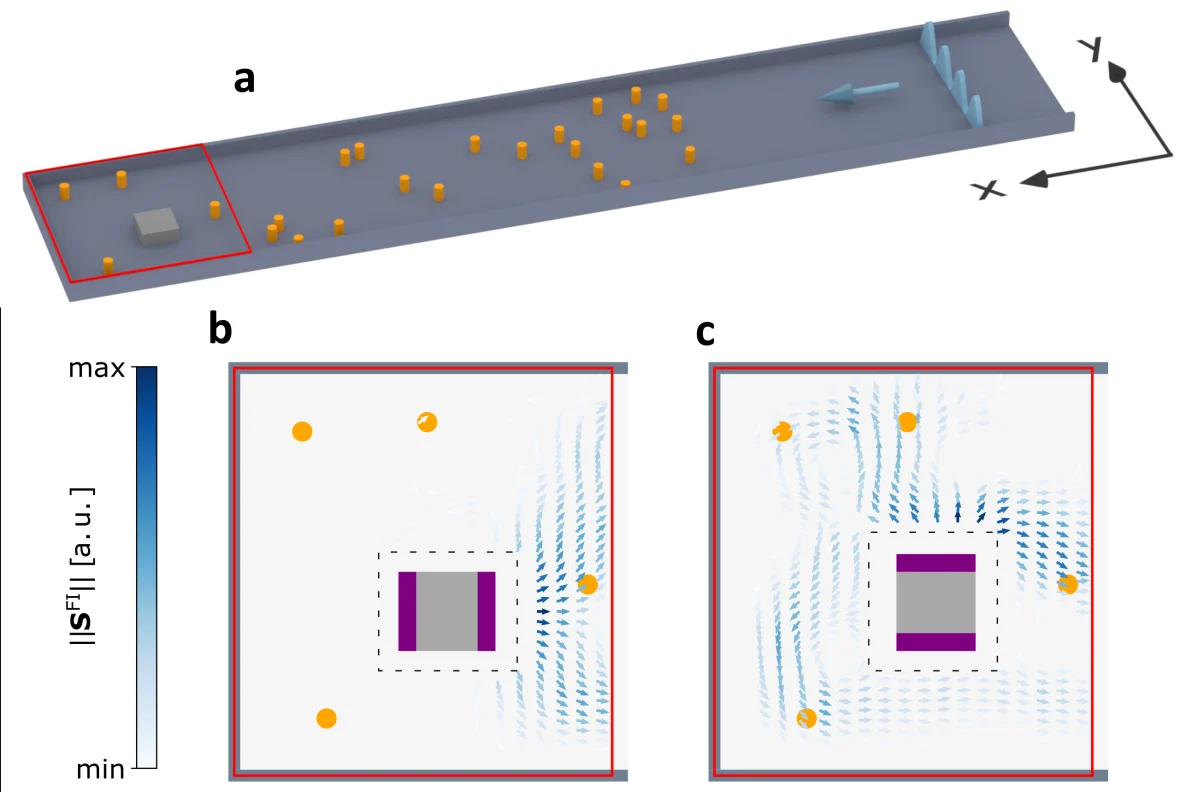
Here’s how the experiment worked:
- Microwaves were injected into the waveguide from one end.
- The waves scattered off the target and the surrounding Teflon objects.
- Sensitive antennas measured the resulting microwave field at many points around the target.
- The target was moved slightly, and the measurements were repeated.
- By comparing the two sets of measurements, the researchers could calculate the Fisher information flux at each point.
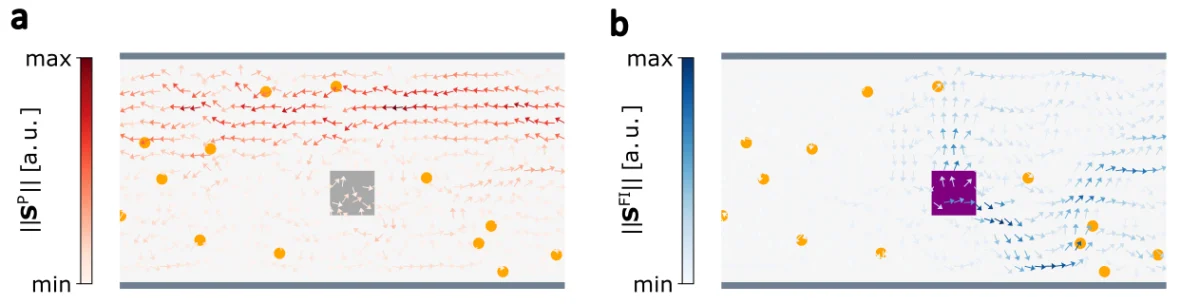
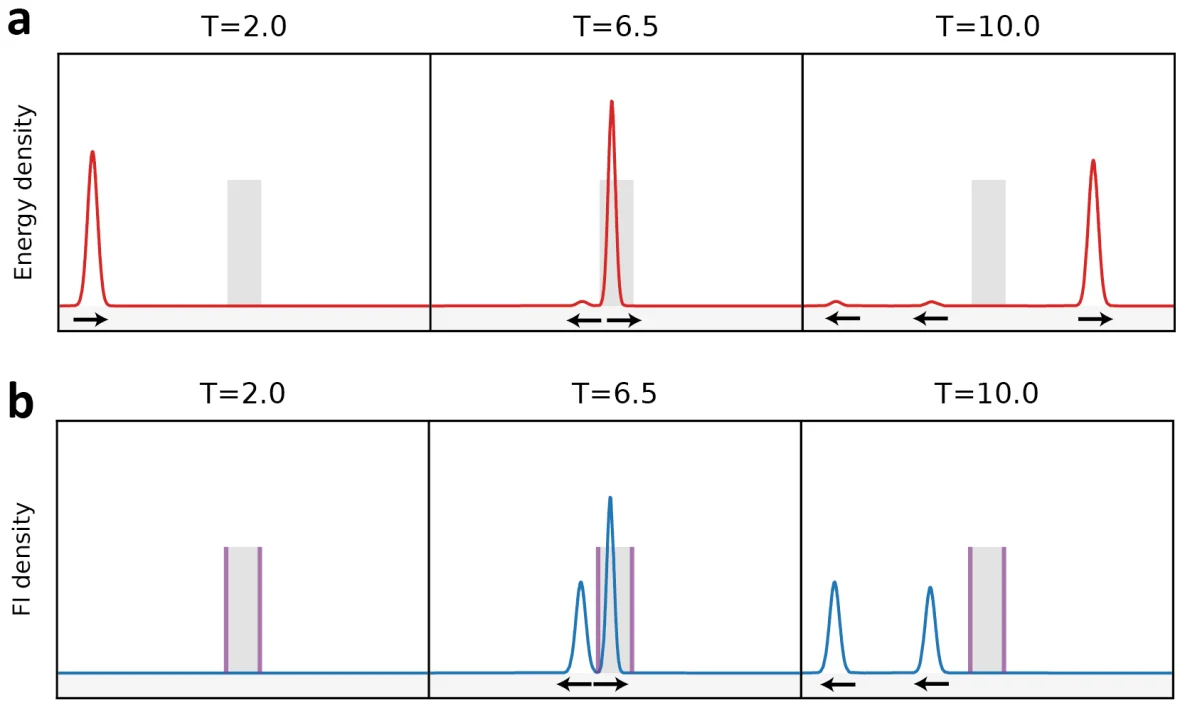
One of the most surprising findings from this work is that the flow of energy and the flow of information can be decoupled (Fig. 3). The researchers demonstrated this with a simulation where most of the wave energy was transmitted through a system, but almost all of the Fisher information flowed in the opposite direction. This has potential applications in secure communication, where you might want to send information in one direction while minimizing the detectable energy in that same direction.
To understand the technical details of how Fisher information propagates, the researchers derived a continuity equation that describes its flow. This equation shows that Fisher information is created at “sources” – areas where the electromagnetic field changes when the parameter of interest (like the target’s position) is varied. The information then flows away from these sources, either propagating out of the system or being reabsorbed by “sinks” such as areas with energy dissipation.
The mathematical framework developed in this study goes beyond just static situations. The researchers extended their theory to the time domain, showing how Fisher information is generated and stored in wave packets as they propagate. This temporal aspect is crucial for understanding how information builds up in a system over time (Fig. 4).
The researchers also made connections to quantum mechanics. They showed that the integrated Fisher information density in their framework corresponds to the quantum Fisher information of coherent light states. This provides a solid theoretical foundation for their work and suggests that the framework could be extended to other quantum systems.
Unified Science in Perspective
While this research was focused on electromagnetic waves, the underlying principles could potentially be applied to other types of waves, such as acoustic waves used in ultrasound imaging or seismic waves used to study the Earth’s interior. This broad applicability makes the work particularly exciting for fields ranging from medical imaging to geophysics.
This discovery bridges the gap between abstract mathematical concepts and physical reality, providing a new tool for scientists and engineers to analyze and manipulate wave phenomena. It could lead to improvements in various fields, such as:
- Medical imaging: Enhanced techniques for interpreting scattered waves in ultrasound or MRI scans.
- Telecommunications: More efficient ways to encode and transmit information using electromagnetic waves.
- Remote sensing: Improved methods for detecting and analyzing objects from a distance using radar or other wave-based technologies.
- Quantum information: New insights into the behavior of quantum systems and potential applications in quantum computing.
The implications of this new understanding of information flow are far-reaching. In fields like levitated optomechanics, where scientists are trying to cool tiny particles to their quantum ground state, knowing exactly how information about a particle’s position radiates out could lead to more efficient detection schemes. In imaging and sensing applications, this framework could guide the design of new systems that maximize the collection of relevant information.
As our world becomes increasingly reliant on precise measurements and efficient information transfer, theories like this one that provide a fundamental understanding of how information propagates through physical systems will become ever more crucial. This work opens up new possibilities for tracking and designing the flow of information, even in complex, disordered environments. It’s a significant step forward in our ability to use waves not just to see the world, but to truly understand it.
References:
[1] Hüpfl, J., Russo, F., Rachbauer, L.M. et al. Continuity equation for the flow of Fisher information in wave scattering. Nat. Phys. (2024). https://doi.org/10.1038/s41567-024-02519-8