

There is a strange and recurring theme running through modern biophysics: magnetic fields far too weak to break, bend, or even noticeably jostle a molecule nonetheless seem to change what living systems do. Migratory birds navigate by a field roughly twenty times weaker than the one holding a note to your refrigerator. Plant growth shifts [1]. Bacterial behavior shifts [2]. Cellular physiology shifts [3]. And the energies involved are so tiny — hundreds of times smaller than the ambient thermal jostling of molecules at body temperature — that classical chemistry has no obvious way to account for the effect at all.
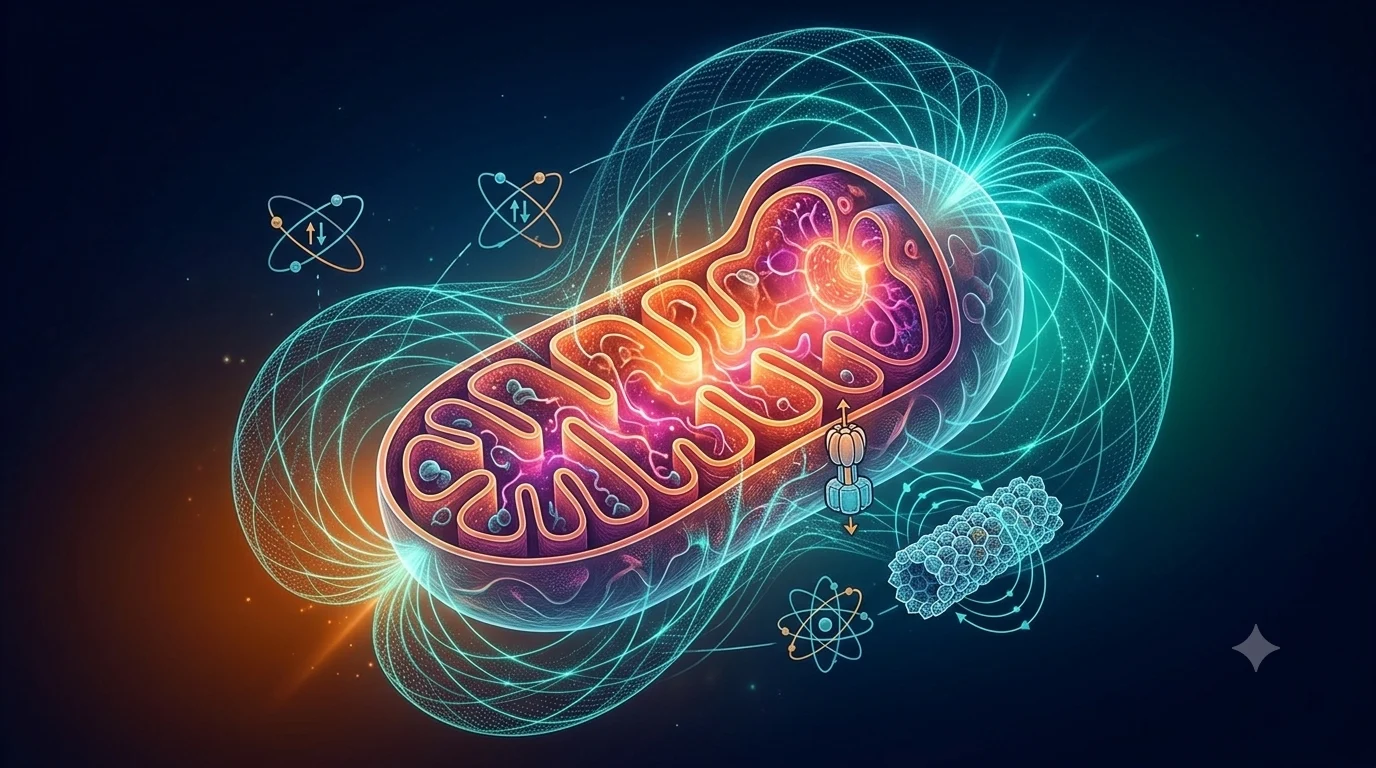
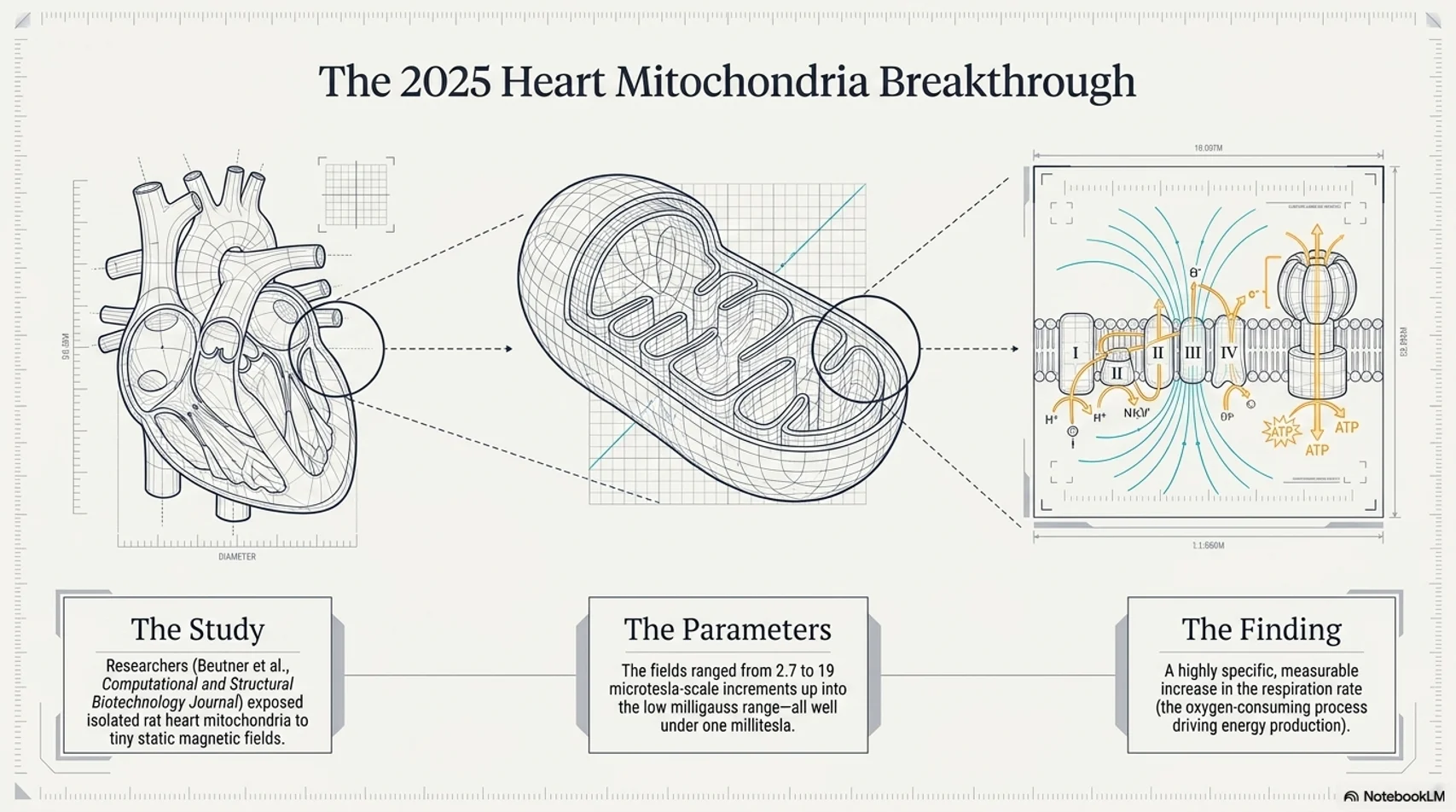
A 2025 paper in Computational and Structural Biotechnology Journal adds a clean and carefully controlled entry to this list [4]. Working with mitochondria — the membrane-bound organelles that generate most of a cell’s usable energy — a team led by Gisela Beutner and Shey-Shing Sheu found that a weak static magnetic field can measurably increase the energy-producing activity of isolated heart mitochondria, while simultaneously reducing their output of damaging reactive byproducts. The effect is small, it is specific, and its shape is peculiar in a way that points toward a distinctly quantum explanation.
The finding: a narrow window that flips a switch
The researchers took mitochondria isolated from adult rat hearts and exposed them to a static magnetic field while measuring their respiration — the oxygen-consuming process that drives energy production. The fields were tiny: from roughly 2.7 to 19 microtesla-scale increments up into the low milligauss range, all well under one millitesla, which is itself already thousands of times weaker than a typical fridge magnet.
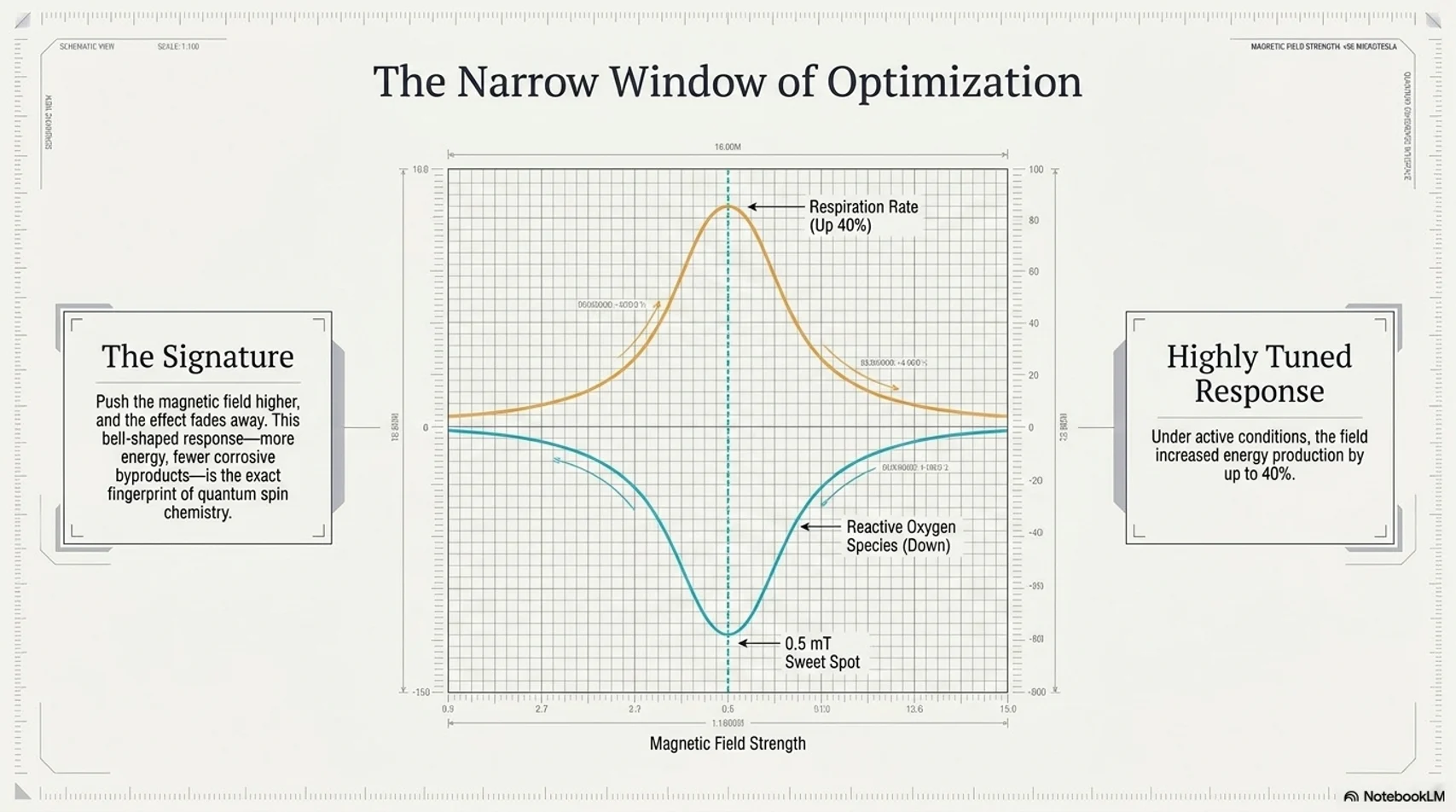
Under active, energy-producing conditions, a field in a narrow window centered around half a millitesla increased the mitochondrial respiration rate by up to roughly 40 percent. Push the field higher, and the effect faded away again. This rise-then-fall pattern — an effect that grows, peaks, and then reverses as the field strengthens — is what researchers call a bell-shaped response, and it is a signature worth paying attention to.
The team traced the effect through the machinery of energy production. Several of the large protein complexes that carry out oxidative phosphorylation — Complexes II, III, and V — showed the same bell-shaped boost, as did two enzymes of the citric acid cycle. Complex I, notably, did not respond. And in a mirror-image twist, the mitochondria’s production of reactive oxygen species — the corrosive byproducts implicated in aging and tissue damage — dropped in an inverted bell shape over the same field range. More energy, fewer harmful byproducts, all from a whisper of a magnetic field.
Crucially, the boost survived a stress test. Mitochondria taken from hearts subjected to a simulated heart-attack injury — ischemia followed by reperfusion — showed the same proportional gain. That detail is what gives the result its medical intrigue.
Why classical physics struggles here
The puzzle is energetic. The interaction between such a weak magnetic field and the electrons inside these enzymes is orders of magnitude smaller than the thermal energy sloshing through the system at body temperature. By the ordinary logic of chemistry, an influence that faint should be drowned out completely — like trying to hear a pin drop over a jet engine. And yet the effect is there, it is reproducible, and it has a characteristic shape.
This is precisely the fingerprint that points physicists toward a mechanism from quantum spin chemistry: the radical pair mechanism. The idea has become the leading explanation for how birds sense the geomagnetic field, and it works not by brute force but by influencing probabilities.
How the radical pair mechanism works
Many chemical reactions pass through a fleeting intermediate in which two molecules each carry a single unpaired electron — a ‘radical pair.’ The two electron spins can be aligned in one of two configurations: a singlet state, where the spins oppose one another, or a triplet state, where they align. These two states funnel the reaction toward different outcomes and at different rates.
The key is that the pair can oscillate between singlet and triplet — and the rate of that interconversion is exquisitely sensitive to magnetic influences, both from an external field and from the tiny magnetic fields of nearby atomic nuclei. Because the reaction is deciding between pathways rather than being pushed over an energy barrier, a vanishingly small magnetic nudge can tilt the balance. The energy of the field does not need to compete with thermal noise; it only needs to bias a quantum coin-flip that the chemistry then amplifies.
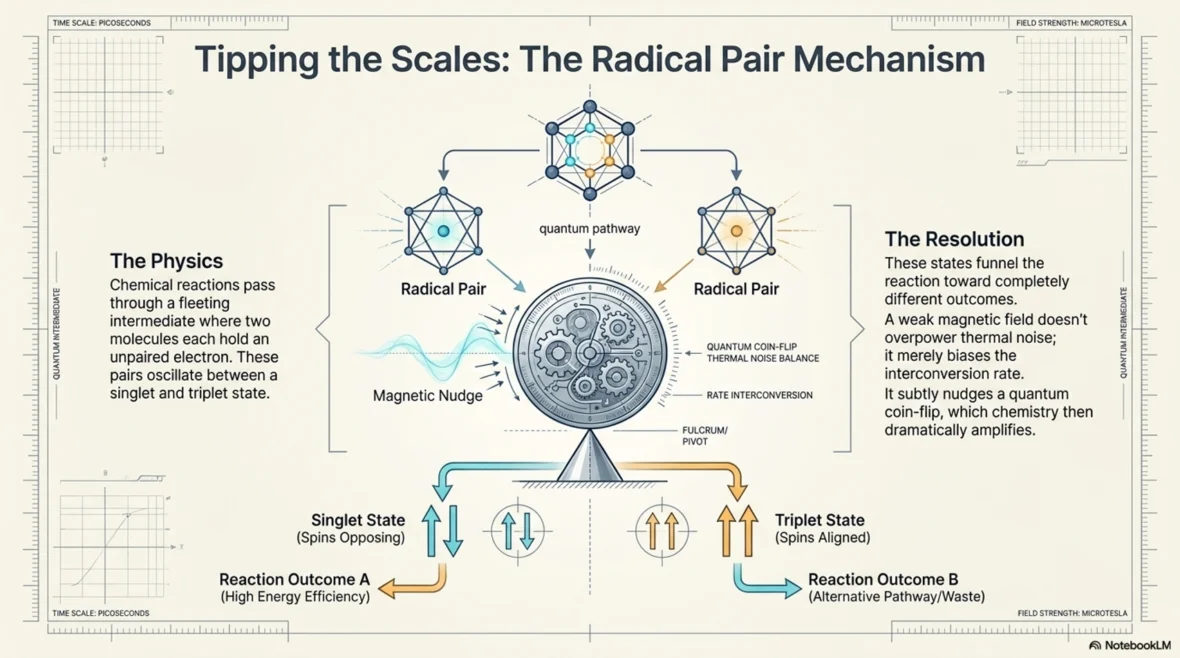
Beutner and colleagues propose exactly this. In their picture, the iron-bearing cytochromes and iron-sulfur clusters threaded through the respiratory complexes host transient radical pairs whose singlet-triplet balance the weak field can shift. The bell shape falls out naturally: at first the field enhances the productive spin state, but as it strengthens a competing effect takes over and suppresses it again. The authors are careful to note they have not yet captured these radical pairs directly — that would require spin-resolved spectroscopy — but the pattern is what the theory predicts.
A longer and more contested backstory
Beutner’s paper does not arrive in a vacuum. It steps into a decades-long and genuinely unsettled conversation about whether — and how — magnetic effects reach into the chemistry of energy metabolism.
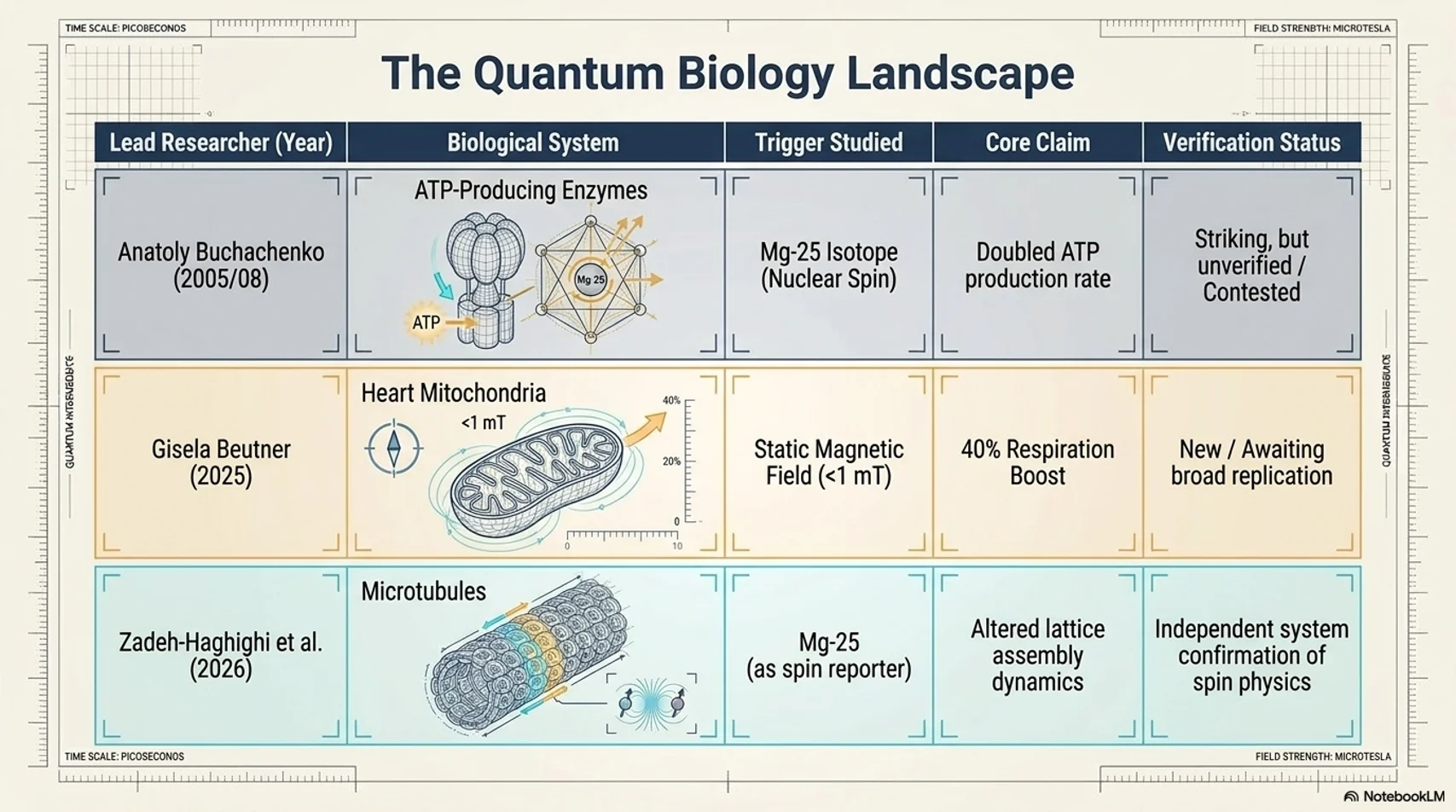
The most provocative chapter belongs to the Russian chemist Anatoly Buchachenko and his collaborators. Beginning in the mid-2000s, they reported something remarkable: that replacing ordinary magnesium in ATP-producing enzymes with magnesium-25 — the one stable magnesium isotope whose nucleus carries a spin, and therefore a tiny magnetic moment — could double or more the rate of ATP synthesis [5]. Ordinary magnesium-24 and magnesium-26, which are spinless, did nothing of the sort. If real, this ‘magnetic isotope effect’ would be a direct demonstration that ATP synthesis runs through a spin-sensitive radical pair, exactly the kind of quantum chemistry Beutner now invokes.
Buchachenko’s group extended the claim across several enzymes and even built experimental drug-delivery vehicles — magnesium-25-loaded nanoparticles aimed at boosting energy production in oxygen-starved heart tissue [6]. The vision was bold: harness a quantum-nuclear effect as a cardiac therapy.
But the isotope claim has never been independently confirmed, and this is where the scientific method exhibits its power to fact-check. In 2012, an independent team working across Trinity College Dublin and the University of Essex set out to reproduce the magnesium-25 effect in creatine kinase, one of the very enzymes Buchachenko had studied. They found nothing — no isotope effect, and no effect from external magnetic fields up to a full tesla [7]. A commentary in the same journal by the Oxford spin-chemistry expert Peter Hore underscored the broader pattern: reports of weak-field effects on biology are common, but the ones subjected to independent replication have usually failed to reproduce [8,9]. Buchachenko’s group has argued that trace iron contamination quenches the effect and explains why others cannot find it — a physically plausible point, but one that also makes the claim difficult to falsify.
Buchachenko has continued to press the idea forward, extending it in a 2026 review to oncology: he proposes that the same nuclear-spin effect — using magnetic isotopes of magnesium, calcium, and zinc to throttle DNA replication in tumor cells — could become the basis of a magnetic anti-cancer therapy, and he presents mortality data in which these isotopes appear to kill cancer cells far more readily than healthy ones [10]. It is a striking vision, but the work remains a single-group program reviewing its own results, resting on the same independently-unconfirmed foundation as the original ATP claim; the dramatic cell-killing figures come from the group’s own earlier studies, and even the radical-pair physicists it draws on treat magneto-oncology as a possibility to be rigorously tested and guarded against artifact, not an established effect.
The upshot, stated plainly: the specific magnesium-25 effect on ATP-producing enzymes remains a striking but unverified single-program claim. What has held up far better is the more general principle — that radical pair chemistry is real, is magnetically sensitive, and does appear in biology. That is the firmer ground on which Beutner’s work stands.
A companion result in a very different system
Readers following this thread will recall our earlier coverage of a 2026 study in Science Advances from a group at the University of Waterloo and the University of Calgary — Zadeh-Haghighi, Craddock, Simon, and colleagues — reporting that magnesium isotopes influence the assembly of microtubules, the structural filaments of the cell [11] (See our earlier article: Quantum Spin Effects Drive Microtubule Assembly).
It is worth being precise about how these results relate, because it is tempting to overstate the connection. Beutner’s study concerns respiration in mitochondria; the Waterloo study concerns a completely different reaction — the hydrolysis of GTP during microtubule growth — in a completely different structure. They are not the same experiment, and, importantly, the microtubule team was explicit that they could not identify the specific radicals involved, and that they were treating magnesium-25 as a spin reporter on some nearby radical rather than adopting Buchachenko’s specific magnesium-radical chemistry.
What links the three lines of work is not a shared molecular mechanism but a shared physical principle: that weak magnetic fields and nuclear spins can steer biochemical reactions through radical pair intermediates. Three independent systems — mitochondrial respiration, microtubule assembly, and, more contentiously, enzymatic ATP synthesis — all pointing, from different directions, at the same underlying quantum physics. Each is at a different stage of confirmation. Together they suggest the phenomenon is worth taking seriously. As Zadeh-Haghighi and Simon put it “hundreds of studies have found that weak magnetic fields can significantly influence various biological systems” [12].
From organelle to organism
If the effects above live at the scale of single proteins and filaments, a striking 2020 study in Cell Metabolism [3] pushes the same theme up to the level of a whole living animal — and it is worth dwelling on, because it is one of the most rigorous demonstrations we have that weak fields can reach into metabolism.
A large team led by Calvin Carter and Val Sheffield at the University of Iowa exposed mouse models of type 2 diabetes to a combination of a weak static magnetic field and a static electric field — roughly a hundred times the strength of Earth’s own fields, but still far too weak to break a bond. Within days, the animals’ insulin sensitivity improved markedly and their glucose tolerance normalized, with no detectable adverse effects. Human liver cells showed a compatible response, hinting the effect is not a quirk of rodents.
The mechanism is where it connects to everything above — and where a subtle but important distinction lives. The researchers traced the benefit to the cell’s redox machinery, and specifically to mitochondrial superoxide in the liver. When they used a targeted enzyme to mop up that superoxide, the entire therapeutic effect vanished. In their model, in other words, the reactive oxygen species is not simply a harmful byproduct to be suppressed — it acts as a signal, a paramagnetic messenger that the field perturbs, triggering an adaptive response that ultimately shifts the whole animal toward a healthier, more reducing redox state.
This is worth stating carefully, because it is easy to flatten. Beutner’s isolated mitochondria showed the field lowering reactive-oxygen output directly. Carter’s living mice used mitochondrial superoxide as the trigger for a systemic adaptation whose end result is also less oxidative stress. Same destination — a calmer redox environment — reached by different routes, and through opposite-looking treatments of the radical itself. They are not two measurements of one phenomenon, and the studies even differ in their particulars: Carter’s effect required both magnetic and electric fields together, and appeared at field strengths higher than the narrow window where Beutner’s peak sits. What unites them is not a shared mechanism but a shared and increasingly hard-to-dismiss conclusion — that weak electromagnetic fields can reach the redox chemistry of living tissue, most plausibly through the same radical-based physics.
Taken together with the microtubule work, then, three independent groups — working on isolated organelles, on purified cytoskeletal protein, and on whole diabetic animals — have arrived, from very different directions, at variations of one idea: that the faint magnetic environment a cell sits in is not biologically silent.
The Unified Perspective
From the vantage of our Unified Physics program, results like Beutner’s are more than isolated curiosities — they are hints of an organizing substrate that conventional models leave unexamined.
The mainstream framing treats each of these radical pairs as a local, isolated event: a magnetic coin-flip happening independently at one enzyme, one cytochrome, one growing filament. ISF’s framework asks a further question. Mitochondria are among the most prolific radical generators in the cell, continuously spinning off unpaired-electron species as they respire. Their inner membranes are folded into elaborate cristae whose geometry shapes the local electromagnetic environment — sculpting the density of available vacuum-field modes into hotspots and quiet zones. Microtubules form vast, geometrically ordered lattices threading the same cellular space.
In the ISF picture, these are not separate stages on which spin chemistry happens to be performed. They are antennas — organelle-scale structures coupled to a shared, geometry-filtered electromagnetic vacuum field. The radical pairs are the transducers; the cristae and the lattices are the resonant architecture; and the coupling between them is mediated at the network level by the structured quantum vacuum rather than by any direct chemical contact. The right analogy to draw between Beutner’s mitochondria and the microtubule work, on this view, is not a local parallel between two phosphate-handling reactions — it is a network-level correspondence, two instruments on the same long-range substrate.
This is a stronger and more speculative claim than any single one of these papers makes, and we present it as ISF’s interpretive lens rather than as the consensus reading of the data. But it is exactly the kind of hypothesis these findings invite. If weak fields can tune a mitochondrion, the question ISF finds most interesting is not merely how one enzyme responds — it is what a whole cell full of spin-active, geometrically organized machinery is doing in concert.
Why it matters
Set aside the deeper theory, and the practical stakes are already considerable. If a weak, precisely tuned magnetic field can raise mitochondrial energy output while lowering oxidative stress — and can do so even in mitochondria damaged by a simulated heart attack — then there is a genuine, if early, therapeutic horizon here. Ischemic injury, in which tissue is starved of oxygen and then flooded with damaging byproducts on reperfusion, is exactly the setting where such an effect could matter, from cardiology to neurology to the physiology of spaceflight, where astronauts show signs of mitochondrial disruption.
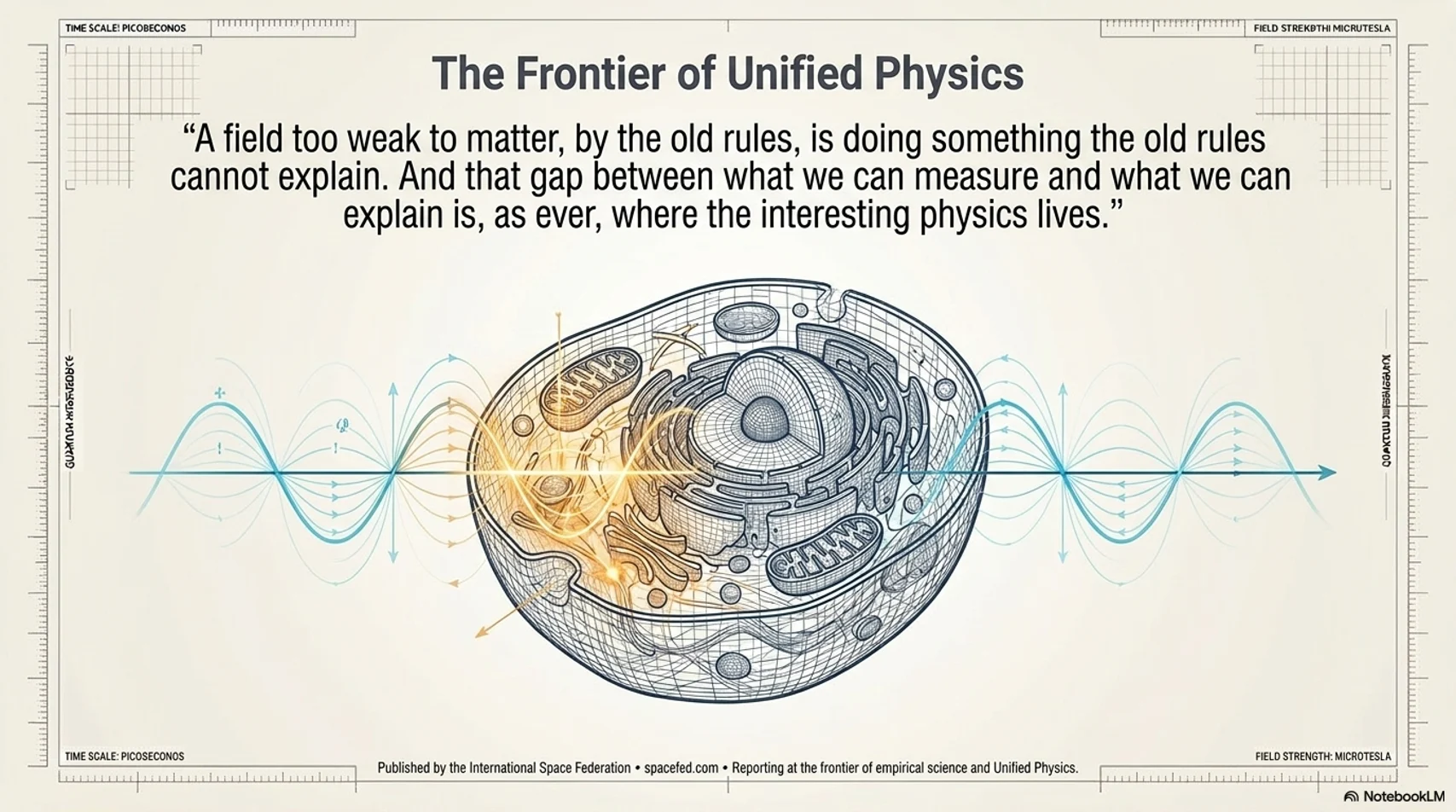
The authors are appropriately cautious. Their work was done in isolated mitochondria, not living hearts; the effect sizes are modest; and the radical pairs remain, for now, inferred rather than observed. The next steps are clear — direct spin spectroscopy to catch the intermediates in the act, and experiments in intact cells and whole organs. But the direction of travel is striking. A field too weak to matter, by the old rules, is doing something the old rules cannot explain.
And that gap between what we can measure and what we can explain is, as ever, where the interesting physics lives.
References & Further Reading
[1] M. E. Maffei, “Magnetic field effects on plant growth, development, and evolution,” Front. Plant Sci., vol. 5, Sep. 2014, doi: 10.3389/fpls.2014.00445.
[2] H. Li, Y. Fang, and J. Huang, “Reactive oxygen species mediate bioeffects of static magnetic field via impairment of long-chain fatty acid degradation in Escherichia coli,” Front. Microbiol., vol. 16, Jun. 2025, doi: 10.3389/fmicb.2025.1586233.
[3] C. S. Carter et al., “Exposure to Static Magnetic and Electric Fields Treats Type 2 Diabetes,” Cell Metabolism, vol. 32, no. 4, pp. 561-574.e7, Oct. 2020, doi: 10.1016/j.cmet.2020.09.012.
[4] Beutner, G., Yuh, H-J., Goldenberg, I., Wallace, D.C., Porter, G.A. & Sheu, S-S. Low magnetic fields stimulate cardiac mitochondrial bioenergetics with a bell-shaped response: Possibly via a radical pair mechanism. Computational and Structural Biotechnology Journal 30, 144–157 (2025). doi:10.1016/j.csbj.2025.11.055
[5] Buchachenko, A.L. & Kuznetsov, D.A. Magnetic field affects enzymatic ATP synthesis. Journal of the American Chemical Society 130, 12868–12869 (2008). https://doi.org/10.1021/ja804819k
[6] N. Amirshahi et al., “Porphyrin-fullerene nanoparticles for treatment of hypoxic cardiopathies,” Nanotechnol Russia, vol. 3, no. 9, pp. 611–621, Oct. 2008, doi: 10.1134/S1995078008090115.
[7] Crotty, D., Silkstone, G., Poddar, S., Ranson, R., Prina-Mello, A., Wilson, M.T. & Coey, J.M.D. Reexamination of magnetic isotope and field effects on adenosine triphosphate production by creatine kinase. Proceedings of the National Academy of Sciences USA 109, 1437–1442 (2012). https://doi.org/10.1073/pnas.1117840108
[8] Hore, P.J. Are biochemical reactions affected by weak magnetic fields? Proceedings of the National Academy of Sciences USA 109, 1357–1358 (2012). https://doi.org/10.1073/pnas.1120531109
[9] Hore, P.J. & Mouritsen, H. The radical-pair mechanism of magnetoreception. Annual Review of Biophysics 45, 299–344 (2016). doi:10.1146/annurev-biophys-032116-094545
[10] A. L. Buchachenko, “Spin Chemistry as a Means to Kill Cancer by Magnetic Fields,” Russ. J. Phys. Chem. B, vol. 20, no. 5, pp. 520–526, May 2026, doi: 10.1134/S1990793126700132.
[11] Zadeh-Haghighi, H., Siguenza, C.R., Smith, R.P., Simon, C. & Craddock, T.J.A. Tubulin polymerization dynamics are influenced by magnetic isotope effects consistent with the radical pair mechanism. Science Advances 12, eady8317 (2026). https://doi.org/10.1126/sciadv.ady8317
[12] Zadeh-Haghighi, H. & Simon, C. Magnetic field effects in biology from the perspective of the radical pair mechanism. Journal of the Royal Society Interface 19, 20220325 (2022). https://doi.org/10.1098/rsif.2022.0325