
By using this site, you agree to the Privacy Policy.
Accept
The International Space Federation (ISF)The International Space Federation (ISF)The International Space Federation (ISF)
  • Science News
    • All Articles
    • Physics
    • Astronomy
    • Biology
    • Technology
    • Other
  • Research
    • Research Papers
    • Physicists Testimonials
  • Technology
  • About
    • About us
  • ISF News
  • Events
    • Events
  • Get Involved
    • Invest
    • Donate – Zero Point Foundation
  • Careers
  • Contact Us
Reading: Missing Matter In The Sun’s Interior
Share
The International Space Federation (ISF)The International Space Federation (ISF)
Search
  • Science News
    • Physics
    • Astronomy
    • Biology
    • Technology
  • Research Papers
    • Physicists Testimonials
  • About
    • ISF News
  • Events
  • Get involved
    • Invest
  • Translations
    online pharmacy https://worldneurologyonline.com/ no prescription pharmacy
Follow US
© 2022 International Space Federation. All Rights Reserved.
The International Space Federation (ISF) / Explore / Astronomy / Missing Matter In The Sun’s Interior
Astronomy

Missing Matter In The Sun’s Interior

It is often assumed that a structure’s surface can be appropriately represented as a two-dimensional area, completely flat and devoid of any depth. However, in reality, two-dimensional surfaces do not exist in nature, if zoomed in sufficiently even the most seemingly flat surface has 3-dimensional structure. This can pose a problem when physics that have been formulated with two-dimensions are re-examined using a more realistic 3D model.

Dr. William Brown
Last updated: 2024/08/27 at 9:21 AM
Dr. William Brown
Share
4 Min Read
SHARE

It is often assumed that a structure’s surface can be appropriately represented as a two-dimensional area, completely flat and devoid of any depth. However, in reality, two-dimensional surfaces do not exist in nature, if zoomed in sufficiently even the most seemingly flat surface has 3-dimensional structure. This can pose a problem when physics that have been formulated with two-dimensions are re-examined using a more realistic 3D model.

The Shift to a 3D Model of the Sun

Just such a situation arose when astronomer Martin Asplund forewent the usual 2D model of the Sun’s surface, and instead used a supercomputer to model it as 3-dimensional surface. Asplund was hoping to formulate a more accurate model for analyzing spectral and seismological data to better understand the Sun’s interior.

Since the interior cannot be directly observed, sound and light emissions emanating from the Sun’s surface are a window into the interior. Asplund’s new model brought to light a fascinating, if not controversial revelation, the seismological and spectrophotometric data indicated that the Sun had significantly less heavy elements than was previously calculated (using the defunct 2D model).

The Mystery of the Sun’s Missing Matter

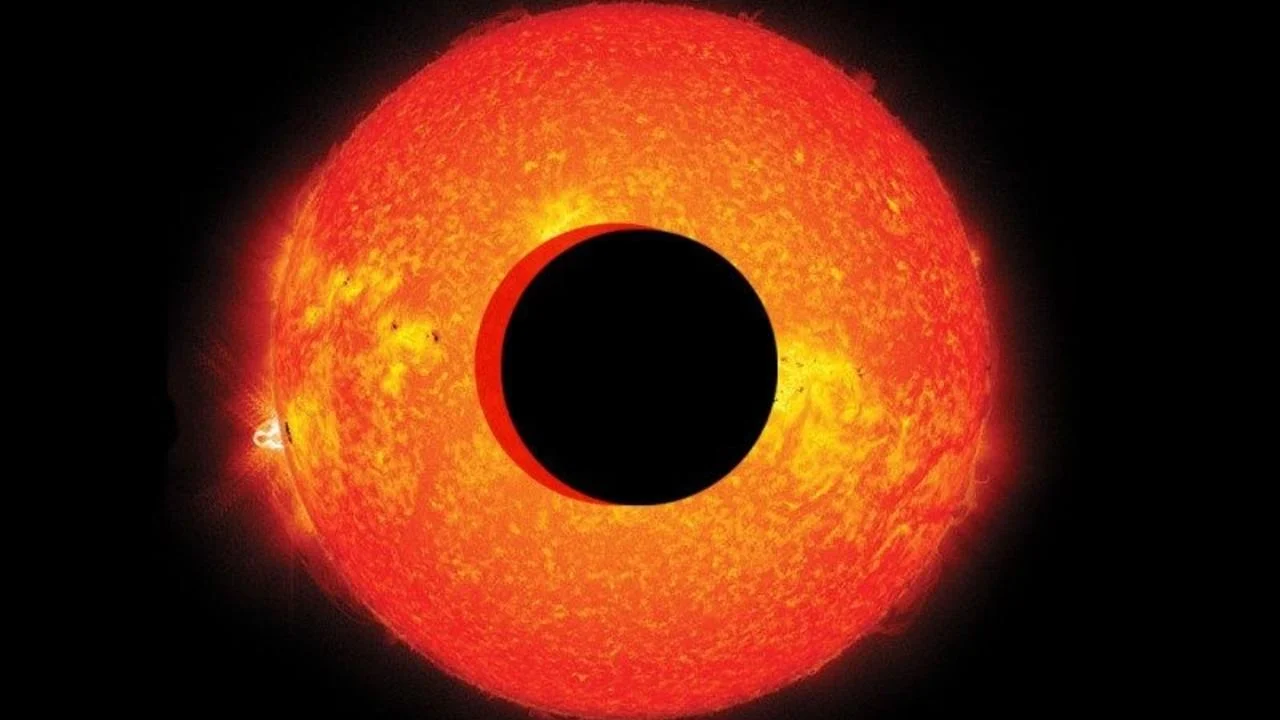
Because light and sound pass through heavy elements (most every element past hydrogen is referred to as a metal by astronomers) differently than light elements like hydrogen and helium, the Asplund’s updated calculations suggested a highly different chemical composition for the Sun—essentially the now absentee heavy elements account for several billion megatonnes of missing matter (the equivalent of around 1500 Earths).

The solution to the seeming conundrum is to posit that there is some form of matter at the center of the Sun—about 1027 kilograms of it—that does not behave like ordinary states of matter. Perhaps under the extreme temperatures and pressures of the interior region matter takes on different quantum properties, and has altered opacity or acoustic resonances.

Jim Bailey, at Sandia National Laboratories in New Mexico, seemed to confirm that this is indeed possible when he used the Z Pulsed Power Facility, or Z machine, to expose matter to temperatures and pressures equivalent to those found at certain locations within the Sun’s interior. Bailey found that his opacity measurements under these conditions indicated that matter may absorb and transmit light, and perhaps sound as well, differently when under conditions that deviate far from “normal” laboratory environments.

Another potential explanation is that some form of dark matter is at the center of the Sun, accounting for the mass yet only weakly interacting with the propagating phononic and photonic emissions. The exact nature of dark matter remains a mystery, several proposals have ranged from new sources of matter like weakly interacting massive particles (WIMPS), axions, to primordial black holes and superfluid dynamics of spacetime. Further analysis and supercomputer modeling may begin to reveal what lies in the Sun’s interior, but for now all that is certain is that the conventional model is not offering explanations that match observations.

Article: Hiding in plain sight: the mystery of the Sun’s missing matter
Learn more in our free Unified Science Course

Sign Up For Daily Newsletter

Be keep up! Get the latest breaking news delivered straight to your inbox.
loader

loader

loader

By signing up, you acknowledge the data practices in our Privacy Policy. You may unsubscribe at any time.
En vous inscrivant, vous reconnaissez les pratiques en matière de données dans notre politique de confidentialité. Vous pouvez vous désinscrire à n'importe quel moment.
Al registrarse, reconoce las prácticas de datos en nuestra política de privacidad. Puedes darte de baja en cualquier momento.
Share This Article
Facebook Twitter Copy Link Print
By Dr. William Brown
William Brown is a biophysicist, investigating the physics operational at the cellular and molecular level of the biological system. He presents lectures (Unified Science Review), talks, and Q&A forums to teach the syncretic theories of unified science. He is a part of the research team at The International Space Federation where he applies his extensive knowledge of cellular and molecular biology to an exploration of the biological system from a unified physics perspective; developing an understanding of life from the most fundamental level.
Previous Article Pilot Wave Theory Explains EM Drive
Next Article New Sodium Battery for a Cost-Effective Power Storage

Stay Connected

981k Like
18.7k Follow
7.7k Follow
7.3k Subscribe

Categories

  • Astronomy106
  • Biology69
  • ISF News25
  • ISF Research14
  • Other22
  • Physics168
  • Technology36

You Might also Like

Astronomy

The Rotating Universe: Radio Galaxies and the Cosmic Dipole Anomaly

22. December 2025.
Astronomy

“Black Hole Stars” Detected at Cosmic Dawn

23. October 2025.
Astronomy

New Evidence Points to a Compact Object at the Sun’s Core

5. August 2025.
Astronomy

Image Reveals Coherently Ordered Spiral Vortex Around Milky Way’s Supermassive Black Hole

24. June 2024.
The International Space Federation (ISF)The International Space Federation (ISF)

Harnessing quantum vacuum energy for sustainable solutions – a unified approach to science, technology and education.

Quick links

  • About
  • Research Papers
  • Events
  • Invest

Explore

  • ISF Research
  • Physics
  • Technology
  • Astronomy
  • Biology
  • ISF News

Sign Up for Our Newsletter

Subscribe to our newsletter to get our newest articles instantly!

loader

Follow US
© 2023 International Space Federation. All Rights Reserved. INTERNATIONAL SPACE FEDERATION is a trademark of ISFS SA. The mark is registered in the United States under Registration No. 7772313. The ®️ symbol is used exclusively in the U.S.
  • Press
  • Careers
  • Privacy policy
  • Carrieres
  • Presse
  • Prensa
Join Us!

Subscribe to our newsletter and never miss our latest news.

loader

Welcome Back!

Sign in to your account

Lost your password?