

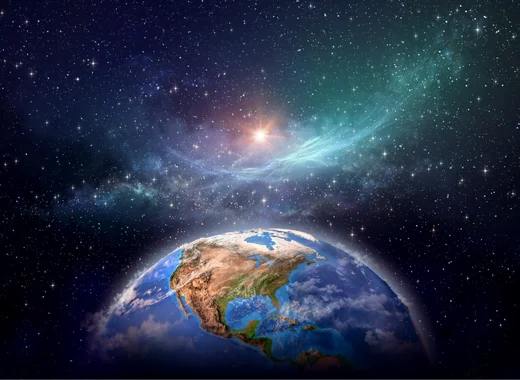
A planet that orbits a solar-type star and supposedly is a part of a solar system like ours with goldilocks conditions capable of supporting life and liquid water is commonly referred to as an exoplanet. The first exoplanet that was discovered to be revolving around a star like our sun was 51 Pegasi b. It is located about 50 light-years away in the Pegasus constellation and was discovered in 1995 by Swiss astronomers Michel Mayor and Didier Queloz [1]. This discovery won them a share of the 2019 Nobel prize in physics. Since the first detection, thousands of exoplanets have been discovered by probes sent to interstellar space by agencies like NASA.
Step-by-Step Process in Categorizing Earth-like Planets
Several factors are responsible for determining whether a newly discovered planet could be categorised as Earth-like. Here is a step-wise breakdown of all the important processes that scientists adopt in the classification of planets:
- The first step involves the measurement of the planet’s radius when it passes in front of a star. This basically allows an estimation of the planet’s size.
- Next, in order to measure the mass, the amount of twist a star undergoes due to the planet’s orbital motion comes in handy. This further allows the calculation of the planet’s density and helps segregate solid planetary surfaces from gassy ones.
- Moving further, knowing whether the planet’s climate is feasible enough to support water in liquid form becomes paramount. This is chiefly determined by the light that the planet receives from its host star.
- The most difficult part comes during the determination with high precision, of the existence of liquid water. However, once there is a satisfactory hint, the classification and further processes become quite easier.
Astrophysicist Jeremy Leconte, who is the Principal Investigator (PI) of the WHIPLASH project says with regard to the above procedures, “Yet with the above knowledge in hand, everyone would be satisfied. “Unless you want to actually see the aliens down there…When people think of Earth-like, having a rocky planet that is temperate, that has an atmosphere and has liquid water, we’re there.”
The WHIPLASH Project and the TRAPPIST-1 System
The WHIPLASH project is laden with a lot of interesting features and a significant advantage of this formulation is that it allows investigation of the Trappist-1 system which consists of seven planets approximately of the same size as the Earth [2]. The system being close to our solar system is perfect for determining the atmosphere of Earth-like planetary objects.
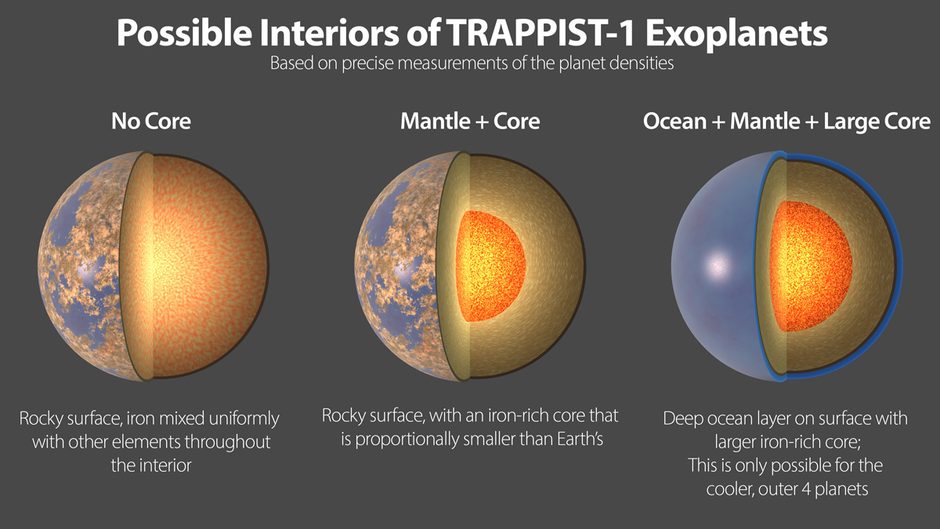 Three possible interiors of the TRAPPIST-1 exoplanets. The more precisely scientists know the density of a planet, the more they can narrow down the range of possible interiors for that planet. All seven planets have very similar densities, so they likely have a similar composition. Image and text credit: NASA/JPL-Caltech
Some of the salient features of the WHIPLASH project are:
- It is aimed at creating a novel framework that would investigate and uncover the physics as well as the composition of exo-planetary atmospheres.
- It is based on a 3D simulator that could simulate planetary atmospheres and analyze observational data
The novel tools and innovative mechanisms offered by the WHIPLASH simulator are expected to deliver a better understanding of the circumstances required to endure water on exoplanets, which is a boon to researchers studying planetary science and astrobiology. Leconte further comments on the benefits of his team’s research project: “This system, which our research team was involved in discovering, is becoming a Rosetta Stone of sorts for exoplanet science. Thanks to the work done by the WHIPLASH project, once the JWST and Ariel missions start sending us observations, we’ll be ready to take exoplanet research to a whole new level.”
Another aspect that is germane to discuss here is a possible probe that could be sent to the nearest exoplanets around us. Data and calculations suggest that traveling at approximately 10% of the speed of light (which is a big deal in itself with current technology) would take us not less than 40 years to reach Proxima Centauri b, which is apparently the closest earth-like planet. Thus, it is quite explicit that it would take a lot of technological advancement to convert the idea of sending a probe from science fiction to an actual scientific possibility. In real terms, it could take us many decades before attaining such a huge scientific feat.
References
[1] M. Mayor and D. Queloz, “A Jupiter-mass companion to a solar-type star” Nature 378, pages 355–359 (1995).
[2] D. Queloz et al., “The nature of the TRAPPIST-1 exoplanets” A&A 613, A68 (2018).